Author Archives: Lisa Shambrook

Unknown's avatar

About Lisa Shambrook

An author and dreamer who loves dragons... Author www.lisashambrook.com and owner Amaranth Alchemy on Etsy etsy.com/uk/shop/AmaranthAlchemy

Fundoplication and Hiatus Hernia Repair – Reflux Surgery

Undergoing surgery to fix my Silent Reflux and Chronic Cough.
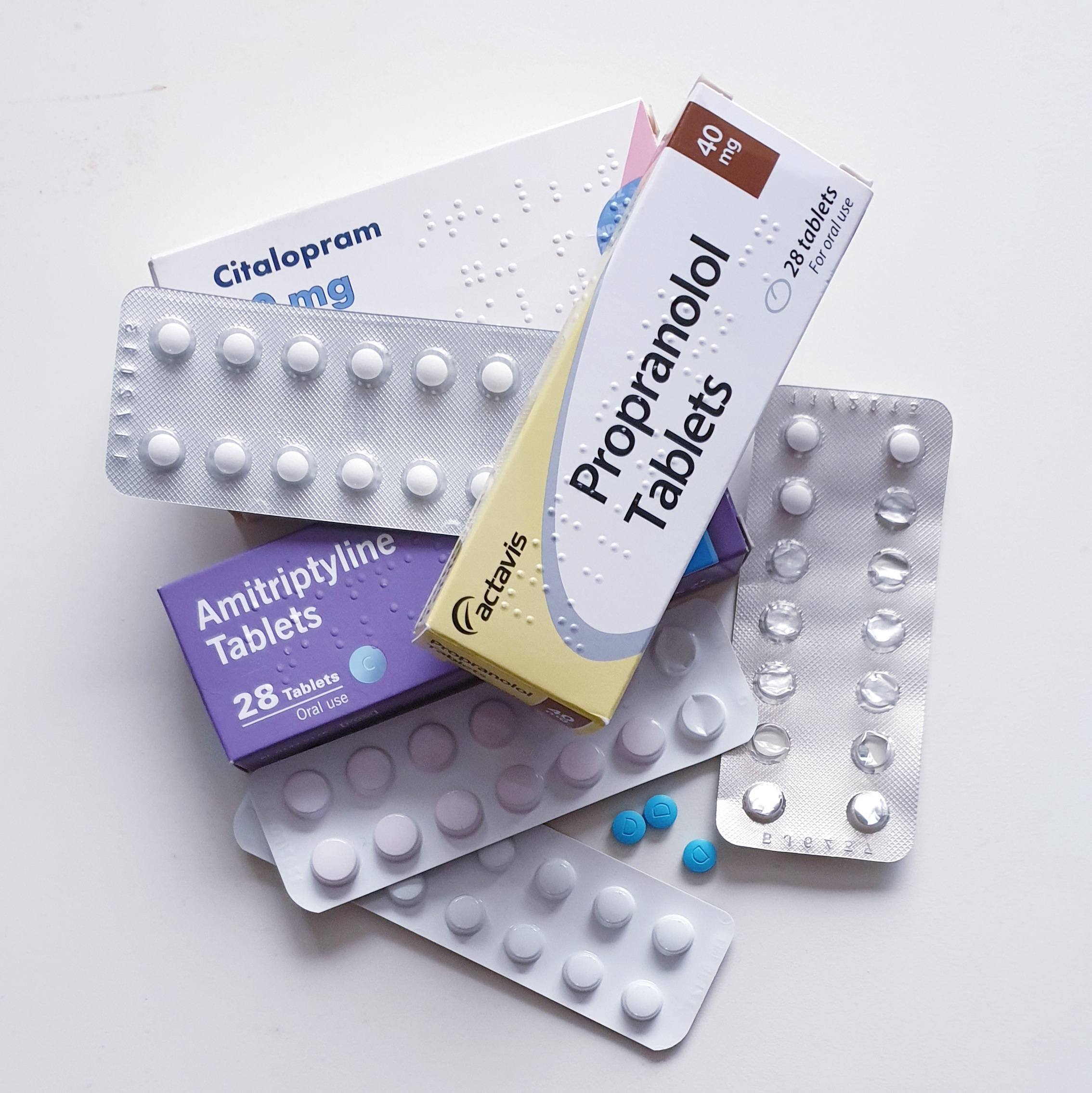
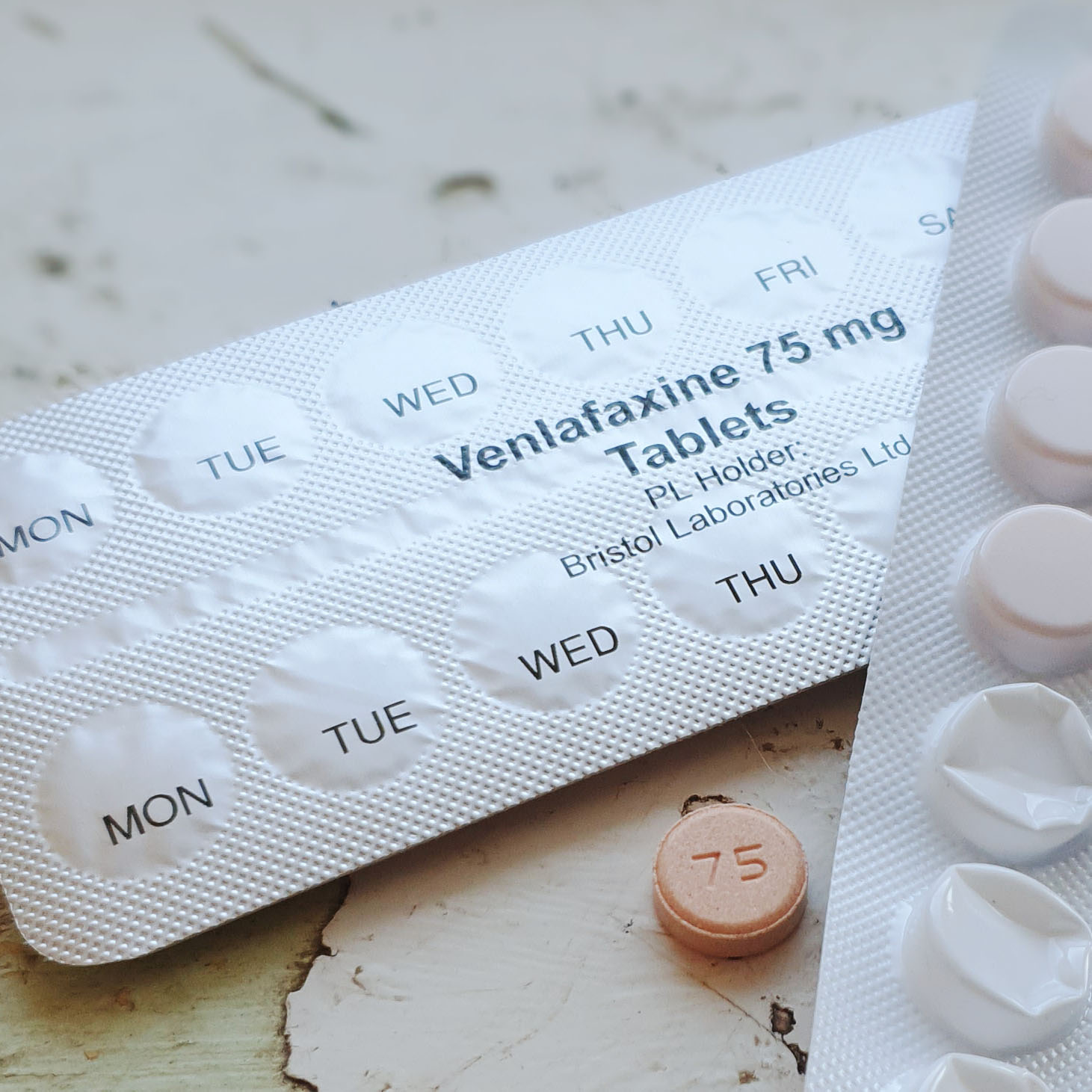
Back in 2008 I noticed I had an irregular but irritating cough, and three years later I saw my GP about it. Over the next four years I had a laryngoscopy, speech therapy, and an x-ray but nothing was found to be a problem. By 2015 the cough was getting seriously worse. I was having coughing fits that were persistent and long making it hard to catch my breath. These fits were causing pain and were so hard my back would go. I was then prescribed antacids, then antihistamines, another x-ray, and then a spirometry test, but nothing worked.

My GP diagnosed Reflux and Reflux Oesophagitis (inflammation of the oesophagus caused by reflux) and prescribed Lansoprazole, Gaviscon, and Prednisolone, then sent me to ENT. The consultant diagnosed Laryngopharyngeal Reflux – Silent Reflux and said some damage around my vocal chords will likely be permanent.
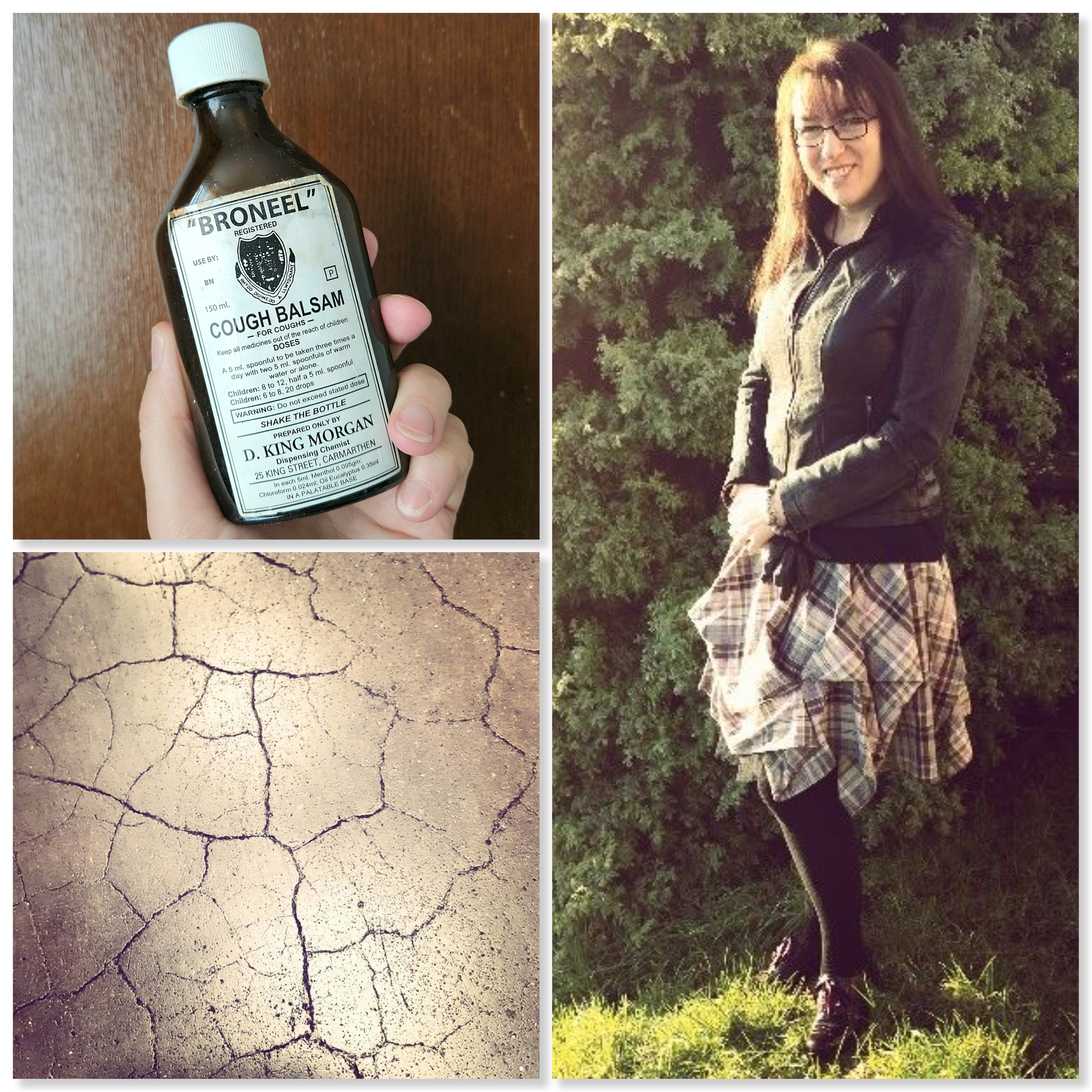
Chronic cough and irritated throat 2015 © Lisa Shambrook

In 2019 after prolapse diagnosis I was referred to Gastroenterology in case my prolapse was related to my persistent cough and Silent Reflux. A year later, another consultant, a Heliobacter pylori blood test, which came back clear, and another chest x-ray. I was told my persistent cough was much worse and impacting my prolapse. I was prescribed Omeprazole every day and Gaviscon every night, and the PPI was soon increased to 40mg a day from 20mg as I was struggling to breathe through severe coughing fits. He then switched my PPI up to Esomeprazole 40mg instead of Omeprazole. A couple of months later my then GP told me nothing was changing and I’d have to go back to Omeprazole and “just live with the reflux and cough.”.

I was scared that if the cough wasn’t brought under control my impending prolapse repair surgery would ultimately fail. A new doctor referred me back to Gastroenterology for an Endoscopy and to see what surgery might be offered.

Seven months later I went in for an Endoscopy. I was off reflux medication in preparation and suffered horrific reflux, constant burn, heartburn, indigestion, vomiting, bloating, noisy belly, and chest pain. Constant coughing which pulled on my prolapse, and I couldn’t sleep for acid in my oesophagus all night. The results of the Endoscopy showed severe Reflux, large hiatus hernia, but no evidence of Barrett’s (Barrett’s oesophagus – a condition where cells in the lining of the gullet become abnormal and can lead to cancer), which was a relief. Another Heliobacter pylori test was clear, and I was told to continue with my double dose PPI and Gaviscon. I was told there was no operation to repair my loose stomach valve, to fix the constant leak of stomach acid, available to me.
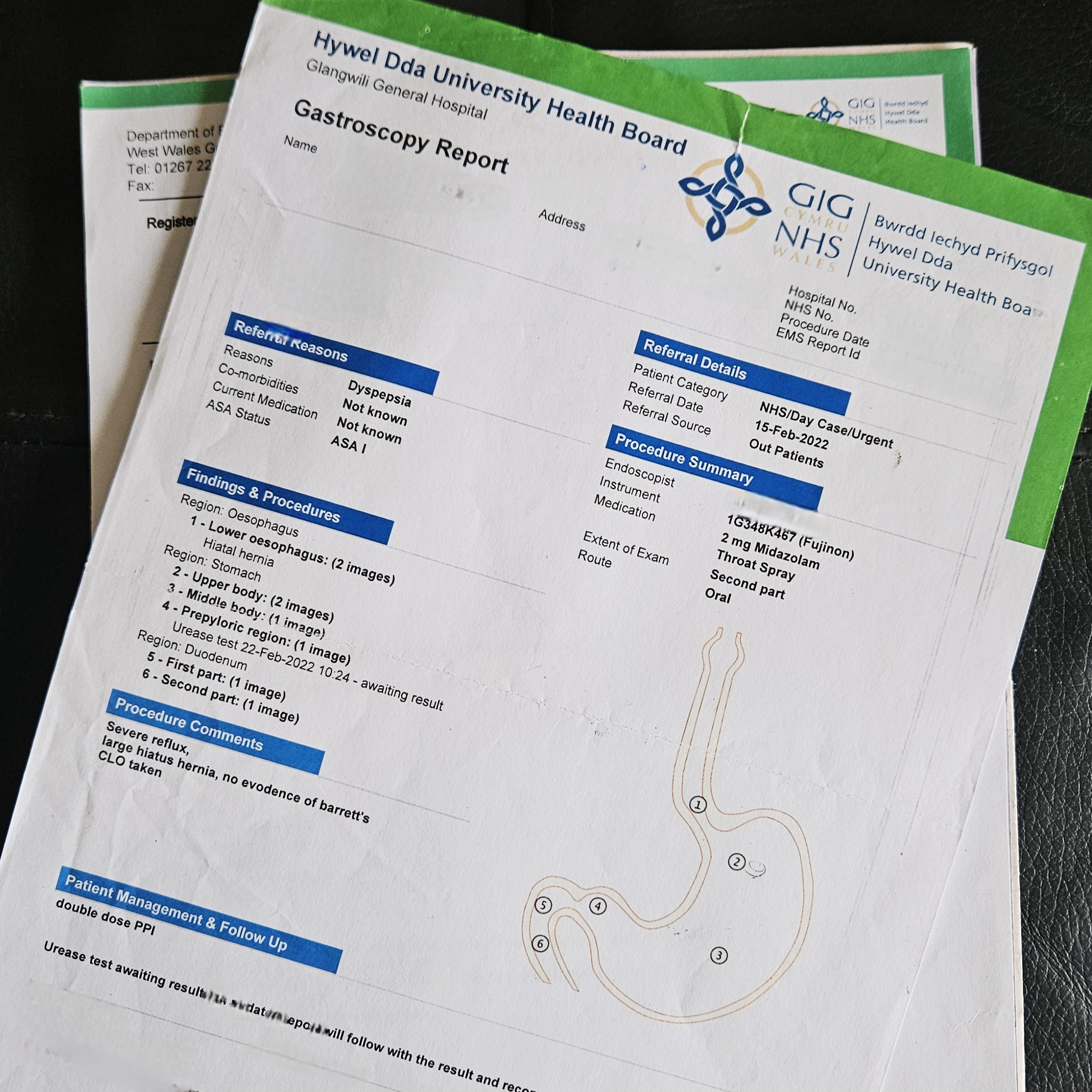
Endoscopy report 2019 © Lisa Shambrook

I went through that year, 2022, with my chronic cough causing breathing difficulties. I was sucking throat lozenges with Hexylresorcinol antiseptic and anaesthetic to help control my cough, and Tic Tacs whenever my throat was too dry and tickly. Another doctor at the practice said that Omeprazole and Gaviscon should stop symptomatic reflux. He sent me for another chest x-ray, and then re-referred me to Gastroenterology and Reflux specialist to see what they could do about my hiatus hernia and reflux cough.
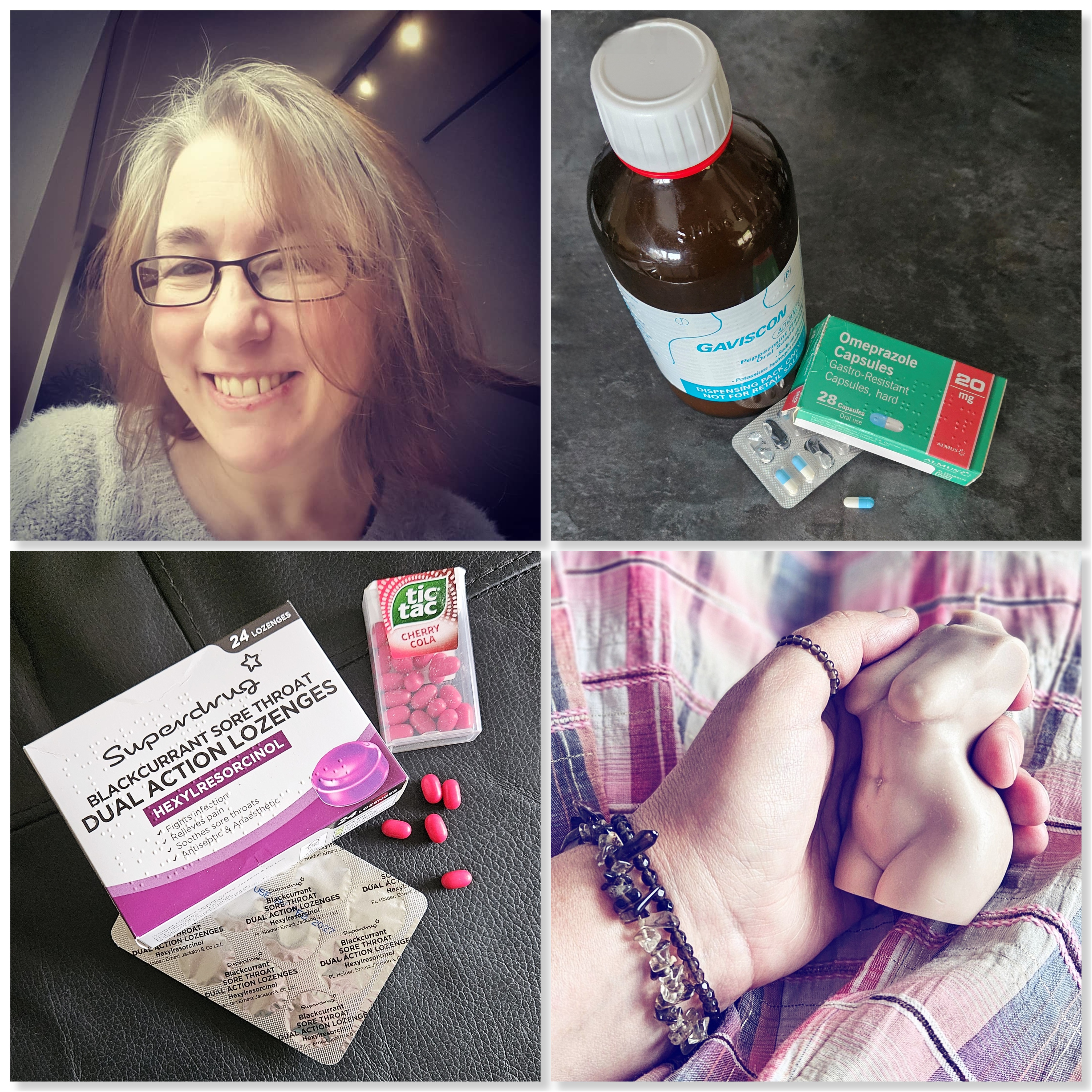
Reflux and chronic cough 2022 © Lisa Shambrook

My chronic cough was getting progressively worse. I had coughing fits every day, causing vomiting after food, and inflammation closing my oesophagus and windpipe making it difficult to breathe, which was incredibly scary, and resulted in a rush to A&E when I couldn’t breathe after a coughing fit. At A&E they did blood tests, lung ultrasound, chest x-ray, and an ECG. All were clear, though they could see that I could barely breathe my SATs were all at 100% so enough oxygen was getting through to breathe. I tried to explain that my cough closed up my airway with inflammation, but once I could breathe again, they just told me I was having a panic attack. I felt really embarrassed, invalidated, and despairing. I mean, it was obvious being unable to breathe would cause panic, but my airway was inflamed and I couldn’t stop it.

I desperately did my own research on surgical intervention, and returned to the doctor’s practice to ask if I could get Fundoplication surgery, but was told that it was very unlikely. It was just after Covid and my new GP told me that hospitals weren’t doing surgeries that weren’t totally necessary, but she did re-refer me anyway with a request for surgery. She also advised me to research private surgery instead.

I knew that I couldn’t go on as I was. My body was in constant discomfort, spasm, and pain with every cough, and my depression and anxiety with the situation was growing. Vince and I talked about the situation knowing we didn’t have money for private surgery, but my quality of life was suffering so badly, that he suggested we take some money from his pension and a loan to cover any private funding. It was a really big step. I was still waiting to see another gastroenterologist on the NHS, but we decided to check out a private surgeon for advice while we waited.

In early 2023, I saw a general surgeon, who specialised in reflux surgery, at Sancta Maria private hospital in Swansea. I explained my reflux diagnosis, my fifteen-year-old chronic cough, and my resulting multiple prolapses. He was lovely and very informative. He did offer Fundoplication surgery, but wanted to conduct his own tests to see if I was actually suitable for the option. He also explained that though my cough had been linked to my silent reflux, he couldn’t guarantee that surgery would get rid of it. The private appointment cost £240, and he sent me for a Barium Swallow test, and pH level and Manometric tests to check the acidity in my stomach. I accepted these tests via the NHS, so would wait for them as he referred me.

A month later I went into hospital for Pelvic Floor and Prolapse surgery and a Hysterectomy on the NHS. I desperately wanted this surgery to work, and it was scary knowing I still had my cough.
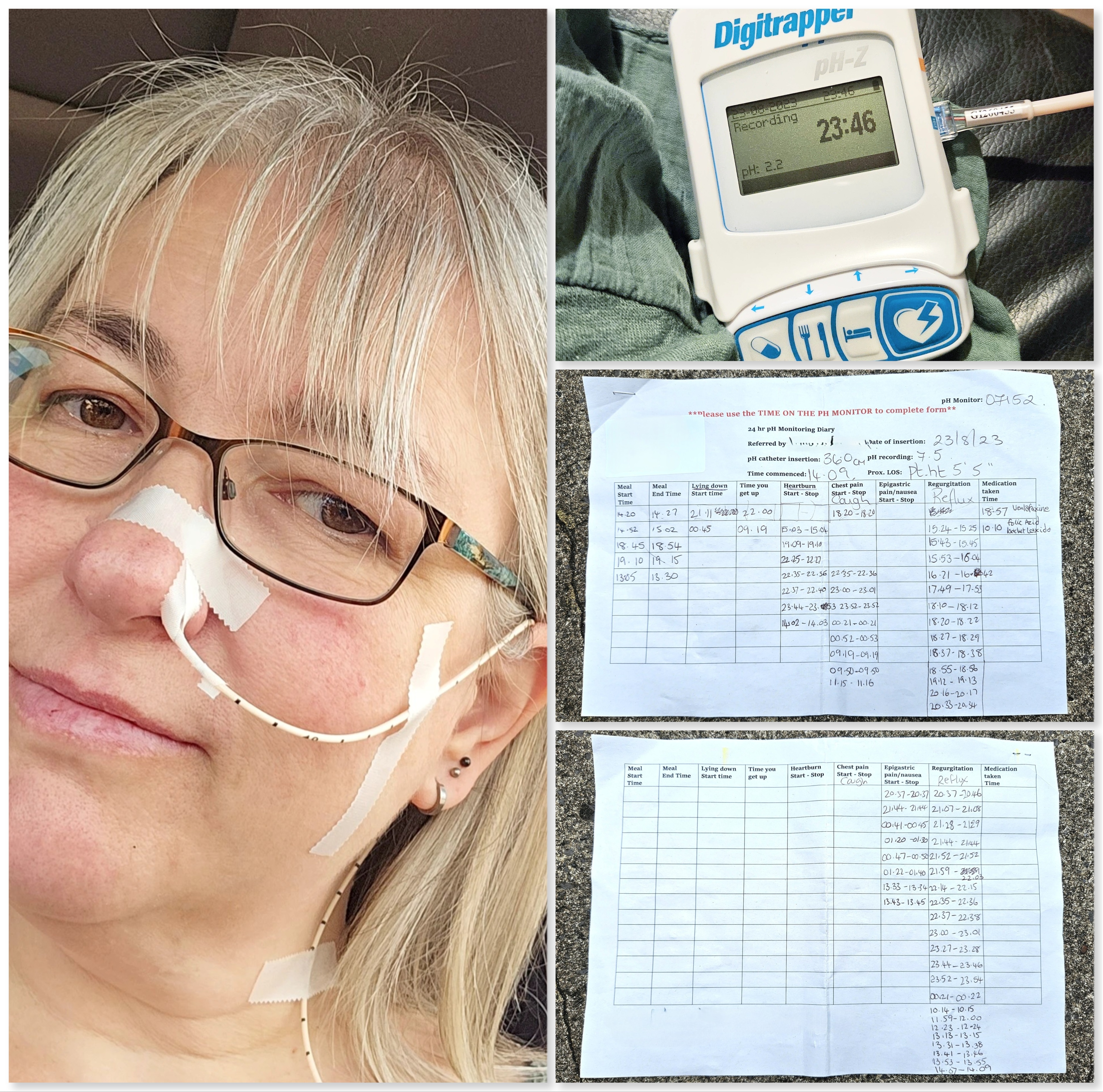
pH testing 2023 © Lisa Shambrook

Two months after that I had my Barium test, which showed no abnormality in swallowing. Four weeks later, I went to Port Talbot hospital for my Manometry tests. The Manometry test was to swallow a narrow tube to check my swallow muscles. I couldn’t swallow the tube at all, my gag reflex made me cough and vomit, and in the end after trying for a while the nurse decided to stop the procedure as my Barium test had already shown no issue with swallowing muscles. Instead, I only had the pH acid level test. A much smaller tube, 1-2mm, was inserted up my nose and down my oesophagus with a sensor at the base of it which rested at the bottom of my throat. This was attached to a monitor that I would wear for 24 hours. It was to measure how far up my oesophagus my reflux acid went and how acidic it was. I was told to eat things that I normally couldn’t – like chocolate, fried chicken, pineapple etc – to get accurate readings of stomach acidity.

Oesophageal acid pH levels should be a 7 on the scale, but if they dropped below 4 that would indicate strong/bad levels of acid. I had to keep a diary of episodes of reflux and coughing and the scores on the monitor. Most of my readings were between 2 and 4 and reached a low of 2.1pH, so I was definitely getting severe reflux. I finally felt validated.
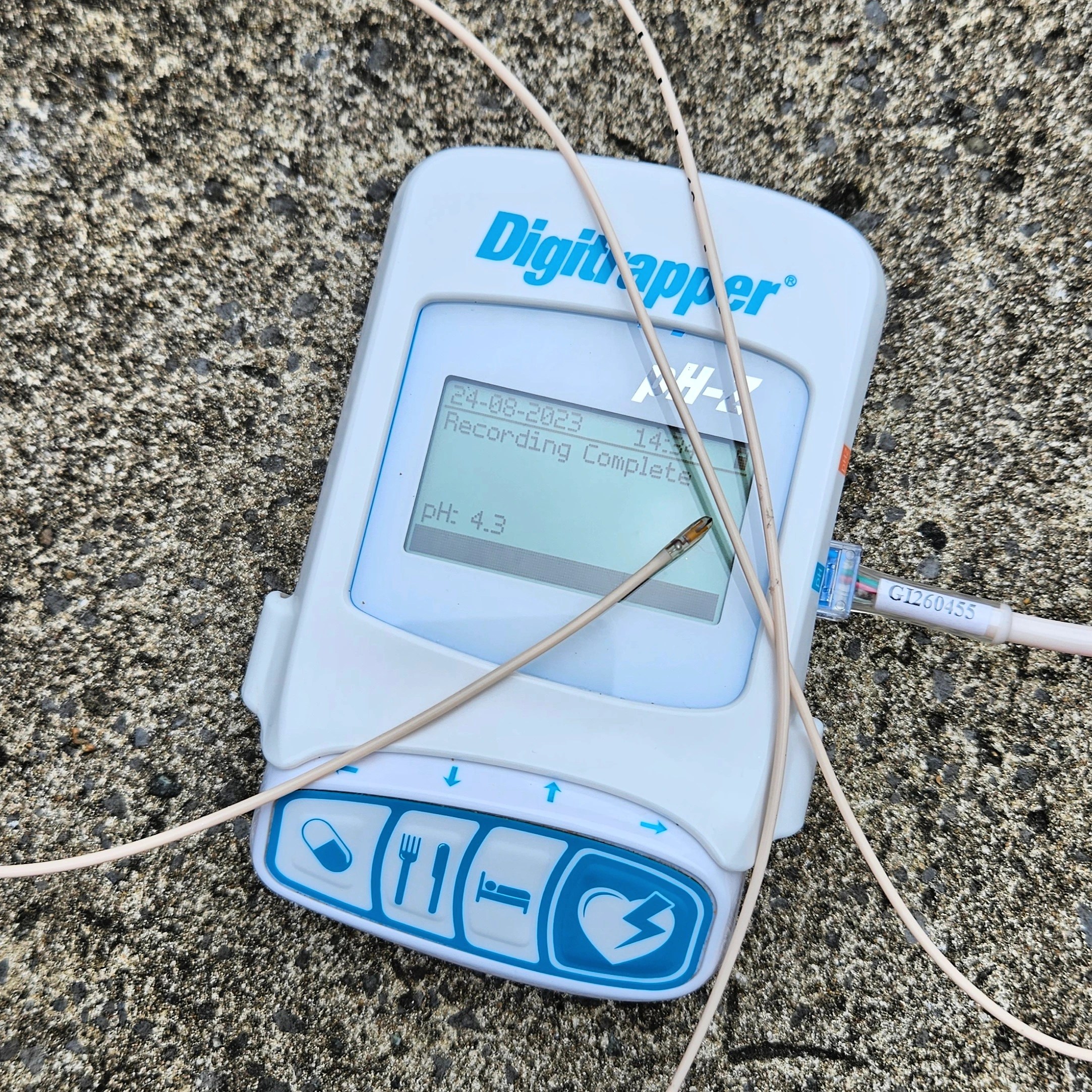
pH testing acid monitor © Lisa Shambrook

Back at Sancta Maria hospital and my surgeon said the acid levels were definitely clear enough to warrant surgery, but he was still wary of whether it was causing my cough, so he referred me to Respiratory on the NHS to check everything that might cause a cough. He was very surprised I hadn’t already been offered these tests by my GP.

Within a week my GP had tried an asthma inhaler after another spirometry test, but no change. Five days later I got my Gastroenterology appointment I’d been referred for a year ago. The consultant was so good, and listened to my full history. He looked at my results of the tests I’d recently had from private referral, and explained the Fundoplication surgery in full for me. He told me I was a good candidate for the surgery on the NHS, but he said he couldn’t advise it because at that current time the surgery wasn’t deemed ‘life-saving, but life-style’. The NHS was only considering essential surgery after Covid and the waiting list would be well over 7 years. He advised me to continue with the private option if I could afford it.

He also explained that Fundoplication surgery (folding the top part of the stomach around itself, like a scarf, and stitched together to tighten the stomach valve and prevent acid escaping into the throat), had a 33% chance of complete success, 33% chance of success which lessens as the years go by but could be controlled by PPIs, and 33% chance of short-term success to no success. So, that was a definite consideration.
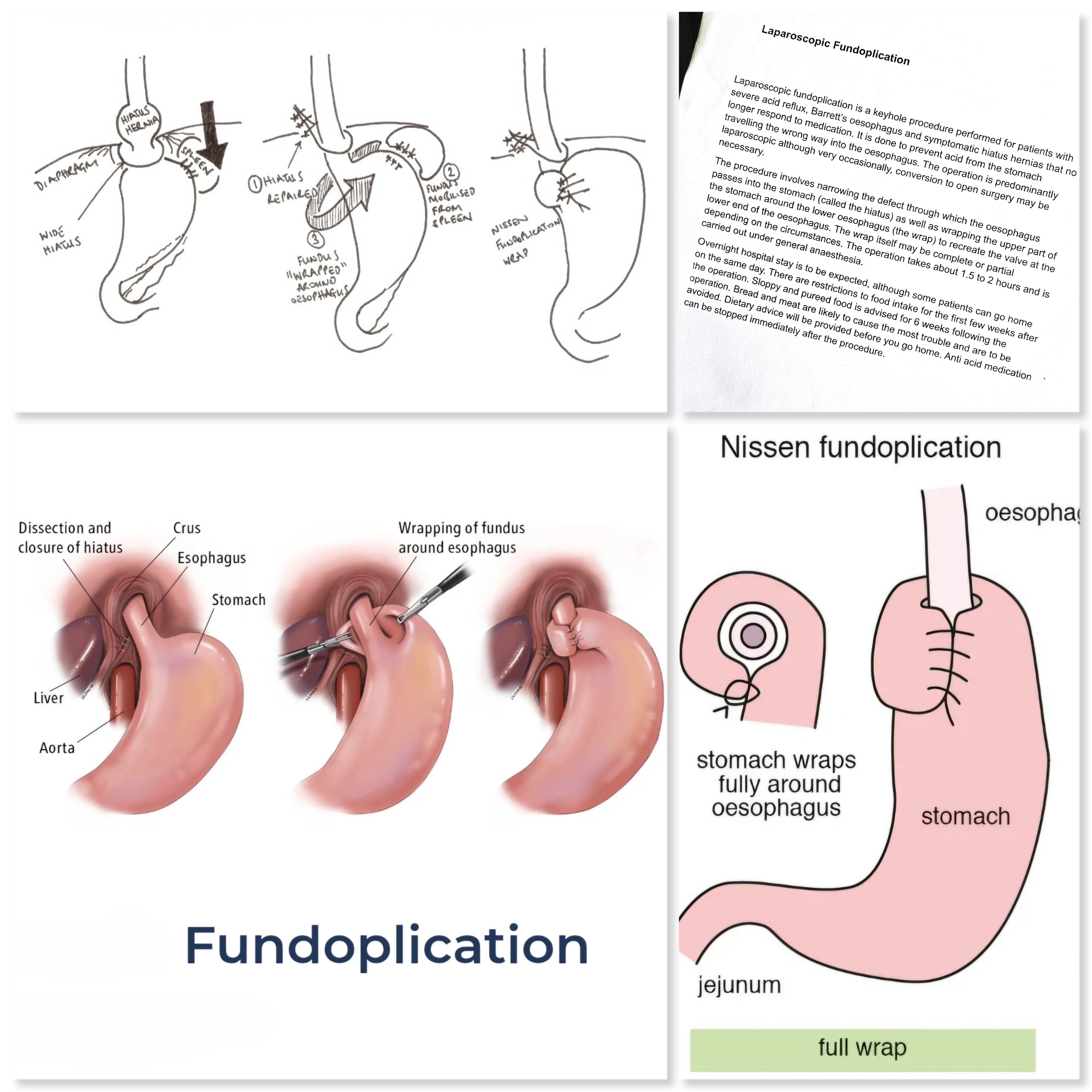
Fundoplication – Nissen 360 – surgery 2024 © Lisa Shambrook

I had a plethora of respiratory tests: breathing and lung capacity, inhalers, blood tests for allergies – dog dander, mould, dust, etc, but no markers showed up, nasal inhaler for post-nasal drip, and turbo inhalers. After six months I had my last breathing test. A breathing exercise on a machine with a drug that gradually tightens your windpipe making it harder to breathe if you’re asthmatic. The drug is doubled each time, but my breathing remained steady and not affected, so I was finally cleared by my consultant and my cough was not caused by lung or respiratory issues.

Back at the private clinic and my surgeon agreed to do my Fundoplication. Prices were scary. The Professor’s fee was £2,900, anaesthetist £500-700, and £5560 for the hospital. Around £9K for surgery. That was a huge amount for a small income family, but taking out of our pension and taking out a loan would have to do.
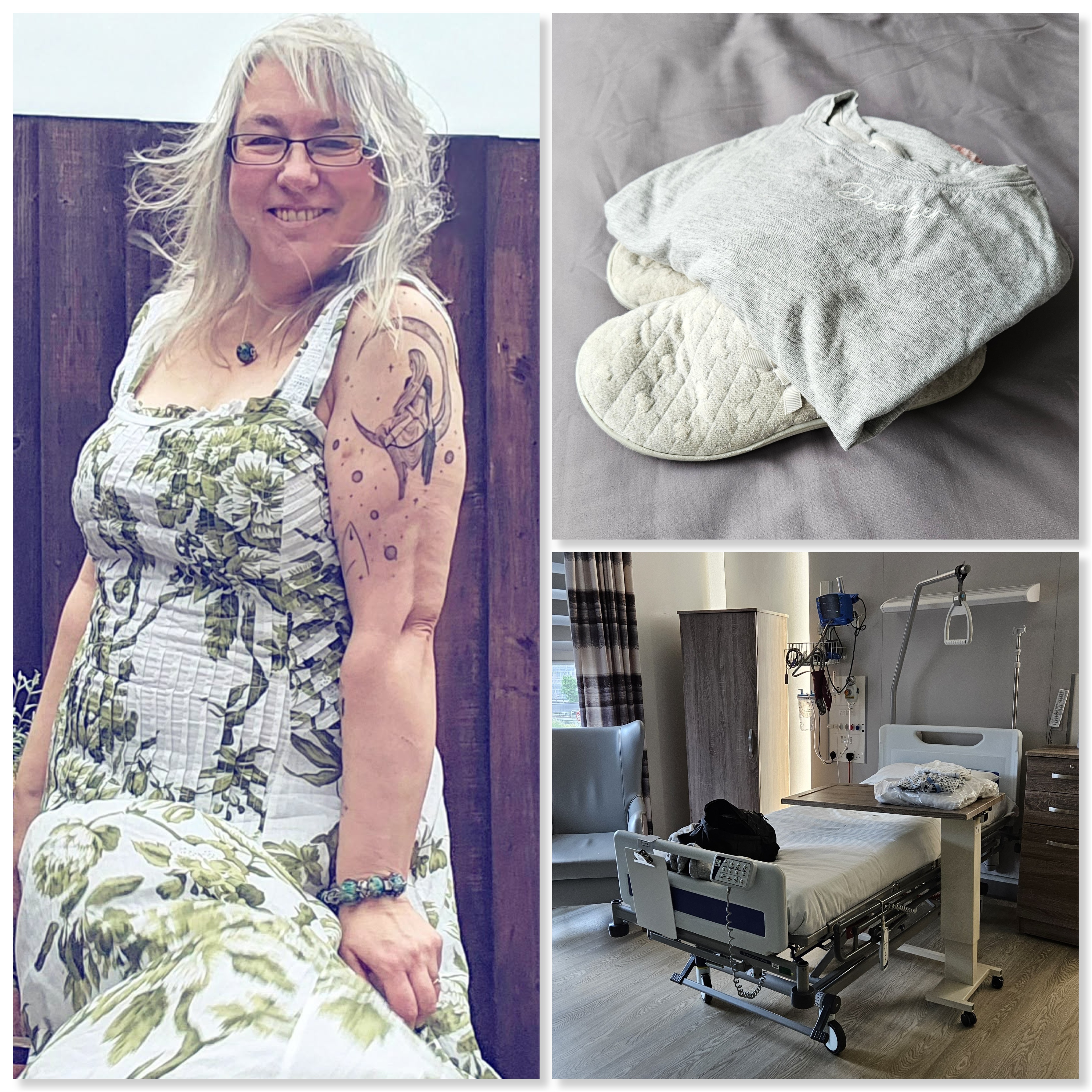
Ready for surgery – Sancta Maria private hospital 2024 © Lisa Shambrook

I finally went in for surgery in July 2024.

The private hospital was very different to its NHS counterpart. It was quiet, staff had more time, it was fully air-conditioned – which during the height of summer was luxury, and when I went in at 7am I was met, given a spacious room of my own with a television and private bathroom. I actually felt guilty being there!

I had pre-surgery checks, a gown, and compression socks, then I met my anaesthetist and they walked me down to the surgical suite with my nurse at 9.45am. My surgeon spoke with me before I was anaesthetised and taken into the operating room.

As with previous surgeries, I briefly recall coming round, but no memory of ending up back in my room. I t was 12.45pm when I became aware of my surroundings. I waited for lunch time, but my nurse reminded me that all I needed to do was ask for food, no set times like NHS hospitals, and I was brought soup.
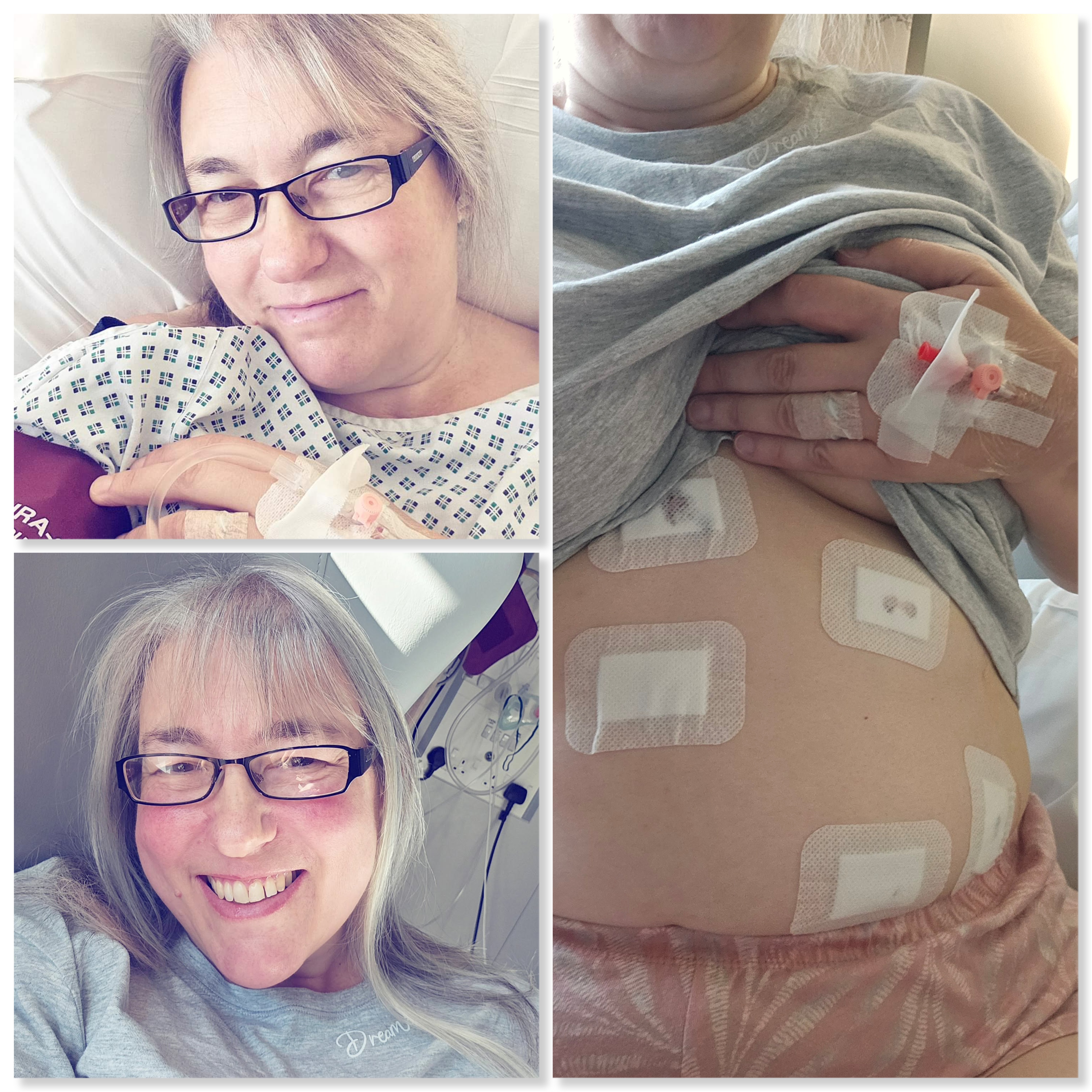
After surgery 2024 © Lisa Shambrook

The professor, my surgeon, popped in to let me know everything had gone really well and the surgery, 360˚ Nissen wrap (fundoplication) and Hiatus Hernia repair, had gone great. I was given Ondansetron (Zofran) for nausea (and that anaesthetic always made me sick) to be sure I didn’t vomit, and morphine then paracetamol for pain. I had a bad headache and felt really bloated.

I dozed until 5pm, then had more soup before watching TV all evening and went to bed when I wanted. Routine observations overnight and I awoke refreshed and with scrambled eggs for breakfast – it felt like a hotel! When my nurse checked my incisions, I noticed they’d been stapled, and I took photos, the staples fascinated me! Five incisions: two below my breastbone and above my belly button, one to the left just beneath my breast, and two to the left of my belly button.
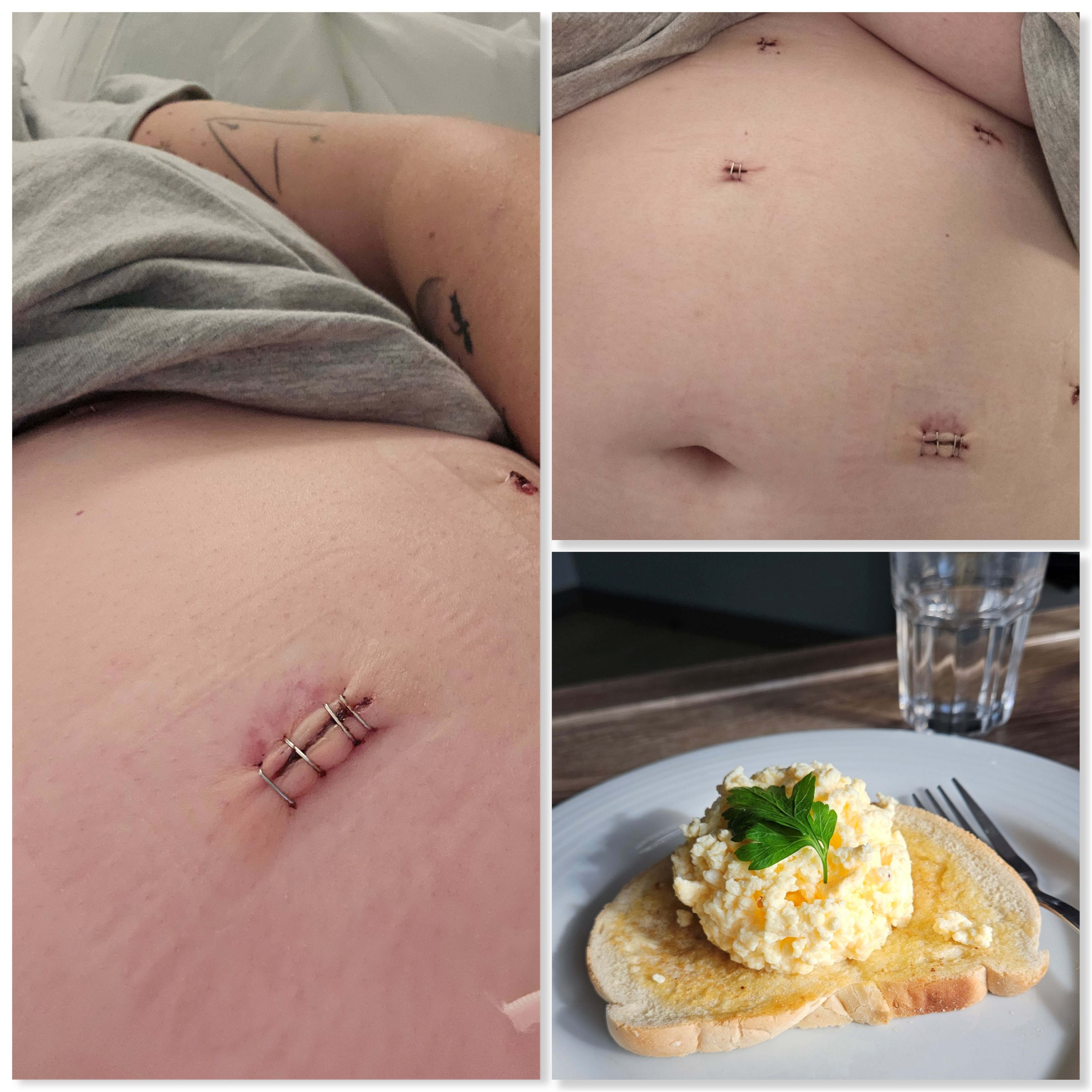
Staples in keyhole surgery incisions – breakfast 2024 © Lisa Shambrook

I was released to go home early afternoon. It was interesting to compare the private and NHS experiences I’d had with surgery. The staff, nurses, surgeons etc were on par with both, brilliant, kind, caring, and efficient, but the difference was in numbers; cost of treatment, probably wages for staff, and the pressure of numbers of patients to the ratio of staff. NHS staff have to cope with vastly more patients, so are under much more pressure.
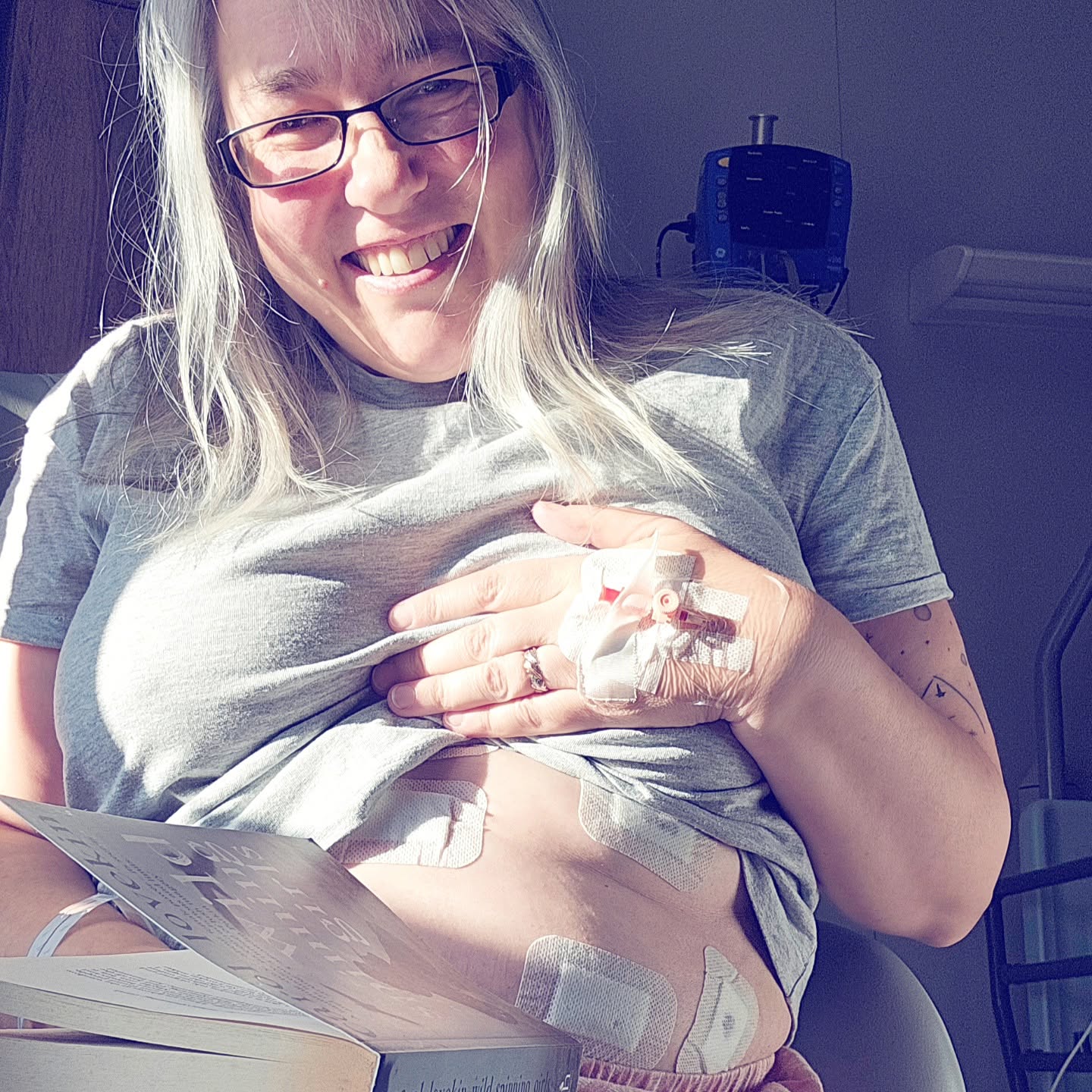
In hospital 2024 © Lisa Shambrook

The following day I noticed that my reflux was gone, but I was also barely eating and my diet was liquid and mashed foods only for two weeks. I continued to take Omeprazole to be sure there was less stomach acid so my stomach could heal, and I took Ondansetron while I still felt sick and bloated. Often Fundoplication surgery will result in an inability to vomit or burp, and, certainly, vomiting could wreck the delicate wrap around the top of the stomach. The second day home and exhaustion hit, and I felt shattered and very weak.

I napped, I ate protein yoghurts, watery soup, banana and soya milk milk-shakes, and juices. I could hardly drink anything, though, and had lost 10lbs by the weekend. The gas, which surgeons pump into your body so that they can reach and find the right organs inside you, usually ends up around your shoulder, leaving you with a lot of pain up there until it disperses.

I also had severe occipital neuralgia, which drove me to tears more than any other pain I was in. Paracetamol and codeine didn’t touch it; we called 111 and I was prescribed quadruple strength Cocodamol from 8mg codeine to 30mg. The next day the pain switched from just stabbing to burning and tingling across the occipital nerve from the tip of my scalp to my chin, with a rash accompanying it. Back to the doctor and it turned out I had Shingles, again. I had no idea it could triggered by surgery when your immune system is busy trying to fix you elsewhere. I then had a reaction to the plasters covering my incisions, so had to get hydrocortisone and sensitive plasters, but no problems changing (and cleaning my incisions with Sodium Chloride) my dressings every day. I just changed the angle of the plasters to avoid the sore patches of skin each time.
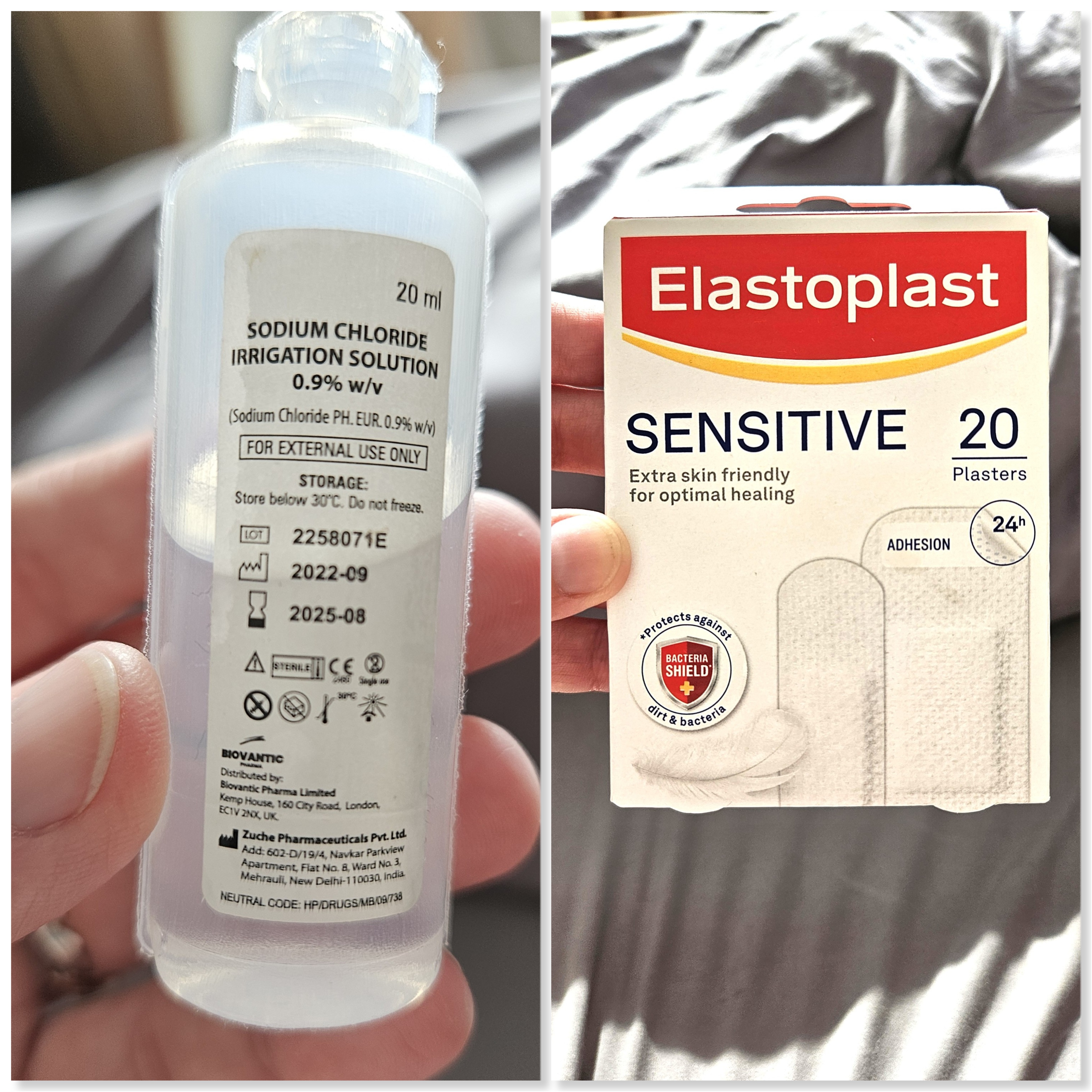
Sodium Chloride and sensitive plasters 2024 © Lisa Shambrook

After a week I felt a little stronger, and went out for hot chocolate with Vince. Not a great idea! I very quickly experienced Dumping Syndrome. This is where sugar goes straight through you, literally, making you run for a bathroom, at the same time as making you feel nausea, faint, shaky, and weak. Not fun!

Twelve days after surgery I had my staples taken out, easy and painless. I freaked out a bit back at home when changing the plasters, though. I had expected the wounds to all have healed over, and edge-to-edge skin closed. Nope. Three were, but two weren’t. These incisions were where tubes and surgical equipment had been used in keyhole surgery to operate, so the holes were different sizes. The biggest hole/incision closest to my belly button was gaping open, about 4mm deep, and 4mm open. The one beneath my breast was open, but not as much. It scared me a bit and I rushed to my nurse friend to ask her advice! Apparently, the deeper, bigger ones will knit together internally first, building up to an external scab when they close and flatten in the long run.
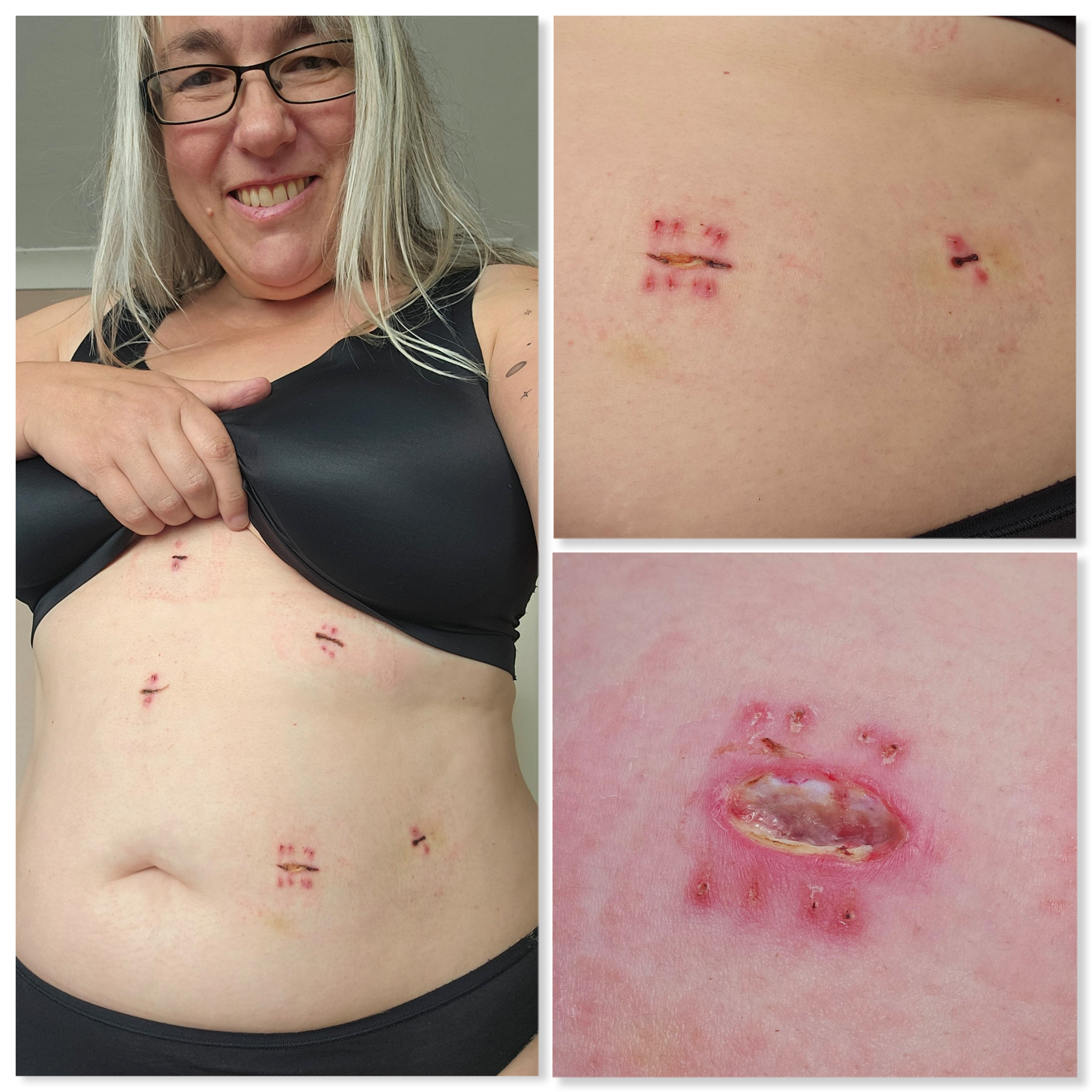
Staples out at 12 days, and healing at 3 weeks 2024 © Lisa Shambrook

After a month, I’d lost a stone (14lbs) in weight, through very small meals: liquid and mashed. I introduced fish in parsley sauce, egg mayo, smoothies, and very mashed potato after a few weeks, but still had almost no appetite, nothing unusual there, lol. At 5 weeks I was eating most things, just not steaks or bread. I was walking regularly when we walked the dog, and kept things gentle, so I felt much stronger by this point.
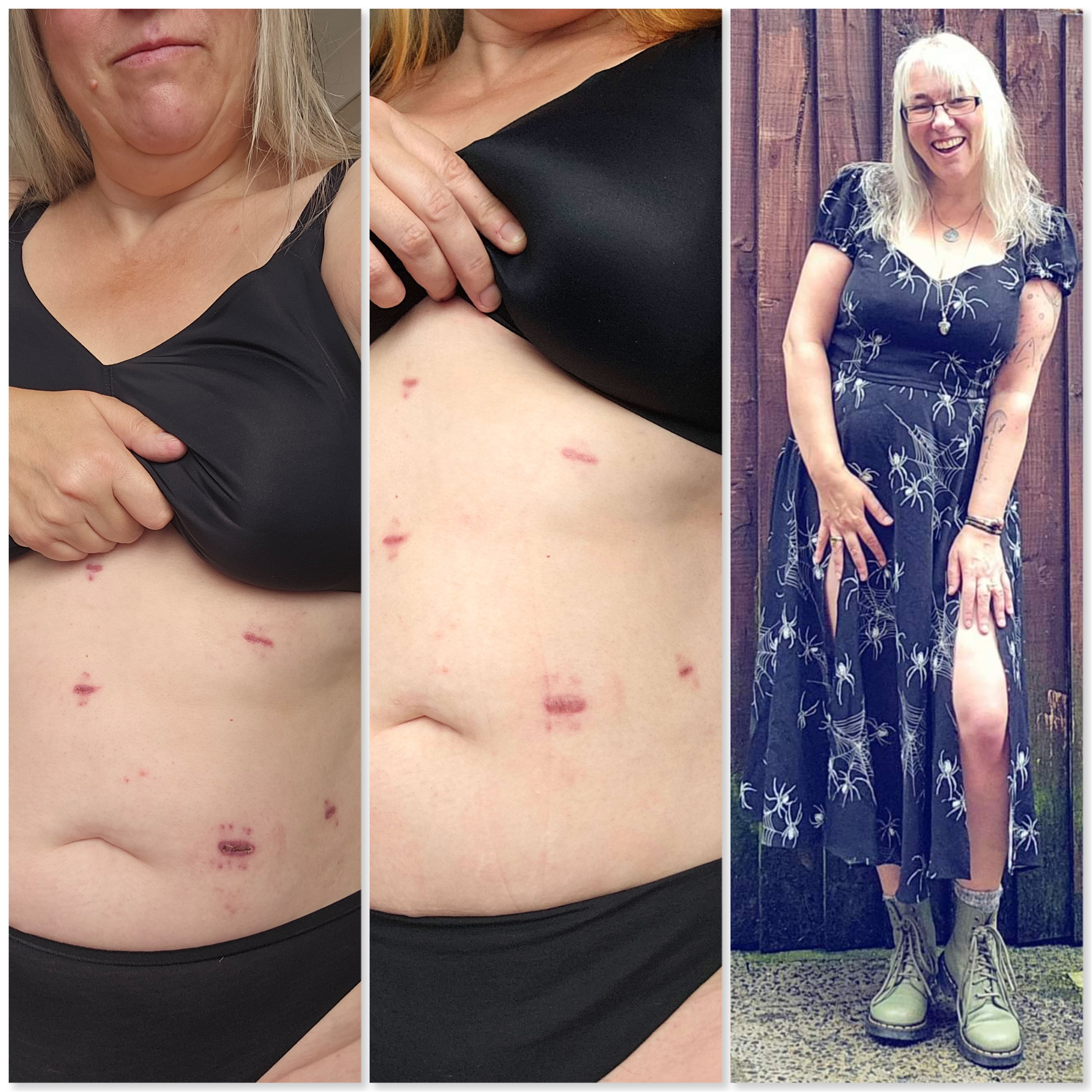
Incisions healing at 5 weeks, and 3 months. Lost 1.5 stone (21lbs) 2024 © Lisa Shambrook

By six weeks I felt pretty much back to normal and it was wonderful to experience no more reflux. I could burp, but mainly from my throat, if the gas was in my stomach, it came out the other end, and I quickly had to accept that passing wind would be the new way of life. Farting jokes were fully acceptable, and it was necessary to have a sense of humour! The reason behind this is because the very top part of your stomach is called the fundus, and it’s where the stomach stores all the gas stomach creates during digestion. Normally that gas slowly disperses and disappears without any issues. However, Fundoplication surgery explains it in its name: the fundus is used to create the wrap that goes around the base of your oesophagus. The stomach which in my case was herniating into the hiatus (the opening in my diaphragm that lets the food pipe pass through to the stomach) is pushed back inside and the wrap reinforces the valve that opens your stomach. So, without a fundus, the fallout is farting, a lot!

Unfortunately, at six weeks I noticed a return of my cough. It wasn’t bad, and nowhere near the horrific coughing fits of the past. My first fear was a failure of my wrap, of the surgery, but I had no reflux. I went back on Omeprazole for a couple of months, but that made no difference to my cough at all, so I did some of my own reflux and stomach acid research.

I read that pepsin, a stomach acid, can migrate out of a stomach and into the oesophagus, and was known to also be a cause for silent reflux and/or a reflux cough. Eating acidic food can activate pepsin in the throat, burning it and perhaps causing a cough. I spent a while cutting acidic food back out of my diet. I also bought an alkaline water filter, to reduce the acidity of the water I drink.

This actually made no difference to my cough, and neither did reintroducing acidic food. So, I went back to my GP, and we concluded that my cough (thankfully much better than before surgery, but still regular) is not respiratory, allergies, post-nasal drip, or reflux, so we moved into more diverse reasons. I’d read about the vagus nerve causing a neuropathic and hypersensitive nerve cough. The vagus nerve runs right behind the lining of the throat behind the tonsils.

This cough is triggered by irritants or sensations: perfume, the cold, movement of the neck, talking, laughing, and smells. The neuropathic cough can cause persistent cough, breathing issues during coughing fits, vomiting, stress incontinence, and more. The description fitted my cough perfectly. It’s a dry cough at the very top of my throat, a sudden tickle, or dry patch causes a coughing fit for what seems like no reason. Mine is often caused by smells, body movement, talking, sudden change in air temperature, cessation of exercise, and other small things.

There have been studies on the vagus nerve showing damage caused by several things: upper respiratory infections, which I’ve had lots of throughout my teens and twenties (when I was diagnosed with ME, Myalgic Encephalomyelitis), or nerve sensitivity, or larynx hypersensitivity, or neuralgia, or shingles etc. I fit a lot of these causes. So, I am now trying a new approach, to try and retrain the vagus nerve if it’s been damaged and caused the cough.
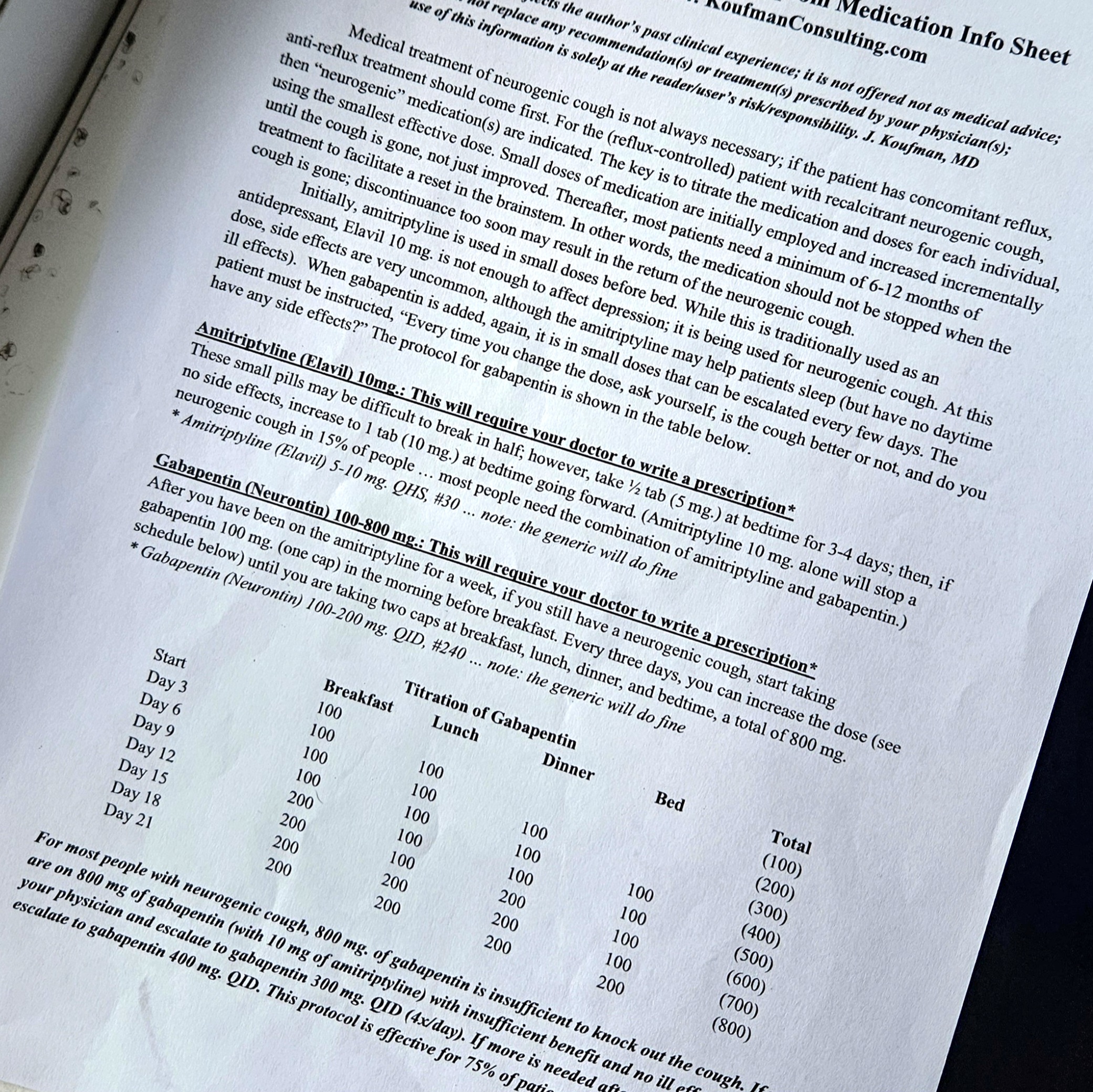
Koufman Chronic Neurogenic Cough Plan 2024 © Lisa Shambrook

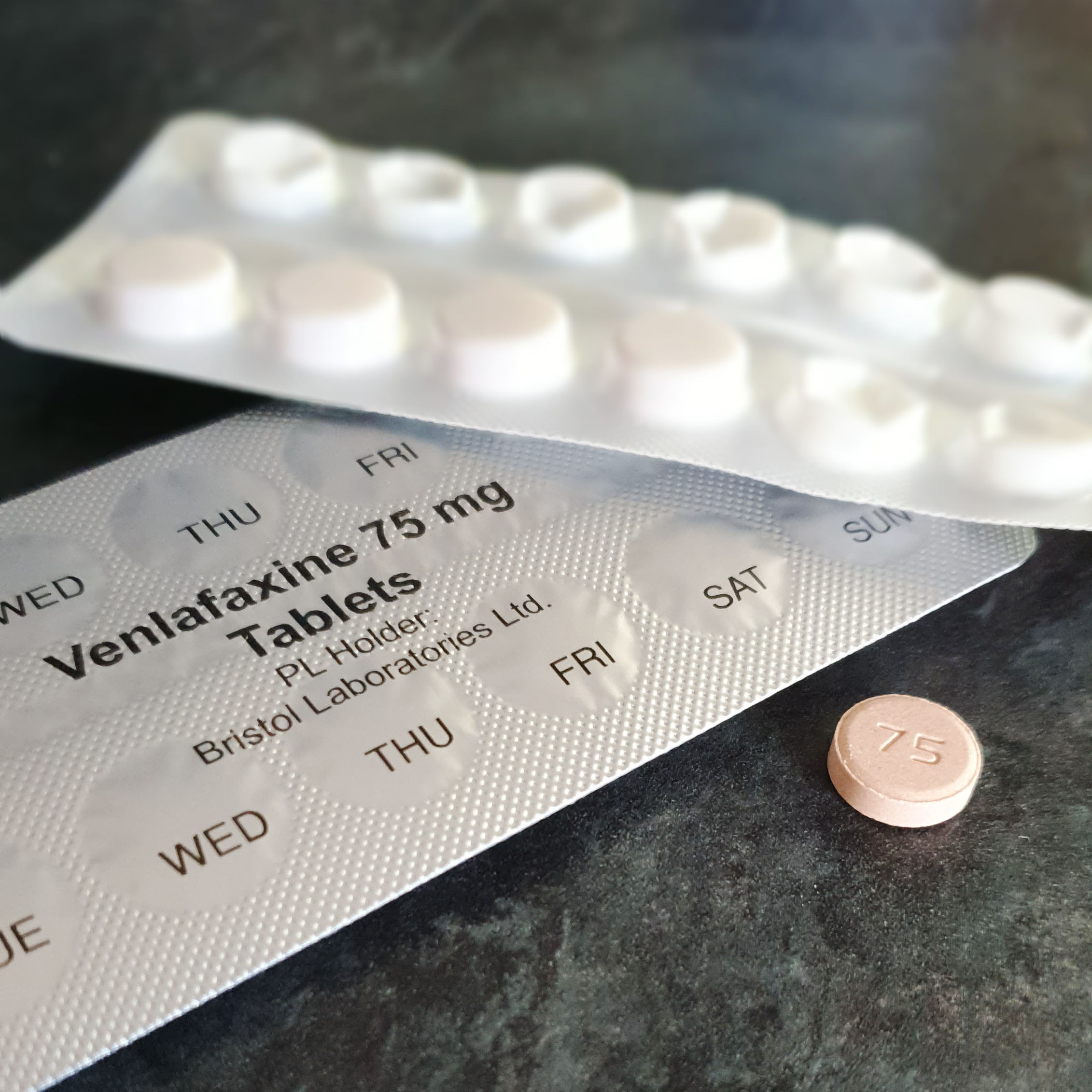
I tried taking low dose Amitriptyline to see if that helped, but it didn’t on its own, so then we added Gabapentin. The purpose of taking the Amitriptyline with the Gabapentin is that the low dose Amitriptyline is supposed to help the Gabapentin work better. Gabapentin is supposed to help calm hypersensitive nerves. I began with 300mg each day (100mg three times a day), then 500mg a day three months later, six months later up to 900mg a day. Another six months and up to 1,200mg a day. The idea is that a consistent dose for up to a year could retrain the nerve and eliminate the cough.

A year-and-a-half later and my surgical scars were healing well; they’ll continue to fade with time. I’d kept the weight I lost off. I wasn’t as hungry as I had been, maybe because my stomach was smaller, and still no reflux.
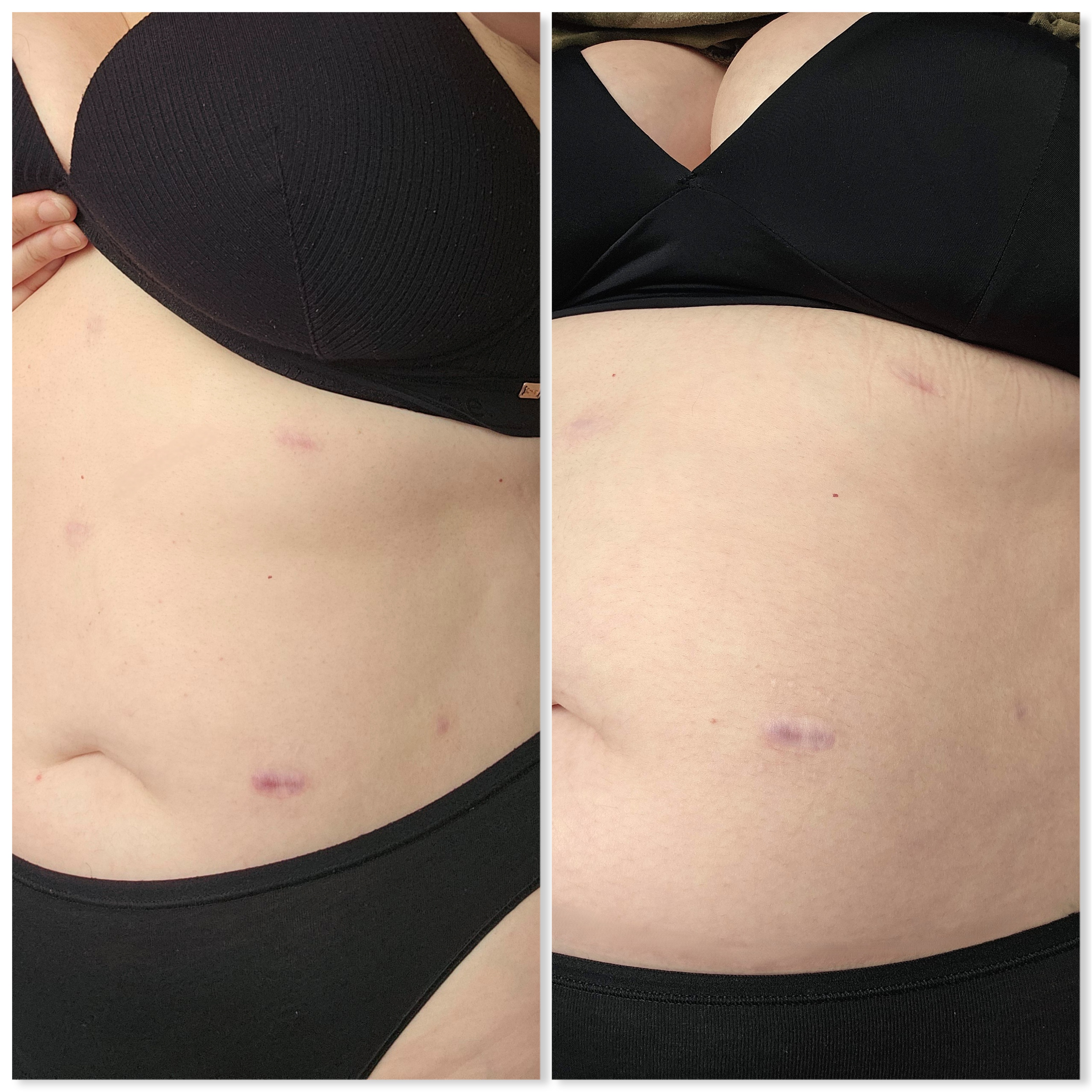
Incisions healing at 1, and 1.5 years 2025 © Lisa Shambrook

The cough is an ongoing thing, and though I still cough, there are no major coughing fits – I sometimes have coughing fits that lead into a sneeze, like from a tickly throat – but my coughing is minimal compared to what it was. If it isn’t successful, then I’ll get referred to neurology to see if there’s anything else they can try.
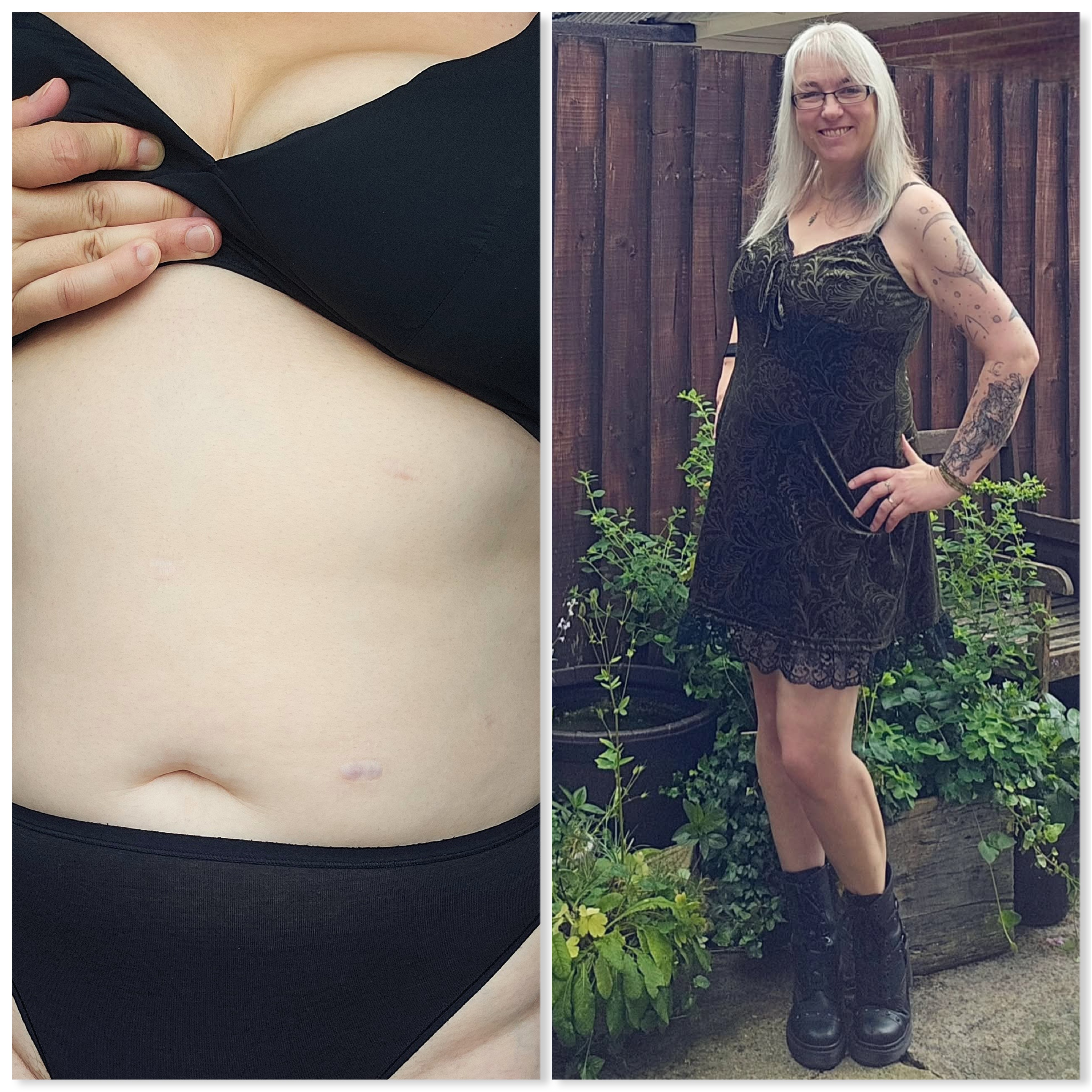
Incisions healing at 2 years and a lot less noticeable 2026 © Lisa Shambrook

My Fundoplication reflux surgery seems to be a complete success two years later, with no reflux and the ability to eat almost anything I want to. Even though the surgery was taken in a bid to eradicate my cough, it has eliminated my reflux, which was definitely making my cough a lot worse. I am fully aware that the wrap can loosen with time, but I am hoping it stays operational for a lot longer, and I am so much happier having had it.
Caramel Pear Tea 2026 © Lisa Shambrook

The Summer Realm Kindle Sale and Why You Should Buy It

At the end of last year my fellow authors and I released a trilogy of Fantasy/Steampunk books: The Summer Realm Trilogy. I’ve been really ill since February, and I haven’t posted much over the last three or four years due to difficult times. So, if you really want to make my day, pick up a Kindle copy of these books, or even just the first one to test the waters!

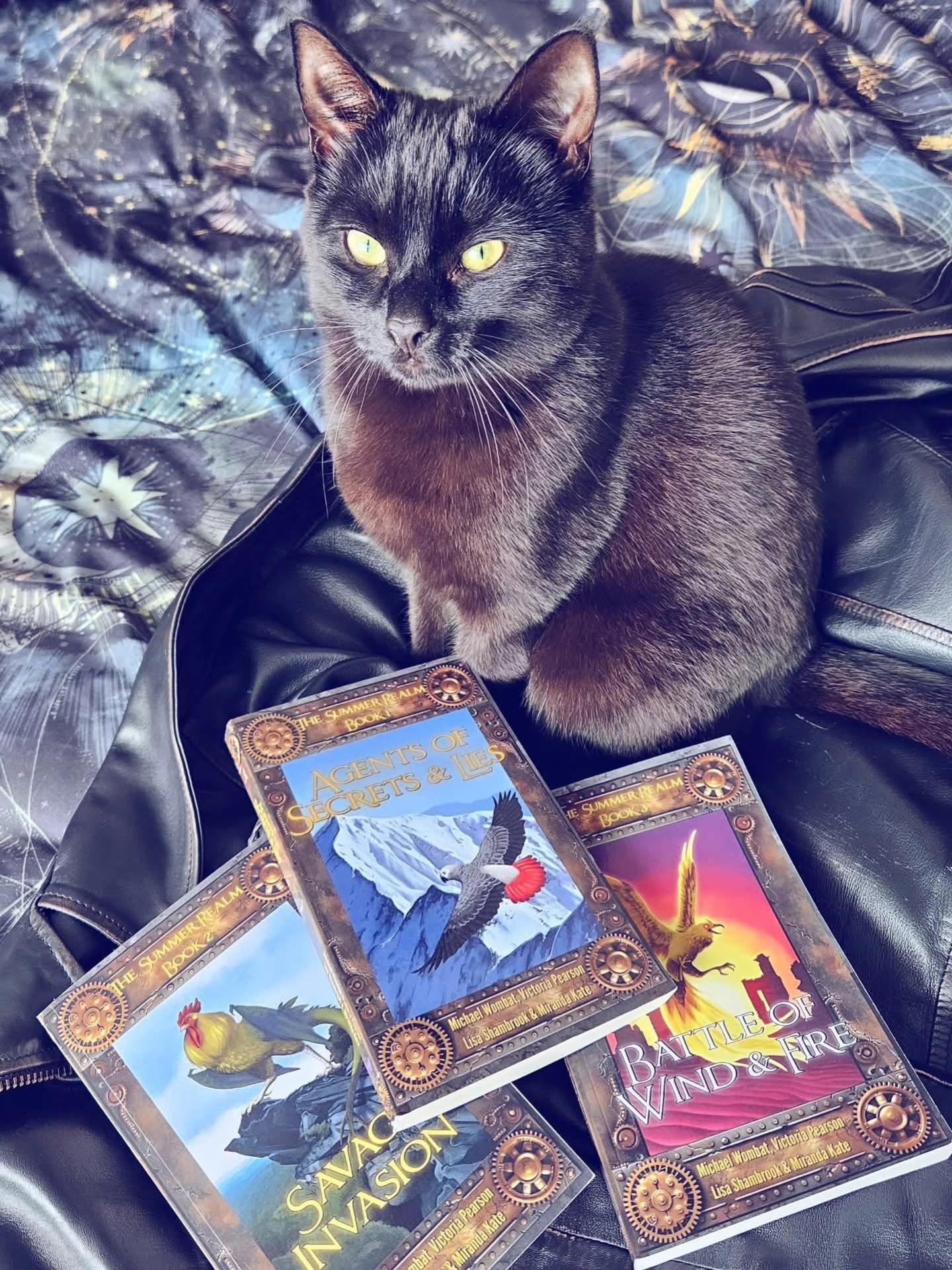
© Lisa Shambrook – Buy on Kindle, so your cat can’t steal the books and say they belong to her now!

I’m preparing several posts about my health, but each post is taking weeks to put together since I am unable to use my hands and arms very well right now. But enough about that, this is about the series of Summer Realm books which we put our heart and soul into, and lost the man responsible for writing Cleaveskull, in the stories, last December. These books mean the world to myself (Wren), Miranda Kate (Tricky), Victoria Pearson (Ash), and Michael Wombat’s family.

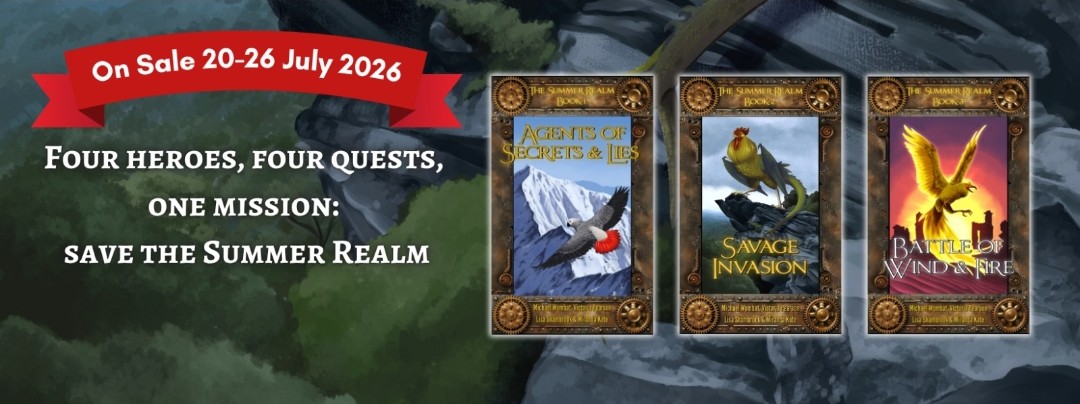
If you haven’t already bought them and can spare a pound or two, the kindle versions are on SALE this week, 20th – 26th July, and honestly, every purchase makes us sing and dance with delight! (And what makes it even better is that you can’t even see or hear me sing and dance, because I can’t sing, and have two left feet!)

The Summer Realm series of books is a unique tale of three agents:
Wren – a reclusive loner mage and her beloved fox,
Cleaveskull – a gentle-hearted airship guard-winder,
and Ash – a skilled in the art of disguise wily spy,
with Tricky – an intriguing and potent witch from another world,
fighting to defeat a threat that will annihilate their realm.
Their stories weave together until they meet for the final showdown.

We put two years into writing these books, and we know it helped Michael spend a little extra time with his family, friends, and with us, as he wrote at the same time as fighting his own battle with cancer. We know we can’t win every clash we encounter, but maybe you’d like to purchase your own copy in his memory? Or just to make our day? Or just because you love fantasy or steampunk? Or just because you love a good tale told well?

Whatever the reason, Agents of Secrets and Lies, Savage Invasion, and Battle of Wind and Fire are on Sale for one week only*, with all our love poured into them!

Buy here… The Summer Realm Books

*My huge apologies that you didn’t get this post at the beginning of the Sale. My arms are just about holding together after writing it, putting it together, and posting it. It’s a far cry from writing every day and loving it. I can’t wait to get back to writing one day ❤

Saving the Summer Realm – The Tale of Four Authors and Pleached Writing

The Summer Realm series of books is a unique tale of three agents:
Wren – a reclusive loner mage and her beloved fox,
Cleaveskull – a gentle-hearted airship guard-winder,
and Ash – a skilled-in-the-art-of-disguise wily spy,
with Tricky – an intriguing and potent witch from another world,
fighting to defeat a threat that will annihilate their realm.
Their stories weave together until they meet for the final showdown.

About two years ago Michael Wombat approached myself, Miranda Kate, and Victoria Pearson with the acorn of an idea and it grew into this huge old oak tree of three books.

Agents of Secrets and Lies, Savage Invasion, Battle of Wind and Fire books © Lisa Shambrook

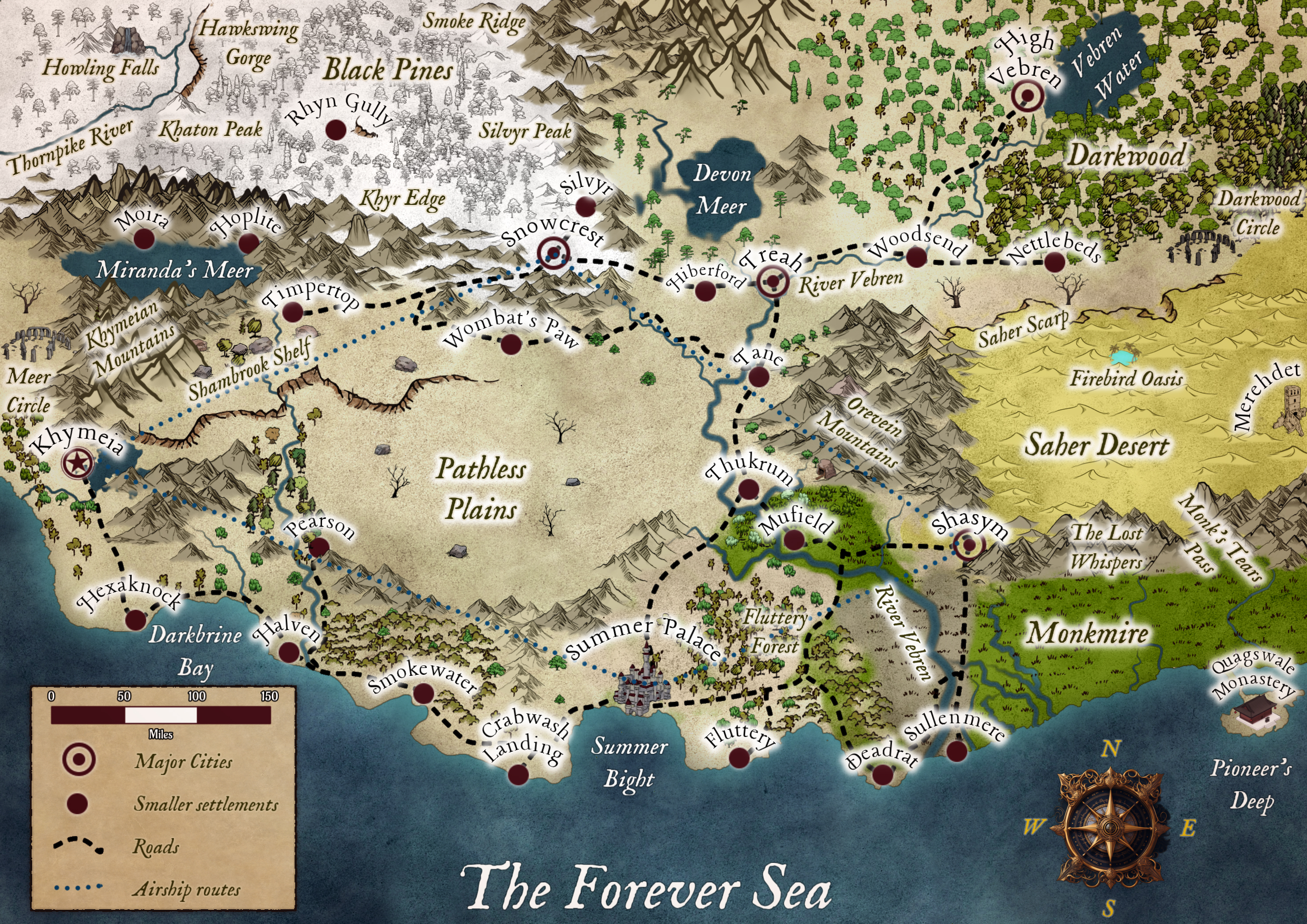
As soon as I was approached, I jumped at the chance and it was a privilege to write with this group. We brainstormed on WhatsApp and created the Summer Realm, a land of steampunk, medieval, and fantasy tech with just more than a hint of Dungeons and Dragons. Michael assigned us a corner of the map and let us loose to create our characters and their stories. Michael knew how the story started, and sent messenger parrots to deliver an individual mission to each of our characters. From there we set about crossing snowfields, deserts, inhospitable lands, and traipsing through towns and cities to achieve our objectives.

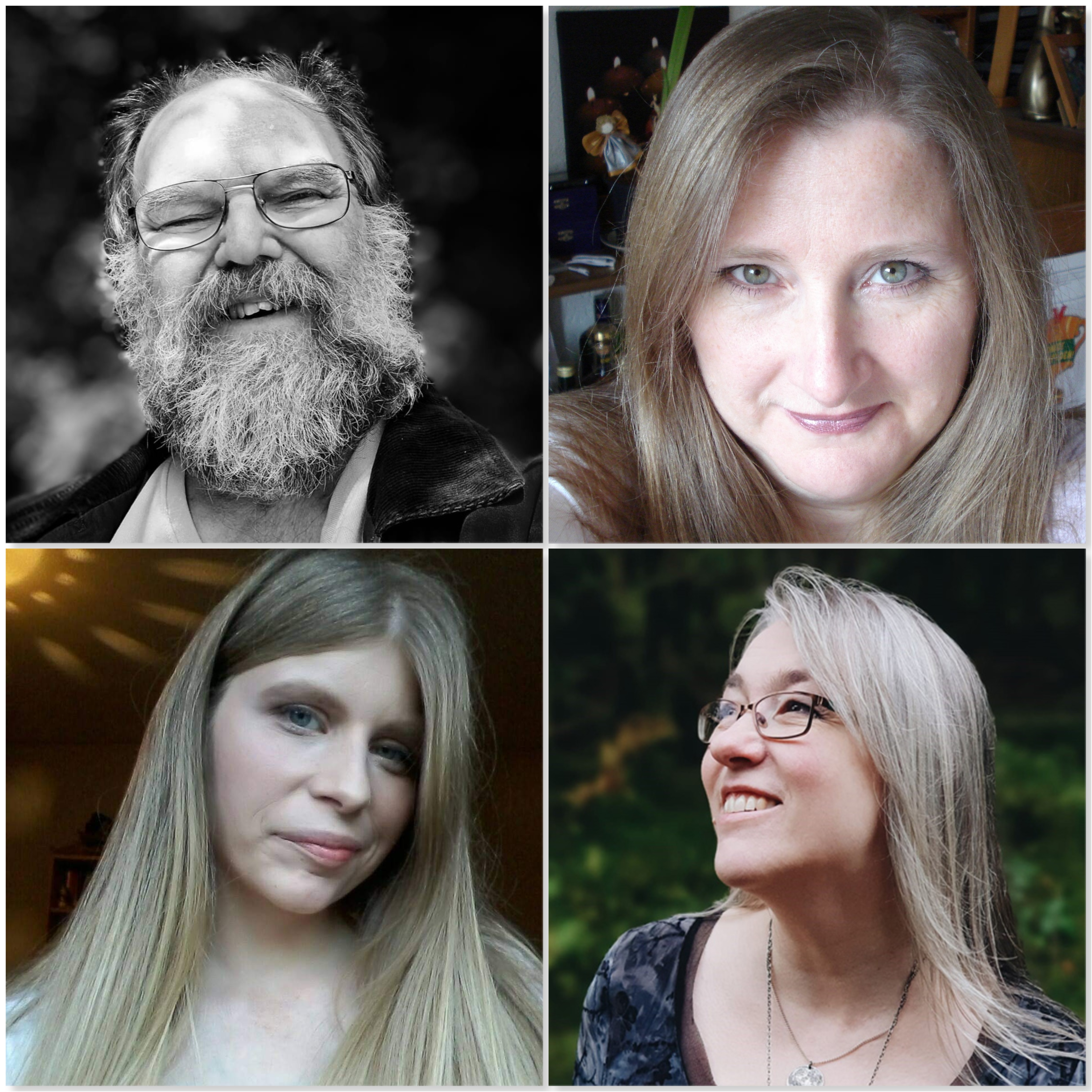
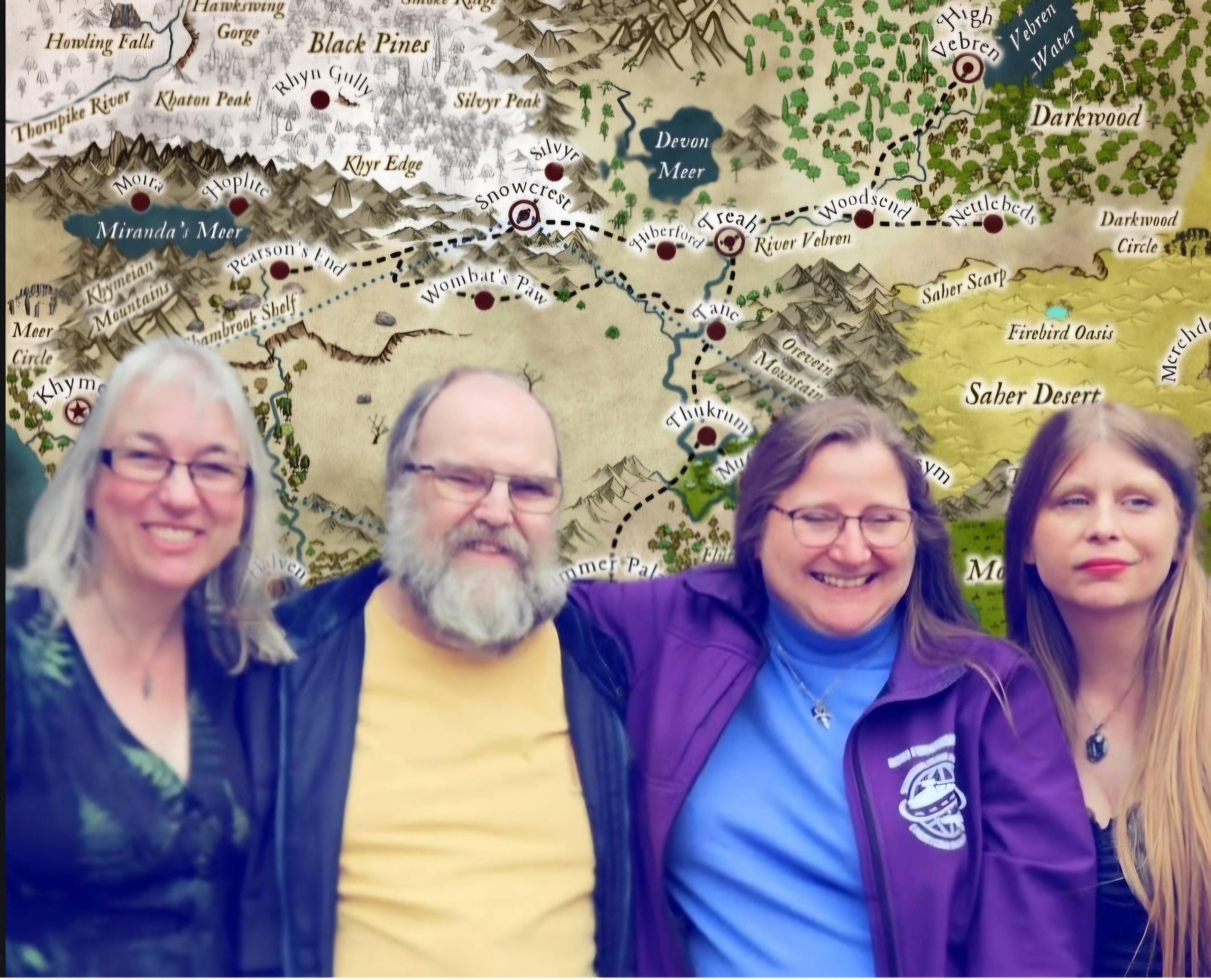
Michael Wombat, Miranda Kate, Victoria Pearson and Lisa Shambrook © Lisa Shambrook

We totally surpassed our original anticipated wordcount, and the single book expanded to become three.

Michael worked tirelessly, though, he was probably exhausted, pleaching* our four stories together – weaving them as if they’d naturally grown together twining like ivy, jasmine, wisteria, and convolvulus.

All through this, Michael was fighting cancer.

As we neared the end of 2025, Michael’s body had done with fighting.

Miranda worked every hour of every day (I’m not even joking) editing, collating, and preparing the files for publishing. Victoria worked on marketing, and we all made tongue-in-cheek videos of our characters. Even I did a video, as camera-shy as I am!

To Miranda’s eternal credit, she privately got a version of all three books in one omnibus printed and sent to Michael. He wept when he opened it. He held the three books in one volume, and saw the fruition of two solid years of work in his own hands.

To our devastation, Michael Wombat passed away, quietly in hospital, just a few days before the first book was published and released.

The Summer Realm was his realm.

The Summer Realm Map © Michael Wombat

To say how proud we, and he, are of these books is an understatement.

I put aside the chaos my own books were going through (I’ll post another day about that), to spend two years writing and being part of this Summer Realm series, and I’d do it all again if it gave me the opportunity to work with these wonderful authors.

And this is what we wrote!

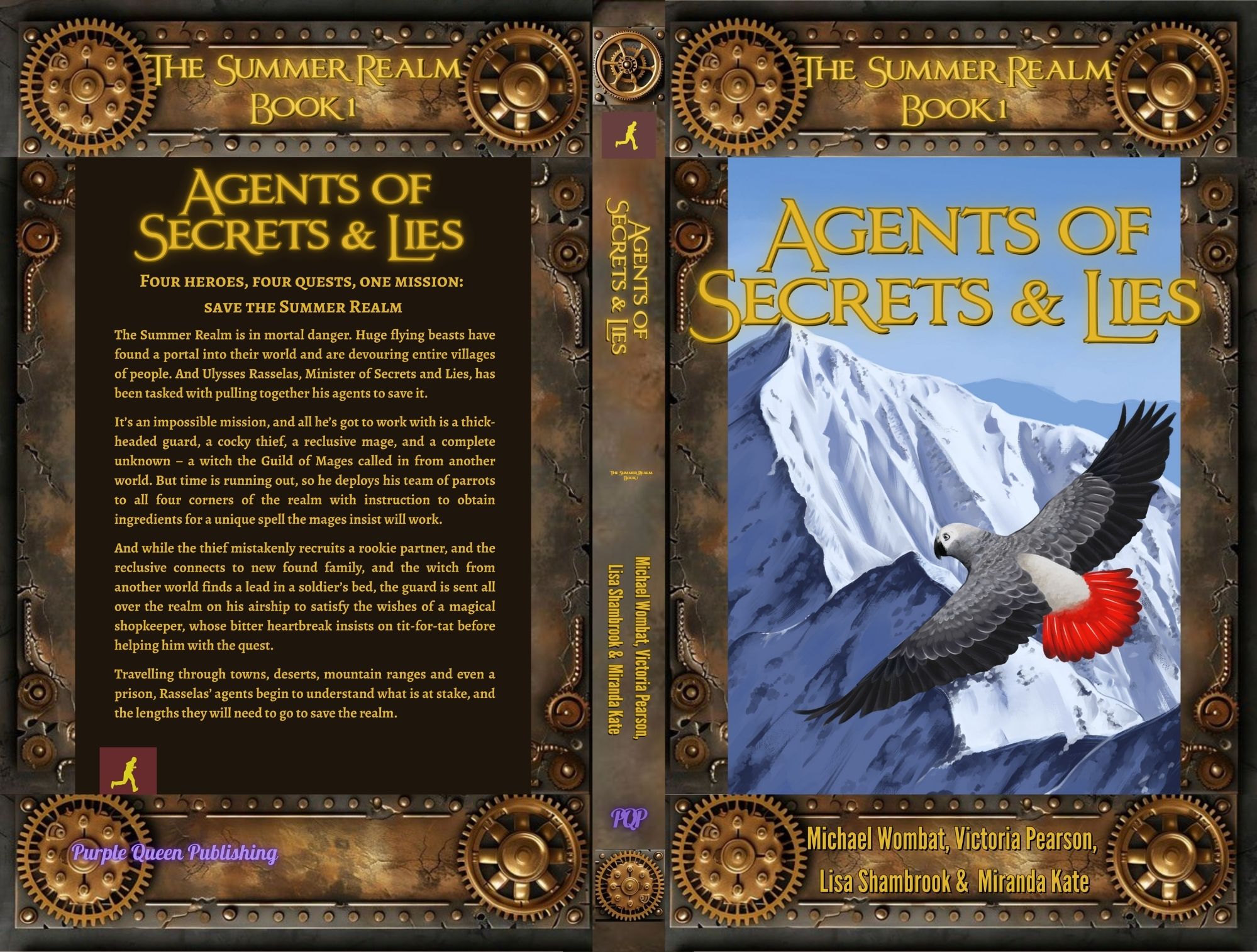
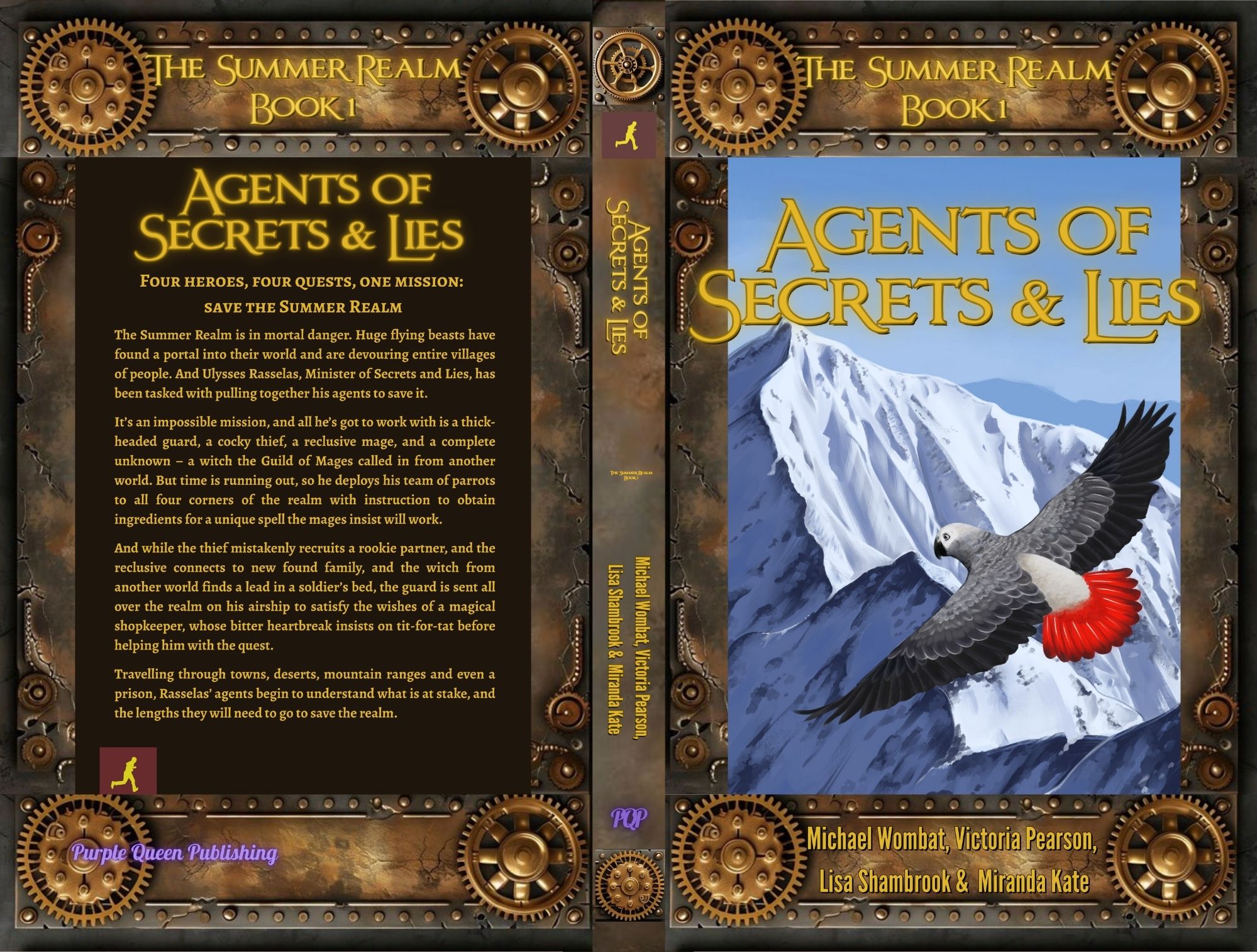
Agents of Secrets and Lies Cover © Kit Cooper and Miranda Kate

Agents of Secrets and Lies

Savage Invasion

and Battle of Wind and Fire

The first book is out there right now, the second available for pre-order and released on 6th February 2026, and the third also available for pre-order and slated for release on 20th March 2026.

We hope you love reading them as much as we loved writing them!

*Pleached When we first started this project, Michael used The Pleached Path as the interim name of the book, because it defined, quite literally, what we were about to do with our writing and stories.

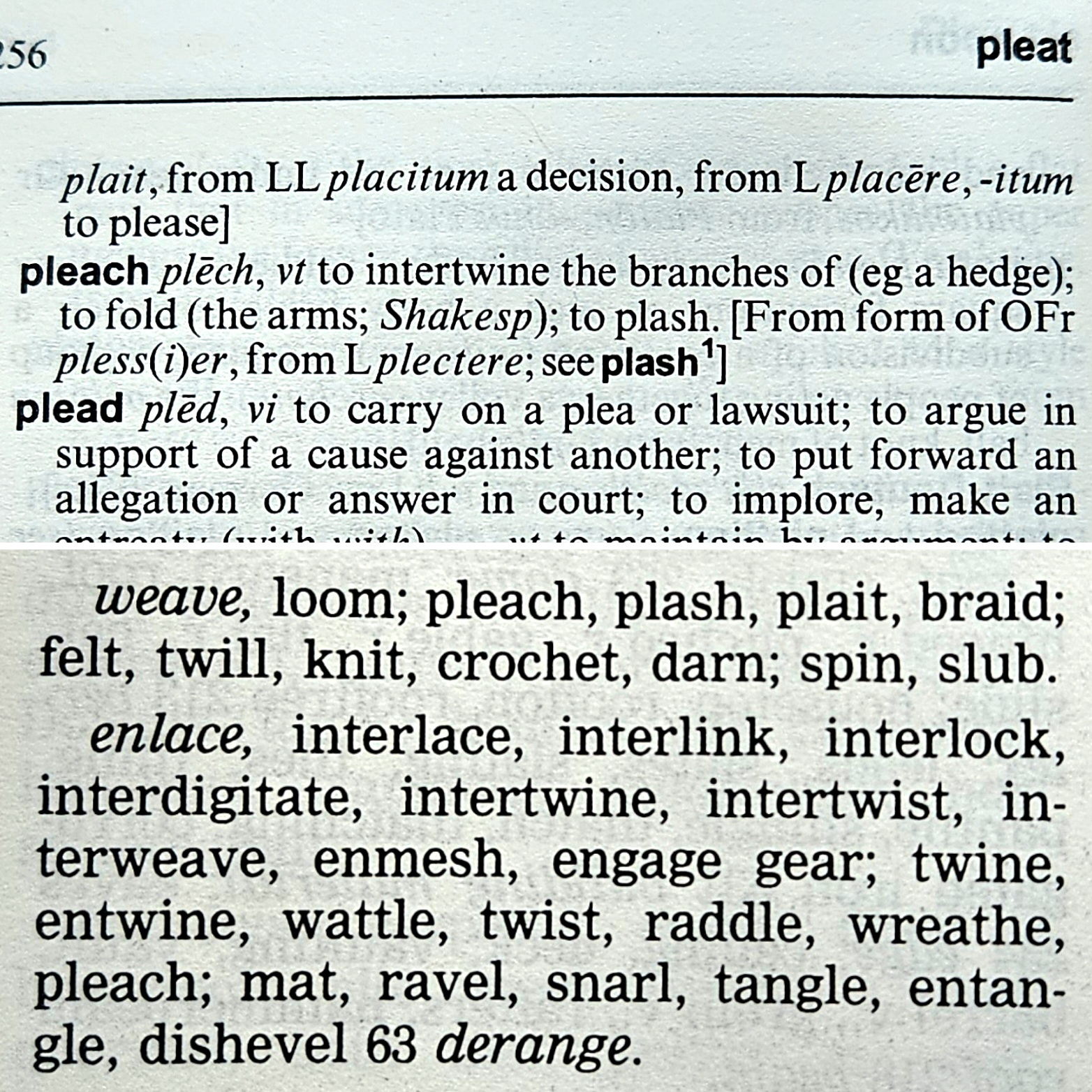
Pleached definition:

Webster Dictionary: pleach plēch, vt to intertwine the branches of (eg a hedge); to fold (the arms; Shakesp); to plash. [From form of OFr pless(i)er, from L plectere

Roget’s Thesaurus: weave, loom; pleach, plait, braid; … enlace, interlace, interlink, interlock, interdigitate, intertwine, intertwist, interweave, enmesh, engage gear; twine, entwine,  …wreathe, pleach;

Pleach definitions © Lisa Shambrook

Hence, the four of us will be forever pleached together because of this work.

Lisa Shambrook, Michael Wombat, Miranda Kate and Victoria Pearson in front of Summer Realm map © the four of us

Deconstruction – Turning Faith into Freedom

Religion – they tell you that you are loved unconditionally,
and then they teach you all the conditions – Anon

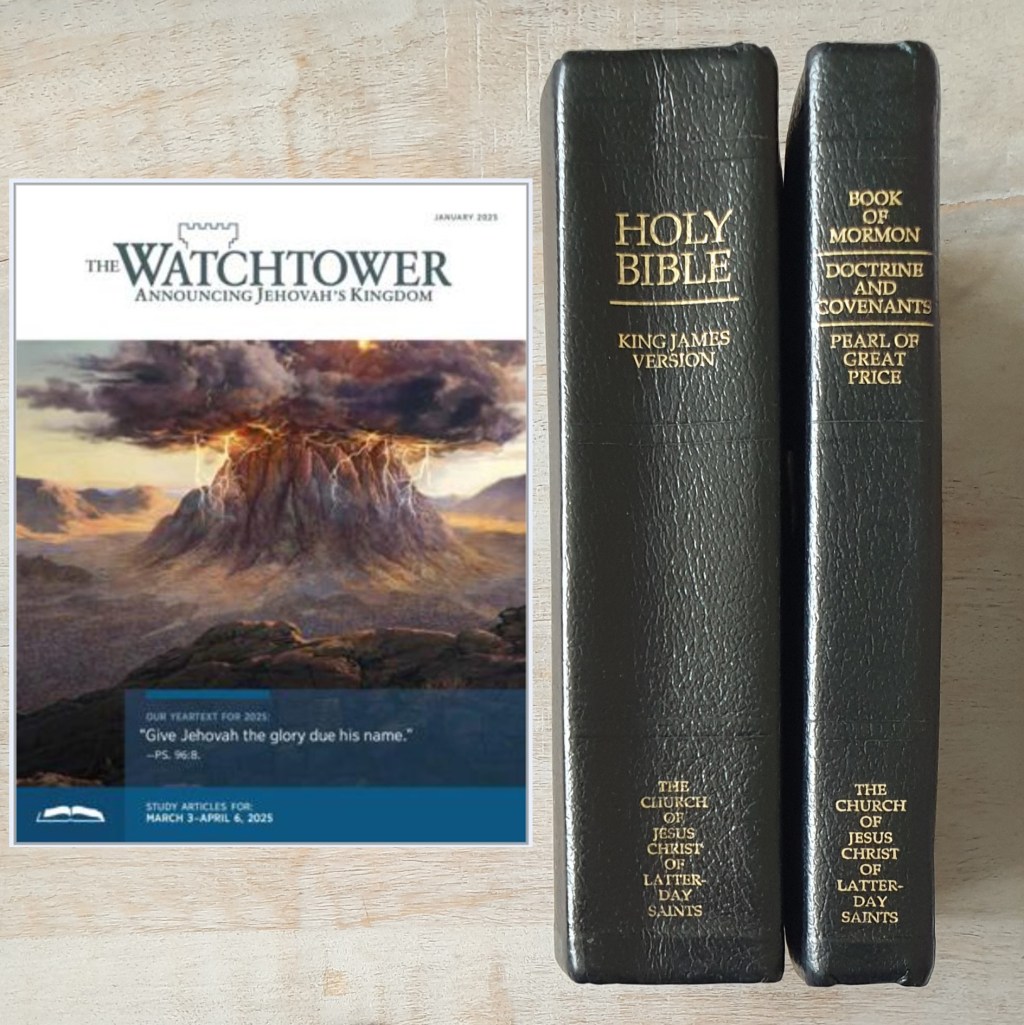
I’m participating in a research study about coping mechanisms and support for people leaving high-demand religions. Some of the fastest growing groups in this category are ex-Jehovah’s Witnesses and ex-Mormons. There’s often little outside support or framework to help those who leave high-demand communities to deal with integrating back into ordinary life. Some people can happily leave religion without a backward glance, but others can find deconstruction very traumatic.

© Lisa Shambrook

Deconstruction is a term that means to break something down, to take it apart and study it to understand its meaning. It’s often used in a critical search to expose flaws, biases, and inconsistencies. It’s deep-diving into a subject to discover what it means to you, and how you feel about it.

Both of the above religions encourage or instruct members to only learn about the religion from trusted sources. These sources will be church sanctioned authored works. However, it’s not easy to come to an unbiased conclusion when you are only allowed approved sources. Deconstruction allows you to research and discover from all the available information and come to terms with information you often haven’t been privy to before.

Some of the fastest growing groups in this category are ex-Jehovah’s Witnesses and ex-Mormons © Lisa Shambrook

Leaving a religion or community you chose to be part of, or were born into, can leave you with many emotions, from deep loss, to huge relief, depending on your standpoint. People are all different, and some can shrug their shoulders and walk away without any lasting issues, while others can feel highly traumatised, struggling with reintegration, shame, guilt, regret, and more. 

© Lisa Shambrook

Religious trauma is a difficult thing to navigate, and can equate to many things from abuse, sexual assault, guilt, shame, financial difficulties, and just managing your life of freedom after you’ve lived a strict regime for so long. We’ve seen many stories of sexual abuse within religion from the high-profile Catholic scandals to smaller or covered-up stories in other religions. I’ve seen and experienced it several times within the religion I was brought up in. This kind of trauma is highly damaging to those that endure it.
Often people don’t take religious trauma seriously, because they’ve simply never experienced it, or cannot believe that a religion they love so much can cause trauma. Just because someone finds themselves easily fitting into the archetype of a specific religion it doesn’t mean everyone will. Accepting that religion works for some and is wrong for someone else is a healthy response. There should be no right or wrong, and no conditioning or shaping someone into something they are not. Judgement should be spared; after all, religion cannot be proven or disproven, so no one should preach the only, single truth when myriad ways exist to live happily.

It’s hard to talk about religious trauma as it’s taken time for me to deconstruct, and to accept both the blessings and regrets I have about the way I was brought up. I used to believe I had no regrets, that everything was a teaching moment, a time to grow, and that I hadn’t missed out on anything. However, I lived a life that was given to me, not forced – because my parents joined a religion that they truly believed and thought was best for their family – but being born inside a specific organisation or belief sees you growing up conditioned to their way of thinking, and that tends to negate choice.

Conforming to what was expected of me age 17 © Lisa Shambrook

I did miss a lot. I tried, as a teen, to live two separate livesan inside and an outside life. The one where I felt free was my outside life, and I thought I knew myself during that time, and maybe I did.

But my cage had been set from a young age, and when I tried to be who I really was, it was wrong. I couldn’t wear the clothes I felt myself in, I could not pierce my ears more than once, and showing cleavage, shoulders, or anything above the knee was chastened. I was told not to swear, I wasn’t allowed to drink tea or coffee, and I never knowingly touched alcohol. I couldn’t experiment with teenage life, I was taught to feel shame for learning about appropriate intimacy in the most natural teenage way, and I wasn’t allowed to openly rebel, and, so, I was conditioned to conform.

Feeling caged © Lisa Shambrook

The teachings of my religion were taught in programs that began at the age of three, continuing through to eighteen, including extra-curricular scripture studying programs during the exam years at school. Teachings are then taught in repetitive rotations throughout adult life, with that caveat of not learning from non-approved sources. 

This was an early pattern that my life followed as I tried to be good. I tried to follow the doctrines I’d been taught. I then taught those doctrines to my own children. That was where the cracks appeared to me. I revisited things I’d been taught as a teen, and some of it shocked me. When you are deep inside a faith, it can be difficult to see the problematic parts of it. When you are teaching people you love and respect more than anyone else, you begin to question things that don’t resonate with the values you suddenly realise you have.

My children, seeing some of the principles with a contemporary view, found that most of it did not fit their life perspectives. My views, whilst bringing up my children, had also changed as I tried to give them compassionate, open-minded morals and ethics. When my children left as young adults I was finally able to give myself permission to leave.

Quote by Elizabeth Gilbert © Lisa Shambrook

After over a decade of questioning, counselling, and attempting to find myself, I left the religion that I didn’t fit into, and stepped into a world I didn’t really understand. To begin with I felt huge relief, but that was tinged with feelings of guilt and shame that had followed me since I was young, and anger that conditioning had stopped me finding out where I was meant to be for so long.

After leaving religion I had counselling from a lovely woman who helped me combat my feelings of guilt and shame, and other situations I’d found myself in due to naivety. Counselling, these days, is something you look for yourself. It’s out there, but I wish it was easier to obtain. It’s been pretty essential to me several times throughout my life.

Deconstruction is a major part of working through trauma. Finding what you believe, what you want, and what you need. Breaking down the constructs, the beliefs, concepts, and doctrines you were moulded with, and dissecting, researching, and finally coming to terms with who you were and who you have become.

Becoming non-conforming age 53 © Lisa Shambrook

I have been reading Recovering Agency: Lifting the Veil of Mormon Mind Control by Luna Lindsey Corbden for over a year to help navigate my own faith crisis. It’s taken so long because there are many triggers, there’s a lot to unpack, and it takes time to work through.

My own deconstruction, the peeling back of decades of taming, is tough, but rewarding. The notion of rebellion has lost the demonization it had carried as a teen, and become a vehicle of exploration, discovery, and fun. I can now show cleavage, have multiple piercings, tattoos, and not feel shame about living life to the full. Sometimes, you just need to be bad, and teenage me is revelling in it!  

As a family we finally discovered what we needed and where we belong. I’ve been married almost 35 years now, and we’re the happiest, closest, and the best we’ve ever been together. It’s beautiful.

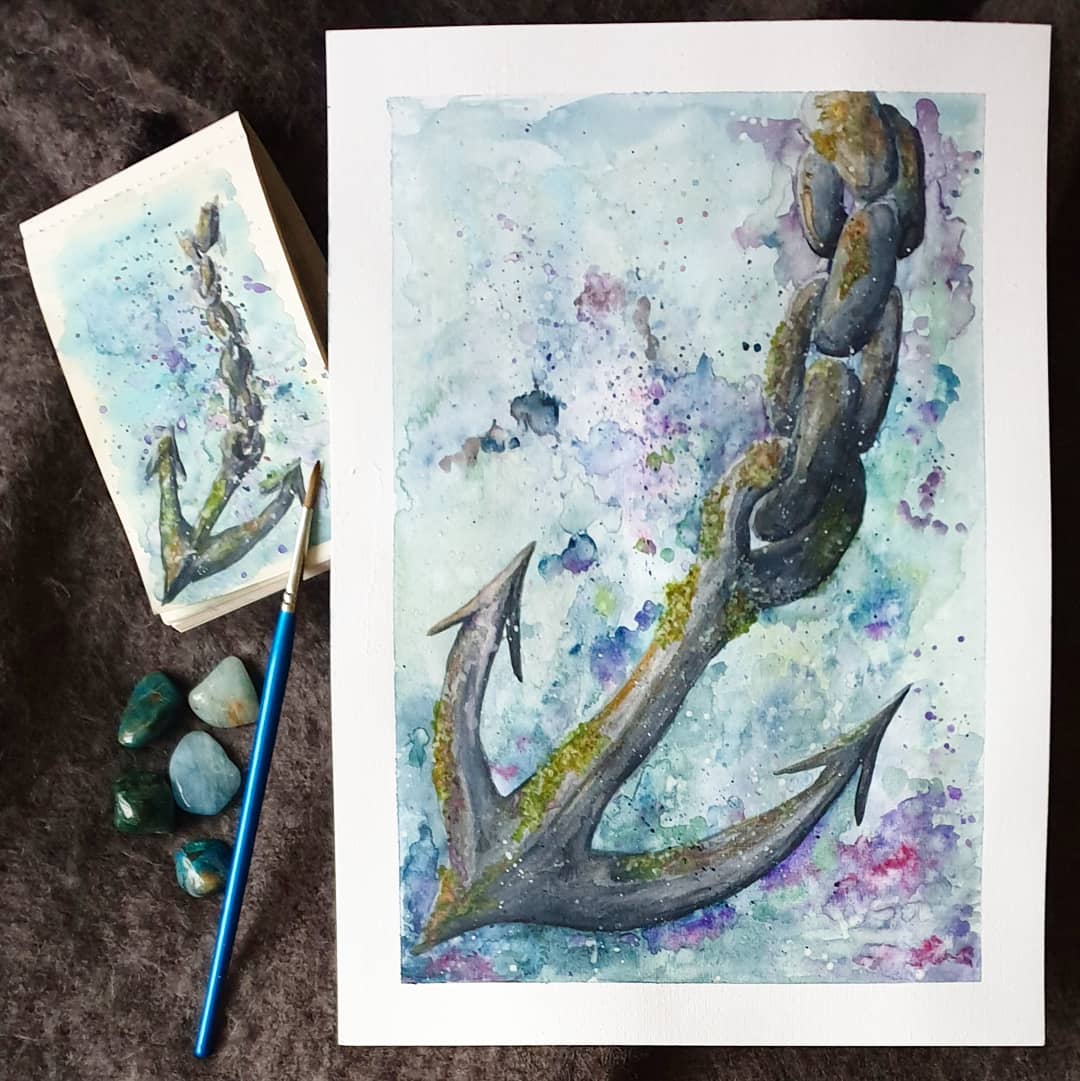
Breaking the chains of my anchor © Lisa Shambrook

I’ve discovered who I am with complete freedom and authenticity.
An anchor that had been weighing me down for my entire life has lifted,
and its chains broken, and I now,
lazily swim in an ocean of new and delightful discoveries.

Let’s Talk About Conditioning

We experience being conditioned in so many ways.
All around us feelings and beliefs are becoming stronger and more opined.
Conflict is everywhere and people are more resolute in their choice of thinking,

but are we thinking for ourselves?

Voices are louder, and opinions and dogmas more exacting. We are polarised as people, from our conflicting beliefs in religion, politics, global warming, refugees and immigrants, war, basic human rights, gender, sexuality, diversity and so much more. Why are we so divided, and are we being manipulated?

Every principle for personal growth, once institutionalised, shifts from serving as a vehicle for self-actualisation to serving the actualisation of the vehicle itself. We are no longer nurtured, but managed. – Matt Berry, A Human Strategy, quoted in The Pattern of the Double Bind in Mormonism

© Lisa Shambrook

The information we consume is biased. Barely any information these days is impartial. The material we use to develop our thoughts, opinions, and beliefs are often flawed,  at best just by people’s innocent preferences and at worst we’re being controlled by institutions like religions, politicians, social media, news and media, and both data and opinions forged from others with motives.

© Lisa Shambrook

We are beginning to understand how our minds and our cognitive structures work in a scientific nature. We live in a now society, we don’t have time to question, to wait and ponder, and we grab at ideas that appeal to us. Those that give us information can teach, liberate, offer positive ideas, build us up, offer compassion and inclusivity, and create peaceful societies. But they can also be destructive, controlling, abusive, oppressive, inciting conflict, and creating a divisive and dangerous society.

Why do we fall for the smooth talk of con men and politicians – if they’re not one and the same in some instances? These models can be either subtle or very open, but millions fall for them. How do we move from being nurtured to being managed?

If we’ve been bamboozled long enough, we tend to reject any evidence of the bamboozle. We’re no longer interested in finding out the truth. The bamboozle has captured us. It’s simply too painful to acknowledge, even to ourselves, that we’ve been taken. Once you give a charlatan power over you, you almost never get it back. – Carl Sagan, Demon Haunted World

To learn, find knowledge, and form opinions we use cognition. Cognition is reasoning, understanding, and intellect. Two other powerful emotional forces go hand in hand with cognition: consonance and dissonance. Consonance is a feeling of harmony, being in accord, the pleasure of knowing you’re right, and it’s a feeling we all seek because it makes us feel good! Dissonance is the opposite; conflict, discord, and disagreement, and that feeling in the pit of your stomach that you might just be wrong. When our cognitions clash, we either fight it struggling to find resolution, or we embrace the opportunity of learning and discovering. We often prefer to prove ourselves right and feel better, than to admit that we are wrong, and find that we need to change or alter our preconceived ideas or beliefs.

Religions, these days, often use soft conditioning, drawing us in with love and ideas of saving and rescuing us, then slowly teaching us doctrines and requirements, leading to bringing us round to their way of thinking. Old style fire and brimstone is much rarer these days as people are less enticed by it in our climate. Politicians also work slowly on us, leaning in on general fears and needs in society. We fall into accepting the things we’re taught. After all we’ve been programmed to accept knowledge imparted to us by parents and teachers from a very young age. We believe many things simply because they’ve been taught by people we love and trust.

I never questioned the religion I’d been brought up in as a child because it was simply the way we lived. It was right because my parents had taught it, and my parents not only knew everything, but loved me and wanted the best for me. So, going to church wasn’t a choice, it was a given, the same as going to school was.

As a teenager that changed because I started thinking for myself, but when you believe something so thoroughly, dissonance is a painful process. When someone tells you “You only believe this because it’s all you’ve ever known,” there’s a dissonance that hits so hard you either have to face it and question it, or you ignore the discomfort and justify, rationalise, or deny it. I denied it. I couldn’t face the pain of what I’d known all my life to be wrong. That’s not to say I didn’t question it, I did and it hurt. But I also listened to what I’d been taught, and then tried my hardest throughout my twenties to convince myself I was the perfect Mormon.

After all, there is no need to be objective when you know you are right. – Chris L. Morin, Suddenly Strangers

It’s easier to continue to believe what you think is right, instead of researching and finding out you might not be.

© Lisa Shambrook

We all have bias, even if we can’t see it.

Confirmation bias is the tendency to search for, interpret, favour, and recall information in a way that confirms or supports one’s prior beliefs or values. – Wikipedia

Our brains work with patterns, and when we use them our cognition grows, patterns help the neurons in our brains connect information and create knowledge. So, confirmation bias can be good as it shows us that ‘so and so must be true because then such and such always happens,’ confirming its truth. It’s how we create and understand language, maths, and science for example. It’s also why when there’s a discrepancy, it can be easier to discount or ignore it because it doesn’t make sense, and things should make sense.

© Lisa Shambrook

I’m using my religious experience to demonstrate this because it’s easy for me to recognise it. When I was young and learned difficult things about the history of the religion I was brought up with, for example polygamy or the Mountain Meadows Massacre (where Native Americans were slaughtered by a group of pioneers), I ignored it, or found ways to make it either palatable or an acceptable part of Mormon history. I concentrated about the good things in that religion and told myself I couldn’t possibly understand all the difficult things and I wasn’t expected to, and that God would make it right in the end. I reinterpreted what I didn’t like or didn’t understand.

I saw another example when I recently watched an episode of ‘Go Back to Where You Came From’ on Channel 4, a programme taking several Brits with highly racist and anti-immigration views, to places many immigrants try to escape and come to Britain from. One of the women on the show believed that all immigrants should be stopped no matter what they’ve been through, but when she arrived in Somalia she experienced the fear they live under and was genuinely frightened for her own safety. After a few days seeing what Somalians go through in a city without adequate governance, laws, safety, and in utter poverty, she spoke again. This time though she’d been visibly moved she was unable to give up on her prejudice, and commented that it wasn’t her responsibility to help these people, and that what was required was for them (the people) to make a government, to get sanitation, and to build an economy. She couldn’t understand that none of these things could happen while the country was still in a state of war and conflict. She couldn’t deal with cognitive dissonance and moved to confirmation bias instead.

All I want is compliance with my wishes, after reasonable discussion. – Winston Churchill

© Lisa Shambrook

We give into our biases because it’s easier than recognising them and changing them. Where does bias or opinion come from? Parents, upbringing, social standing, friends, teachers, religions, politics, social media, leaders, all affect our thinking. Obedience to authority is ingrained from the beginning.

Blind obedience is dangerous and confining. Think of Hans Christian Andersen’s – The Emperor’s New Clothes. When two con men arrived and weaved new clothes for the Emperor that they said were invisible to those who were incompetent or stupid. Neither the Emperor nor his minions could admit that they were invisible without being seen as fools. So, the Emperor wore his new clothes out in the street and all the people uncomfortably went along with it, not wanting to appear stupid. It took a child to point out that the Emperor was naked for the townsfolk to agree that they’d been fooled.    

We often agree with something, even if it’s uncomfortable, because it’s easier, or we don’t want to think we’ve been fooled.

Those who can make you believe absurdities, can make you commit atrocities. – Voltaire, Miracles and Idolatry

The dogma of the group reflects the psychology of the leader. – Dr. Michael Welner

© Lisa Shambrook

Don’t set yourself aside. Your intellect, knowledge, and learning are constantly developing. Don’t let organisations or individuals control your knowledge, and the information you can gather to make educated choices. If you are told, or directed to only find information in one place, then challenge that. Look elsewhere, talk to more people, and learn more widely. Seek truth.

Past events, it is argued, have no objective existence, but survive only in written records and in human memories. The past is whatever the records and the memories agree upon. And since the Party is in full control of all records, and in equally full control of its members, it follows that the past is whatever the Party chooses to make it. – George Orwell, 1984

I shudder at the list of apparent falsehoods for which I would have given my life. – Brad L. Morin, Suddenly Strangers

© Rayn Shambrook

We have power in thinking, questioning, studying, and learning. We need exposure to different opinions, information, and cultures to be able to form well-rounded thoughts and concepts. If we’ve only ever been exposed to one sort of culture than we cannot possibly believe we understand what another thinks, or how another lives. That just encourages the believe that we know what is best according to how we’ve chosen to live our lives, and that others should be doing the exact same thing. So many different ways of life exist on this planet, and all peaceable ways that don’t choose to hurt another are equally valid, even if they’re different to our – or the majority – choice.

What a tragic loss that often we are exposed to only one religious or philosophical view. In this group-facilitated…narrow-mindedness we find the roots of prejudice, bigotry, and hatred. – John D. Goldhammer, Under the Influence

© Rayn Shambrook

So, can we reject the conditioning we’ve been through? Can we even recognise it? It can be incredibly difficult to recognise and accept when we’ve been conditioned or controlled. We generally believe our thoughts are truly our own, and it’s a tough pill to swallow to recognise we need to change to alter our thought processes or our beliefs.

It took me a long time, a lot of soul searching, and a great deal of questions – which were refused answers – in my faith, before I was able to accept that the history of my church and its founder were not as clear cut or favourable as I’d been taught they were. Following that, it’s like if you pull one brick from a tower – or Jenga – then everything fails or falls. But it mattered to me that what I followed was correct, both morally and honestly. Leaving a religion like I did, or changing your mind and seeing things differently when you learn and accept reliable information, is powerful and edifying.

It is morally as bad not to care about whether a thing is true or not, as long as it makes you feel good, as it is not to care how you got your money as long as you have it. – Edmund Way Teale, Circle of the Seasons

We are individuals, and we can overcome conditioning if we activate our thought processes and authenticate what we learn. If we are struggling with information that opposes what we’ve been taught, the best thing we can do is to move aside and evaluate.

…we can best see a group or an entire culture for what it really is by removing ourselves from it. – John  D. Goldhammer, Under the Influence

© Lisa Shambrook

Find yourself. Don’t be influenced by social media and its celebrities, or political parties that shout the loudest. We can easily see the damage around us from false media and news reporting, from biased data and statistics, from information that masquerade as facts, and from cults – both political and religious – that want us to follow them unquestioningly. Questions and information are power. We should always use our intelligence to decipher the truth and follow it with courage, ethics, compassion, and love.

© Lisa Shambrook

Lyme Regis, Fossils, Ammonites, and Fun!

‘Mary Anning [is] probably the most important unsung (or inadequately sung)
collecting force in the history of paleontology’

Stephen Jay Gould (palaeontologist and evolutionary biologist)

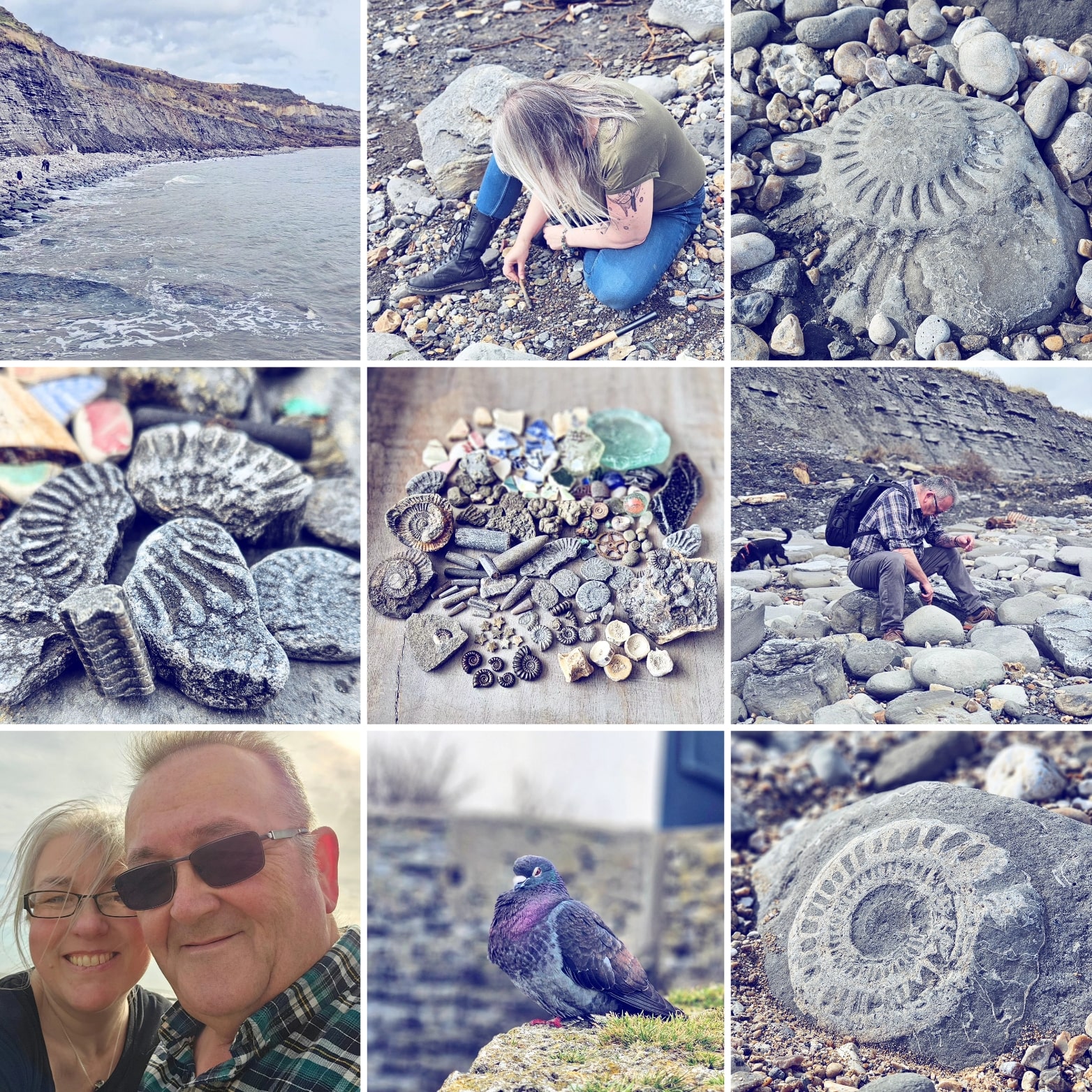
I’ve wanted to go to Lyme Regis for a while and back in April we did. The little town of Lyme Regis, part of the Jurassic Coast in Dorset, is famous for its fossils and for being the home of Mary Anning, one of the most significant fossil hunters in history.

Mary Anning, with her brother, discovered the first Ichthyosaurus skeleton when she was only 11. Then in 1823 she found the complete skeleton of a Plesiosaurus. She unearthed many fossils and sold them, generally without receiving credit for her finds in a male dominated geological community.

Lyme Regis The Royal Lion Hotel, Mary Anning Statue, Museum Lyme Regis Photo © Lisa Shambrook

I’ve been following fossil hunter lymeregisfossils on Instagram and been really inspired, so I really wanted to go and hunt for my own treasures! After some wet and windy months, off we went and arrived to glorious hot sunshine for the whole weekend. We checked into The Royal Lion hotel and walked down to the beach.

One of the things you have to remember about beaches with fossils is that they are constantly eroded as the tides move in and out every day. Fossil hunters are welcomed, because as fossils are revealed on the beaches, if they’re not collected they will be lost forever to the sea.

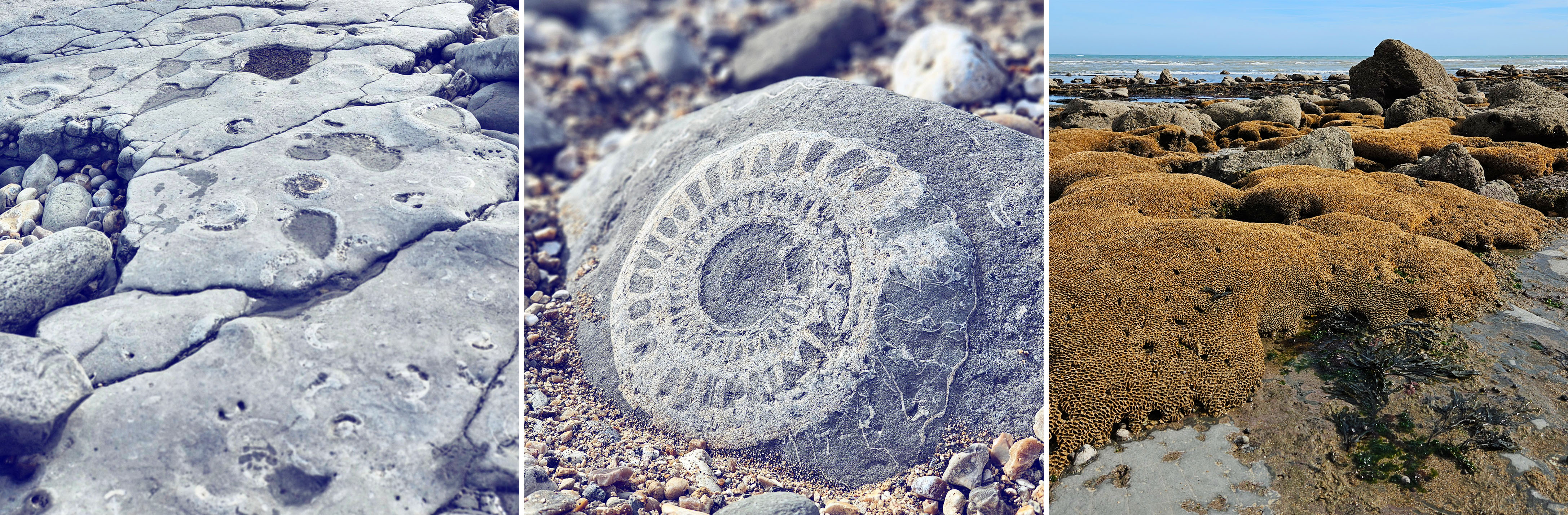
We walked west along the promenade towards the harbour and down to Monmouth beach. It’s a fair walk across pebbles, rocks, and boulders to find the Ammonite Pavement. It erodes more each year, but the pavement is there on a limestone ledge at low tide. Ammonite fossils embedded into the limestone slab from the Late Triassic period. Seeing them and all the large ammonite fossils preserved and imprinted into rocks and boulders was our first moment of Jurassic wonder. The fossils and the swathe of honeycomb tube worm reef were quite a sight to behold!

Ammonite Pavement, Ammonite Rock Fossil, Honeycomb Tube Worms Monmouth Beach © Lisa Shambrook

We booked a local fossil hunting walk with Lyme Regis Museum. We felt the talks beforehand, explaining the history and everything we needed to know about fossil hunting was rather long, but as an autistic person I’d done major research before we went, so I was just raring to go! 

Pavement outside Lyme Regis Museum, Ammonite Fossil on Ammonite Pavement, Lisa and Vince
© Lisa Shambrook

Black Ven beach is to the east of the town and its huge dark cliffs stretch towards Charmouth. The cliffs are limestone and dark shale and reach 130m. Fossils are embedded deep within the cliffs and as they wear away the fossils are released onto the beach. There are regular mudslides and you should keep well away from the cliffs to avoid any sudden movement in them. In the Victorian era the cliffs were used as rubbish dumps and as they’ve eroded the rubbish ends up on the beach too.

We walked from the museum to Black Ven and down the steps to the beach. You aren’t likely to be alone on the beach, you’ll be sharing it with many fossil hunters and the overriding sound, besides waves, is the chink of hammers splitting open large pebbles in the hope of finding an ammonite inside!

Black Ven Beach and Cliffs, Vince, and Victorian finds on the beach © Lisa Shambrook

Most people will find a few fossils, but there are plenty of tips for finding them. It’s good to know what you’re looking for.

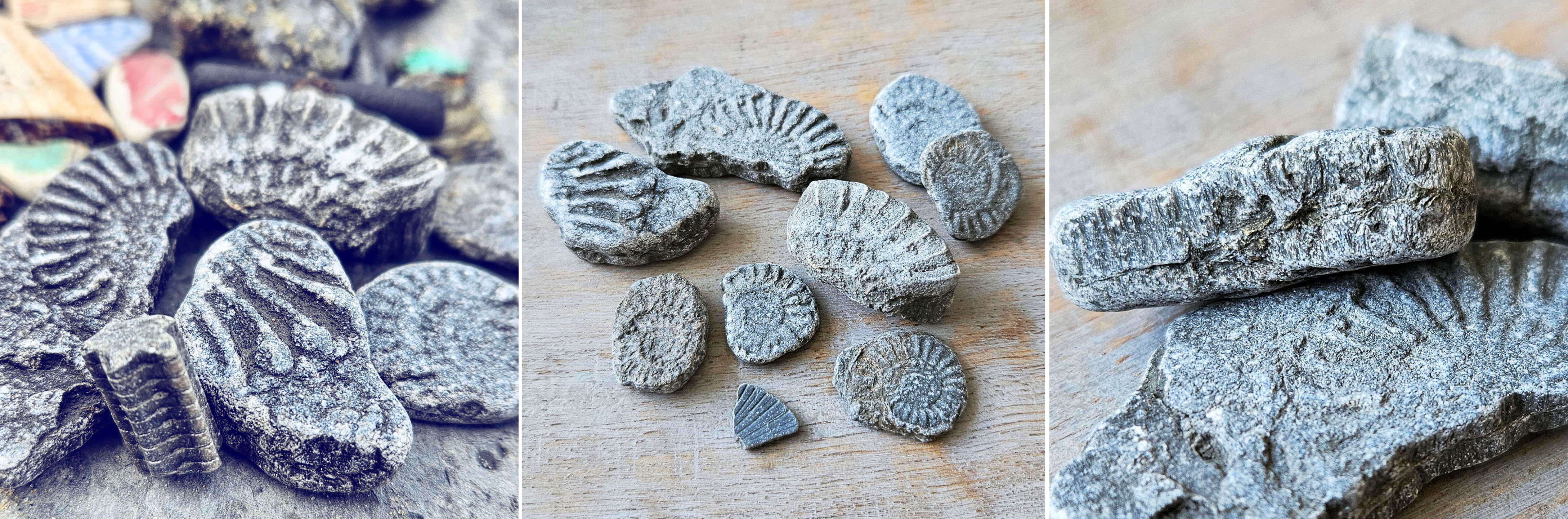
The easiest ammonite fossils to find are beef shale fossils. The stones are grey and thick. Beef shale is the base rock the cliffs are made from and with mudslides and rock falls they are the most obvious fossils. You can find ammonite impressions and fossils in small pieces of beef shale across the beach.

Beef Shale Ammonite Fossils © Lisa Shambrook

Belemnites are the internal part of an extinct squid-like creature. They are bullet-shaped black or grey stones that shouldn’t be too difficult to find. Some are the pointed domed end of the stone, and some look like narrow sticks.

Belemnite Fossils © Lisa Shambrook

Calcite ammonites and ammonite fossils can be found within oval rocks, but most will need to be hammered to chip them open to find them. A round or oval shaped pebble may have an edge that looks a little like a spine, which would tell you there’s likely to be an ammonite inside.

Calcite Ammonite and Rock Fossils © Lisa Shambrook

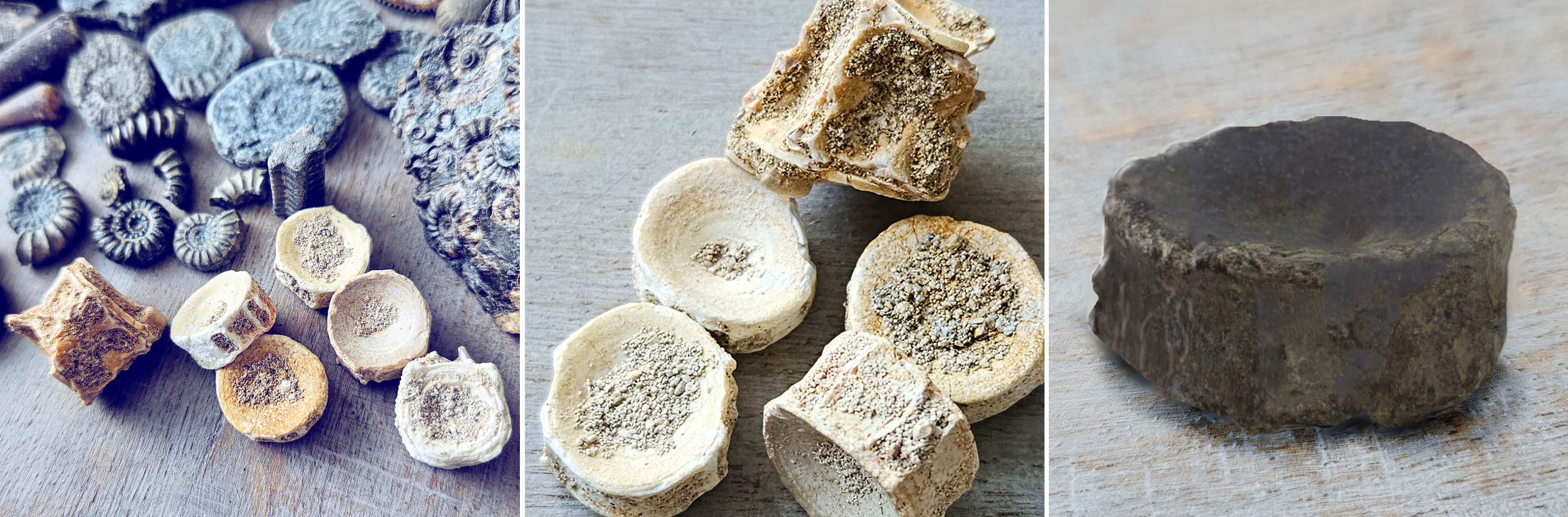
Dinosaur or Plesiosaurus vertebrae can be found as black pebble-like discs, but more difficult to identify if you’re not sure of them.

Dinosaur Vertebrae Fossils © Lisa Shambrook

Pyritised Ammonites are a great find. These are ammonite fossils where their original organic material was slowly replaced by iron pyrite with fossilisation, rather than with calcite or quartz. Beautiful little bronze coloured pyrite ammonites. If you come across pyrite on the beach, small pieces of bronze coloured material, or glittered shale, you could be close to a pyritised ammonite. If you’re lucky you could find an intact ammonite, or you could find part of one. Pretty cool either way!

Pyritised Ammonites and Pyrite © Lisa Shambrook

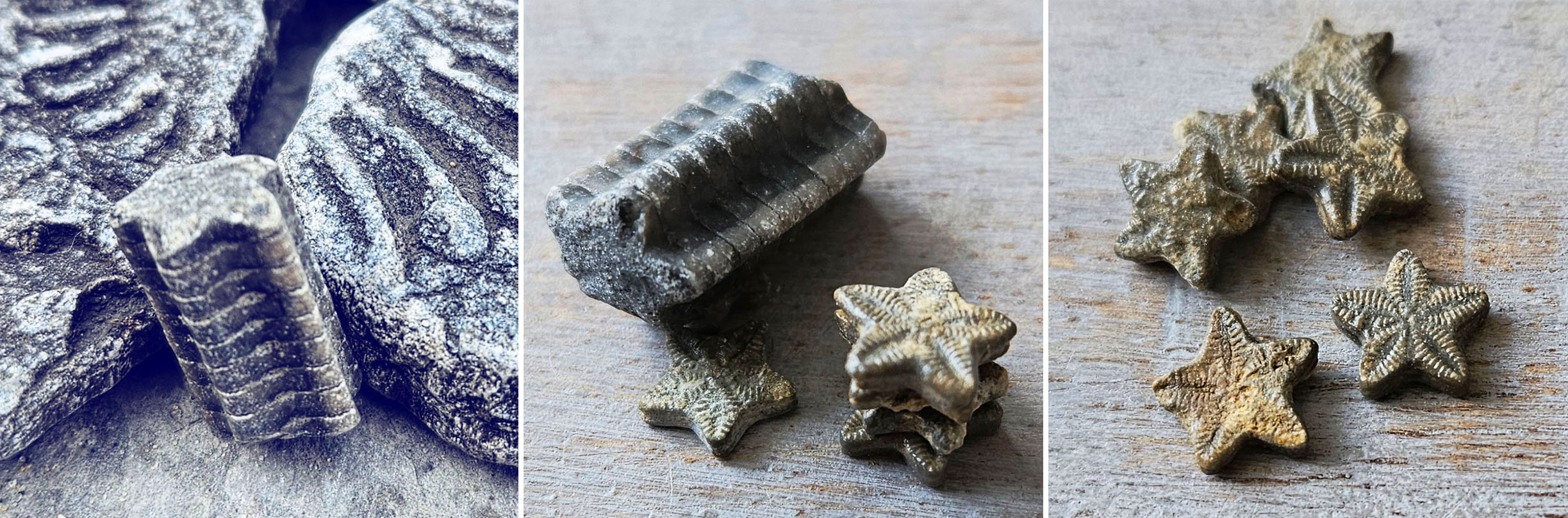
Crinoid stems or stars are the fossils of an extinct sea lily, a sort of biological anemone. It had long stems with fern-like fronds which waved around in the ocean. Some stones are imprinted with the stem and frond fossils, and you can find crinoid stems. The stems are made from segments of star shaped pieces, which can be found as a stack or as single tiny stars.

Crinoid Stem and Stars © Lisa Shambrook

There are plenty more treasure to find, depending on what you call a treasure! You remember that I said the Victorians dumped their rubbish on the cliffs… the beach is strewn with their remnants. Beware that amid the pebbles, sand, and rocks, glass is all across the beach. Most of it is sea washed and has become sea glass, but some sharp pieces still remain. There are huge pieces of metal, piping, springs, broken cogs, equipment, broken china, tiles, bottle tops, Verdigris copper fragments, marbles, toys, and even bullets from the wars to be found or searched through.

Metal, China, Sea Glass © Lisa Shambrook

I found a tiny white china doll, which I later discovered was a Frozen Charlotte, a cheap doll made in the Victorian times. The tiny ones like I found were often placed in puddings or cakes to be found when eaten, a bit like the silver sixpence in a Christmas pudding!

That first afternoon on the beach we spent a lot of time sifting through tiny stones and pebbles with our fingers, and with a piece of piping I’d found. We found beef shale fossils quite easily, and a few belemnites. I found lovely pieces of broken crockery, sea glass, a tiny cog, my frozen charlotte, and a marble. There were lots of pyrite, from the weird bubbly organic pieces which looked like bubbly grey-gold stones, to glittery pyrite. I searched frantically for pyritised ammonites, which was what I wanted to find the most, but I didn’t find any. I really wanted a pyritised ammonite and a crinoid, but as everyone began to leave, I’d not found those.

First Day Fossil Hunting, Frozen Charlotte, Fossilised Gas Bubbles © Lisa Shambrook

I was disappointed, but I also knew that finding anything was a gift, pot-luck really. It was getting late and the tide was coming in when I asked the ocean for one little fossil… I hugged Vince and then looked down and there I saw a crinoid stack. Nine tiny star-shaped segments just sitting against a rock beside us. I was ridiculously happy!

The next day we were due to drive home, but we stayed a little longer and went back to Black Ven. We had to wait while the tide went out. The best time to search for fossils is said to be an hour before and after low tide, when the beach has been churned up with the tide and released new fossils. We were a bit earlier, knowing we had to go home. So, we waited for the tide to move away from the steps to get onto the beach, and then searched. My second haul brought me more shale ammonite fossils, the butt end of a bullet, more china and sea glass, a few more belemnites, tiny fossilised gas bubbles, which look like teeny brown mushrooms, and I finally found my pyritised ammonites! Broken pieces and a couple of full ones.

Second Day Fossil Hunting, Lisa, and Bullet butt © Lisa Shambrook

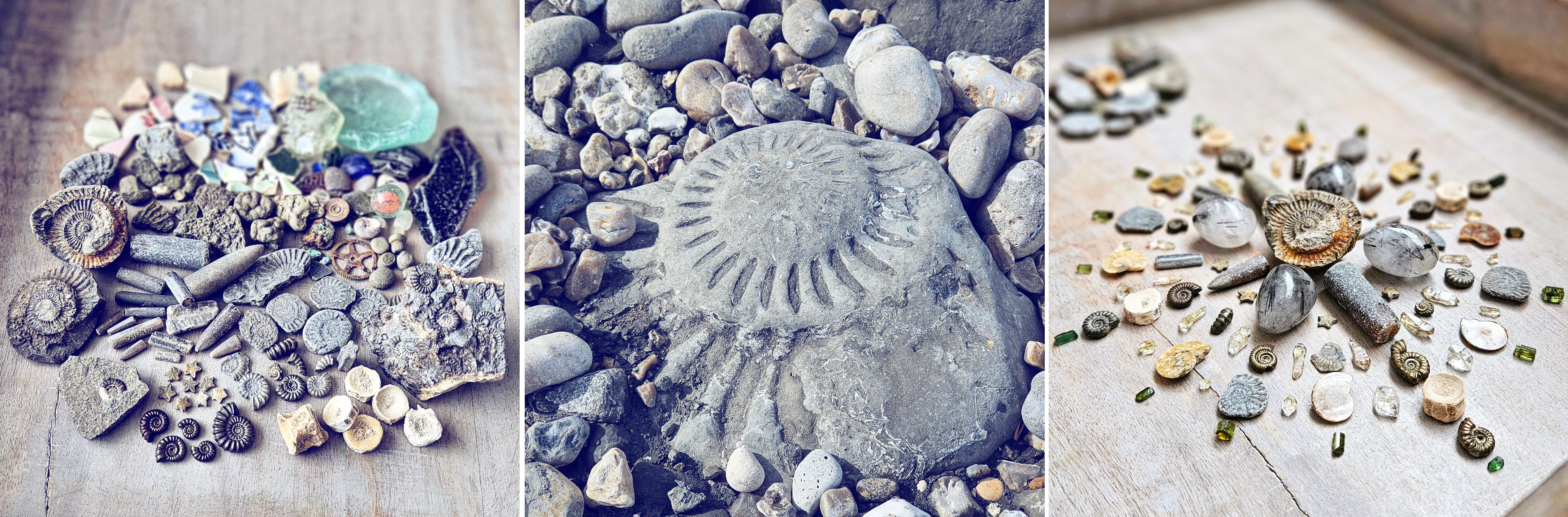
I did buy a few prepared pyritised ammonites, a calcite ammonite, half ammonite pebbles, an ammonite fossilised piece of rock, cream-coloured dinosaur vertebrae, and a few crinoid stars from the local fossil shops. I wanted to make a crystal grid back home with my fossils!

Final Fossil Hunting and Buying Haul, Ammonite Rock Fossil on Monmouth Beach, Crystal Grid made with my fossils for Grounding and a Deep Connection to the Past © Lisa Shambrook

To top it off, the hotel was lovely, and Vince and I had what was probably the most expensive and delicious dinner out we’d ever had! Tom’s in Lyme Regis, we felt very posh! Melt-in-the-mouth Dartmoor steak, potatoes Anna, cavolo nero kale, wild mushrooms, and peppercorn sauce, and then chocolate mousse, honeycomb, and salted caramel. It was stunning, and I really wanted to take a photo of it, but it felt too upmarket to do so, lol! Beautiful drinks too, Hendricks, lemonade, and sliced cucumber, which I loved, and Lyme Regis Gold Cap lager, which Vince enjoyed. We came away just a little drunk and very satisfied!

It was the best weekend in a long time, and we can’t wait to go back.

Lyme Regis caught both our imagination and our hearts.

Our trip to Lyme Regis to fossil hunt © Lisa Shambrook

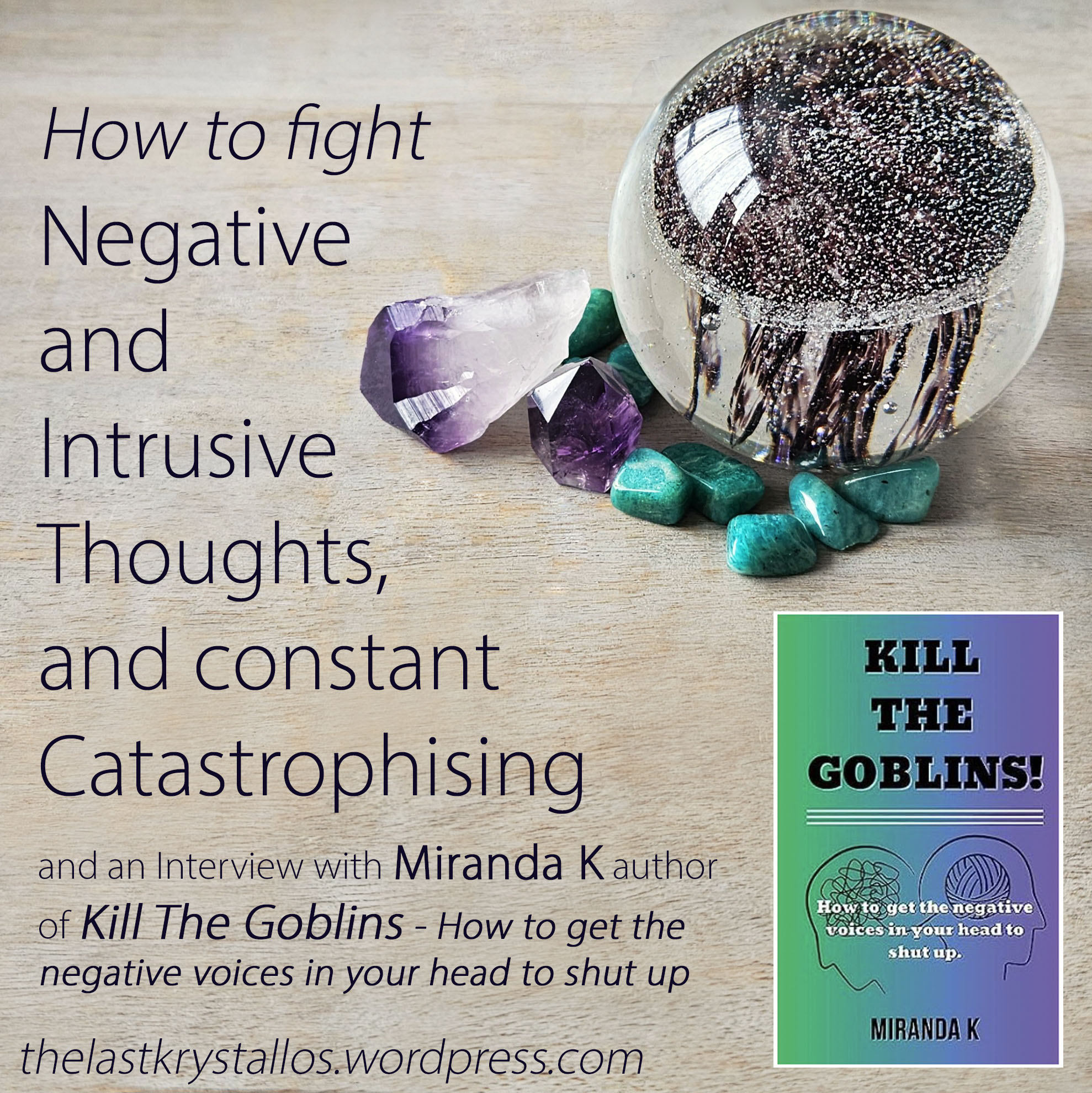
How to Fight Negative and Intrusive Thoughts, and Constant Catastrophising

We are more often frightened than hurt;
and we suffer more from imagination than from reality.
Lucius Annaeus Seneca

How do you escape when intrusive thoughts and catastrophising invade?

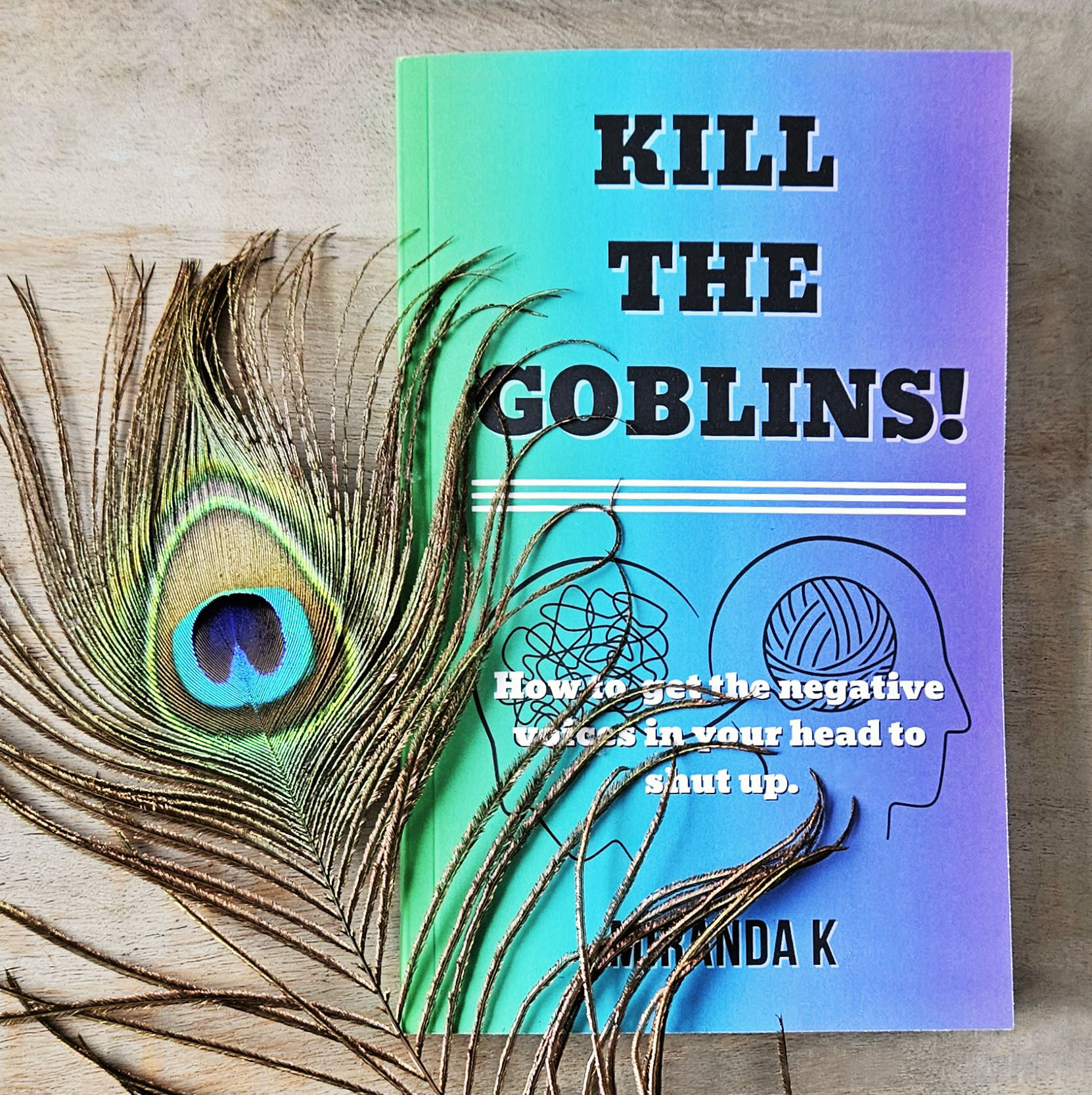
I’m going to talk a bit about negative thoughts and how they affect you, and introduce you to Miranda K’s book Kill The Goblins: How to get the voices in your head to shut up, because I’ve suffered with my brain spiralling out of control since I was a child right through to late adulthood. Only recently have I found ways to combat the goblins, the brain weasels, the spectres, the ghouls, whatever you call them, in my head.

Find Peace © Lisa Shambrook

A study back in 2014 found that 94% of the UK population experienced unwanted and unpleasant thoughts: Did you lock your door when you left the house? What would it feel like to jump from a tall building? But these are passing thoughts that help us to recognise what is and what isn’t dangerous and our appropriate reactions to it. The thoughts in themselves are not the issue, they’re natural, it’s how you react to them that becomes the problem.

More serious negative thoughts can be a symptom of mental health conditions, most commonly Obsessive Compulsive Disorder (OCD) and Generalised Anxiety Disorder (GAD). People suffering with OCD and anxiety can question these thoughts, believing them or letting them lead to unhealthy urges or habits, which in turn steer them to more intrusive thoughts or catastrophising.  

Fear © Lisa Shambrook

I was an introverted child with deep, imaginative, and invasive thoughts. At fourteen, I was repressed, had trauma, and had developed control-based disordered eating and self-harm. Intrusive thoughts were just part of me. I was that person who lay in bed, wide-eyed in the dark, unable to turn off my brain. Thoughts to self-harm, both physically and mentally, were already ingrained as was a great deal of fear. As an undiagnosed autistic I struggled with taking information at face value and being unable to read between the lines.

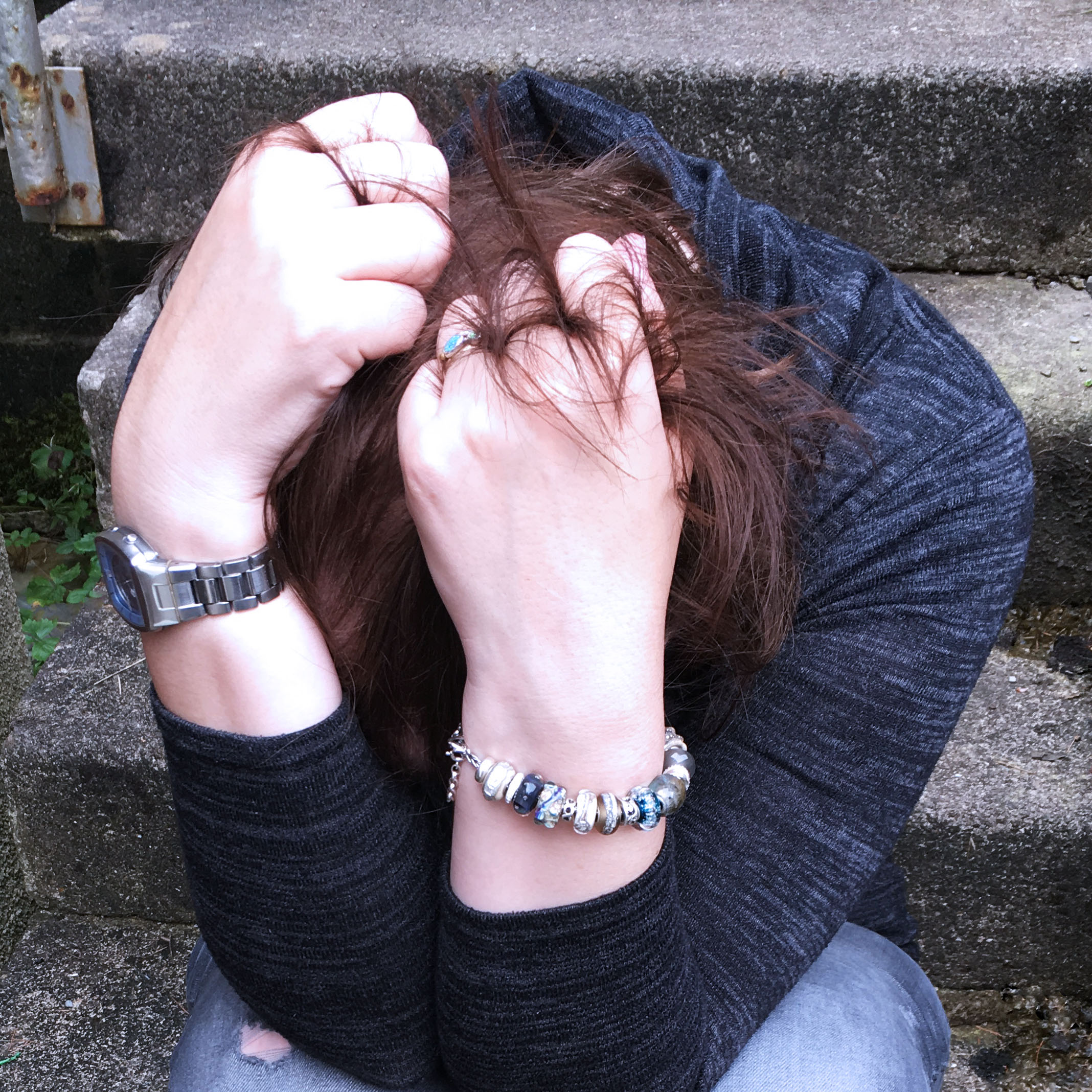
As a child and a teen I was a worrier, and then later I understood that most of my issues were with catastrophising. Fear of what could happen spiralling out of control in my mind.

Worst case scenario © Lisa Shambrook

This is just an example of one of my catastrophising episodes:
‘When my husband got a motorbike, years ago, there was always a risk he might have an accident, and most people would accept that and get on with their lives. Not me. When he left for the three mile journey to work at 6am, I would lay awake listening to his bike start up and move down the road. I could hear it turn the corner at the roundabout and then fade away. Instead of going back to sleep, I’d visualise his journey in my head. I’d see the next roundabout, then the next, then the stretch of bypass… and so on until he arrived at work ready to take his bus out.

But it wouldn’t end there. My brain would rewind and wonder if he’d actually made it to work. Somewhere along the route a lorry might have clipped the bike. My brain would show him mangled beneath it. Blue lights for an ambulance and blue lights for police at my door. Being told he was dead. I’d go through telling my kids, his family. I’d then go through the process of arranging a funeral, trying to work out what I’d live on. And by the time my brain had stopped with this charade I was a single parent, with no means to live and nothing to live for.’

Catastrophising, along with intrusive thoughts, is a poison.

Crystal Grid for Healing and Protection © Lisa Shambrook

Even as far as six or seven years ago I didn’t know much about catastrophising. My friend, Miranda, and I had often talked about mental health issues, and helped each other with what we knew. Miranda had a history of trauma, and a better understanding of negative thoughts and their consequences than I did. We talked a lot, and she helped me learn to understand catastrophising.

In 2019 I asked for referral for CBT to help with my excessive anxiety and catastrophising. I got referred to Integrated Psychological Therapies Services, who told me that everyone has and gets through negative thoughts. It didn’t matter how serious my thoughts were, that they also included self-harm and suicidal ideation, there was no help available.

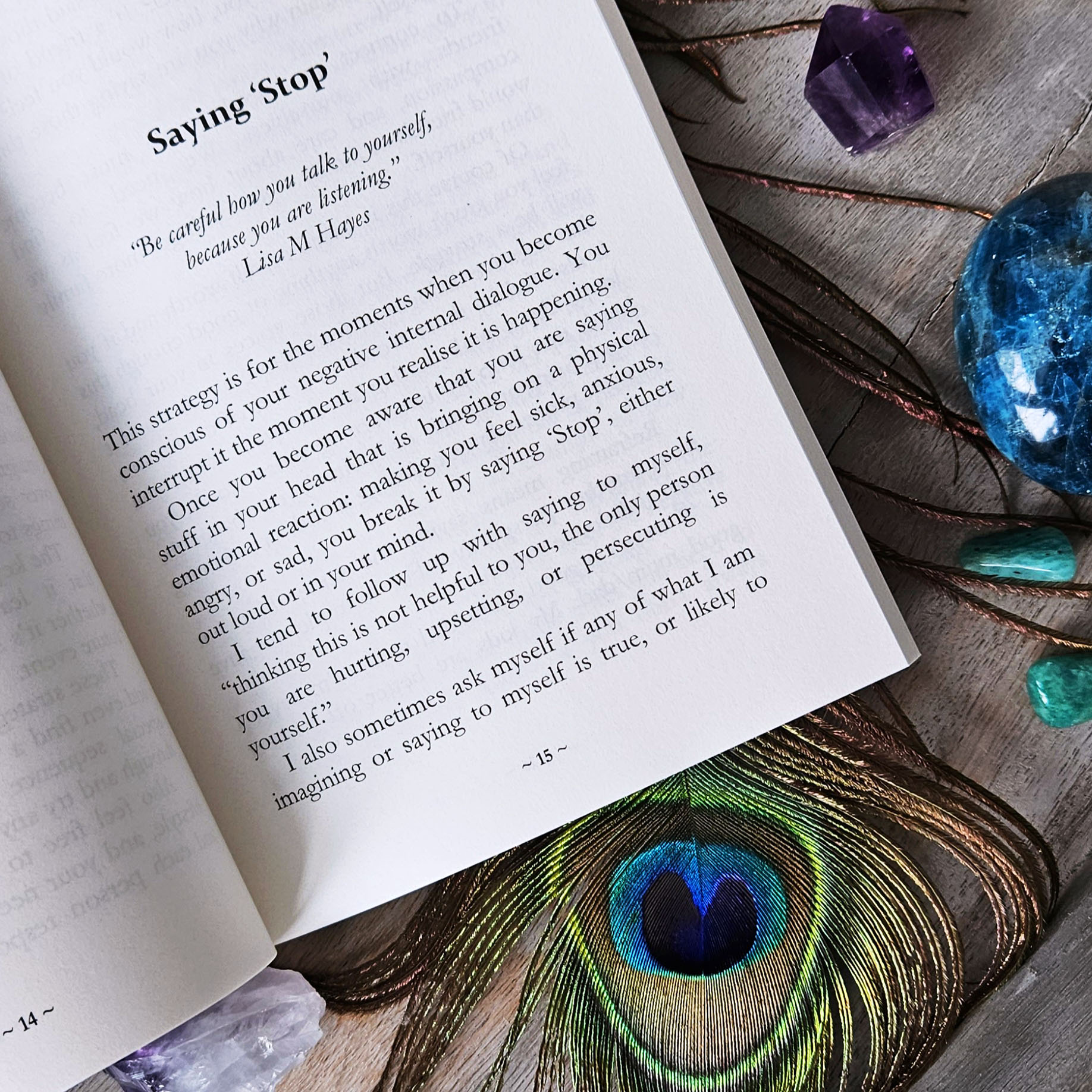
Saying Stop © Lisa Shambrook

I used a few of Miranda’s ideas and by the time I got a great counsellor, a year later, I’d learned to control a fair bit of my intrusive thoughts and catastrophising. My counsellor was impressed with how well I’d done in such a short amount of time. Along with medication, those tools changed my life.

I learned to recognise catastrophising and say ‘Stop!’, and then rewind what my brain was telling me, forcing it to play out in a normal way instead. So, with my husband and his motorbike journey to work, it would stop at arriving at work and his getting on with his day. The idea being that every time I began to catastrophise I would change the story so it would eventually become a non-story, and it would stop. This was my most effective tool and I’ve used it on all my negative and intrusive thoughts.

Kill The Goblins by Miranda K © Lisa Shambrook

Miranda recently wrote a self-help book on this very subject: Kill The Goblins: How to get the voices in your head to shut up. It’s very accessible, written in a way to help you work out for yourself what will work best for your negative thoughts.

I decided to talk to Miranda and ask about how she chose to write this book:

Miranda K © Miranda

I asked Miranda, who usually writes fiction with a good dose of horror or fantasy, what made her decide to write a self-help book, and why focus on negative thoughts?

There’s a lot to unpack there, so I’ll take it piece by piece. I’ve been an avid reader of self-help books most of my life, because I suffered a difficult and abusive childhood. I’m constantly working on healing the damage done to me and recovering myself. Writing fiction helps me escape from and also process some of the trauma, especially in my darker writing. It helps me put into words or in stories how it made me feel, and enables me to express feelings I wasn’t allowed to express as a child.

There is often a discussion about why people write horror or fantasy – or mix them together like me – and whether it relates to mental health. I actually wrote an article about this for a Horror review site called Ginger Nuts of Horror, and explained what led me to writing horror, and how it relates to my childhood, and why it is still my go-to genre as a reader. Find article here.

In terms of what made me decide to write my own self-help book, and why negative thoughts, the worst and most insidious part of the abuse I suffered was the verbal abuse which shows up later in life as negative self-talk in daily life – you basically replay all the awful things that were said to you, but in your own voice. Since I first went into therapy in my early twenties, initially due to daily panic attacks, I have been working to understand the patterns of behaviours and responses it has created for me, and retrain them. And during a breakdown in 2008 I was completely overrun with paranoid thoughts which led into suicidal ideation, although throughout I was conscious that it was how I was thinking, and I just needed to find someone who could help me change them. So I went into therapy and over six years of therapy developed the tools to do that and completely rebuild myself.

And now more than ten years on, I feel I’m on the other side of what I refer to as ‘the wall’, and realise I am not alone in having to be vigilant with my thoughts on a daily basis, several people around me also struggle, so after offering a few strategies I realised I had a lot of helpful knowledge, and decided this was what I needed to write about. And coupled with losing my mother in early 2021, I felt it was time I could finally share this with a wider more public audience.

Goblins © Lisa Shambrook

Your book is called Kill The Goblins, how did you come up with the idea of using Goblins to personify negative thoughts?

Even though I make sure not to touch on any esoteric or ‘woo-woo’ in this book, I do dabble myself, and started using the term Goblins after reading a particular card in a set by Colette Baron-Reid called the Oracle Map. Card number 5 described them perfectly:

“Goblins are born when you’re wounded and something essential is lost in that experience. From that point on, as you forget your wholeness, they remain with you in the shadows. There they remind you of what brought them into being, by mimicking your own voice, tricking you into believing that you’re unworthy, victimised, or unlovable.”

I felt this encapsulated the mental image of the negative voices in my head, and how they left me feeling. And when others were coining phrases for the voices in their heads, this is the one I settled on. It also helps with the analogy throughout the book of how to go about killing them and stop feeding them.

That’s a briliant way to look at these kinds of thoughts. I’ve gone through major issues with catastrophising and intrusive thoughts myself, and when I read Kill The Goblins several of your coping methods were things I’ve actually used to combat my own mind’s negativity. You’ve utilised a great layout and accessibility to ideas and helps in the book – how did you decide what to include?

I brainstormed the ideas with a friend and wrote a list of all the strategies I had employed, and some of the more common ones. And as I was writing the book more appeared. I even found myself explaining to another friend how to prioritise and realised that was another one, and just kept adding to it until I had enough. I think it came out at around seventeen in the end.

I also touch on overused strategies, and some strategies that I hear people use but that aren’t necessary good in the long term, like demonising a part of yourself, and of course toxic positivity. 

In terms of the layout, having read a lot of self-help books, I knew I wanted to cut out a lot of waffle and just get right down to the actual strategies, so the reader doesn’t have to try read between the lines to understand what to do. And a lot of people pick up and dip into self-help books, rather than read them cover to cover, so I wanted to make it accessible that way too.

Not everyone wants to get in depth about the whys and wherefores either, so I separated out the further discussion for later in the book. Chapter headings are very important to help the reader access the necessary information quickly too.

Look for positivity © Lisa Shambrook

I know you’re very good with affirmations, how important is self-belief and positivity in your life?

I don’t know that I’m great at actively using affirmations, but what you think and say to yourself on a regular basis will affect your mood, your perspective and how you receive everything around you. We look through a lens that is tainted by our thoughts and feelings, so we always need to consider how we are tainting that lens – what we are saying to ourselves. So, finding words that support and help you on a daily basis, for me personally, are imperative.

I wouldn’t describe myself as a positive person per se, I’m a realist, often a sceptic, who will tend towards the negative, so I do have to work to keep an open and balanced mood and outlook. But over the last couple of years, I’ve found that when I do find myself giving a negative mental response to something external, I now have this other voice saying, but that’s not really fair, is it? And it offers a lighter, more positive outlook. I consider this to be a result of training myself out of the negative perspective point all the time, and consistently trying to look at myself and my life through a positive lens.

Self-belief has to be a constant for me. If I don’t believe in myself, no one else will – because there is literally no one else in my life supporting me emotionally. That has been a huge learning curve for me in recent years. And I have to believe in whatever it is I am working on, or I lose all interest and will end up resenting it. Supporting myself by being more ‘heart-centric’ has been a bit of a game changer. I now check in with how I feel about things, and ask myself if what I am doing is what I want to be doing. It also then changes my mood, because my outlook changes and I can be more positive.

So it’s sort of swings and roundabouts, but one feeds the other, like the snake eating its own tail.

What are your writing plans now? Will you extend your self-help work, or focus on fiction, or both?

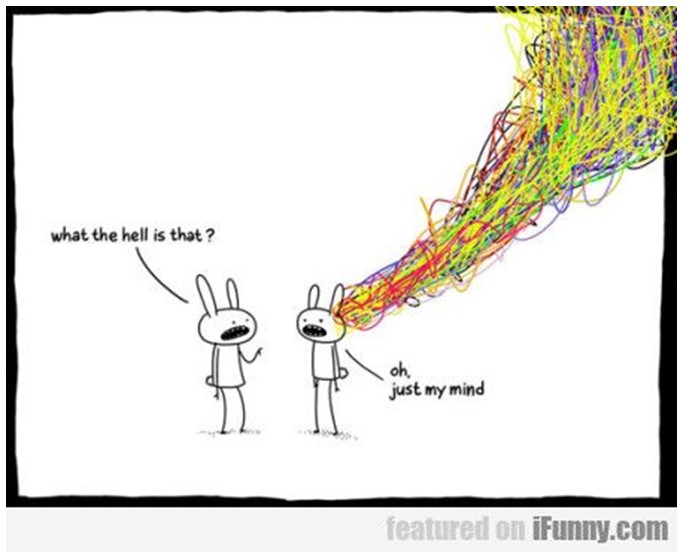
I will be doing both! I am that meme with a load of noise spewing out the back of my head! My head is overrun with ideas, but for the self-help specifically I have two more books planned: one on anger and one on anxiety. I don’t have a timeline yet, but they will be produced in that order. They are both HUGE topics, and ones I have experienced, so I am sort of gestating on what strategies I use (if any) and how I can put it across in a book format to be helpful in the moment.

I also want to develop a course for people, but I am still honing in on exactly what the course would be about and how it will help people.

As for fiction: I’m writing the third book in a dark paranormal trilogy at the moment, I have a psych thriller waiting in the wings, an occult horror also vying for attention, and then I’ll be coming back round for another trilogy or series in the same world I am currently writing in! Phew! And who knows what might pop up in between! All part of a writer’s life.

Thank you, Miranda, I’m trying to keep a positive outlook too, working on keeping the negative thoughts quiet and offering myself a good supply of encouragment! It really helps.

I’ll add links at the end of this post for Miranda’s book and websites.

This book is a must-read for those who are struggling with negative and intrusive thoughts that spiral into a mess. It can also help those with anxiety and panic, as some of the ideas and tools can definitely be used to combat many other issues.

Several parts of her book have really helped me, including a section on reconnecting with what you’re feeling rather than what your thoughts are telling you, and having firm boundaries. I’ve been through religious trauma and sexual assault, and sometimes my fears and thoughts have been connected to those. Learning to allow myself to feel my emotions and listen to them, and how to eliminate guilt, has let me work out where some of my negative thoughts came from. This has allowed me to tackle them head on and to build a framework to work with.

Toxic Positivity © Lisa Shambrook

I’ve also been able to understand that sometimes the thoughts aren’t just in my head, but society has chattering goblins all over the place, trying to shape us, condition us, and to climb into our heads! Being able to feel our own emotions, our own truths, and see the negativity and toxicity for what it is, and to set boundaries that are healthy is how we throw them back out and eradicate them. I realised I had the power to step away from some of my fear and hurt, and to shake it off.

Toxic positivity was also a chapter that revealed a lot to me. When people drain you with toxic positivity you doubt yourself, you lose self-worth, and your fears and negativity grow. Seriously, this book has helped me a great deal, even after counselling. I love my own personal power and the freedom it gives me to trust my own feelings, give them voice, and reconnect to them.

There are healthy ways to deal with negative contemplations, catastrophising, intrusive spirals, and trauma. If you can find a good counsellor, I recommend that, but as waiting lists are so long, Miranda’s book is a great place to start.

Have you had to deal with these issues? What helped you?

Links for Miranda K and Kill The Goblins: How to get the voices in your head to shut up –

Linktree for Miranda K

Linktree for my fiction, Miranda Kate

Link to buy: Kill The Goblins: How to get the voices in your head to shut up – Available across all platforms and this is the best link to find them all.

Rayncloud Art and Squidge the Frog Kickstarter

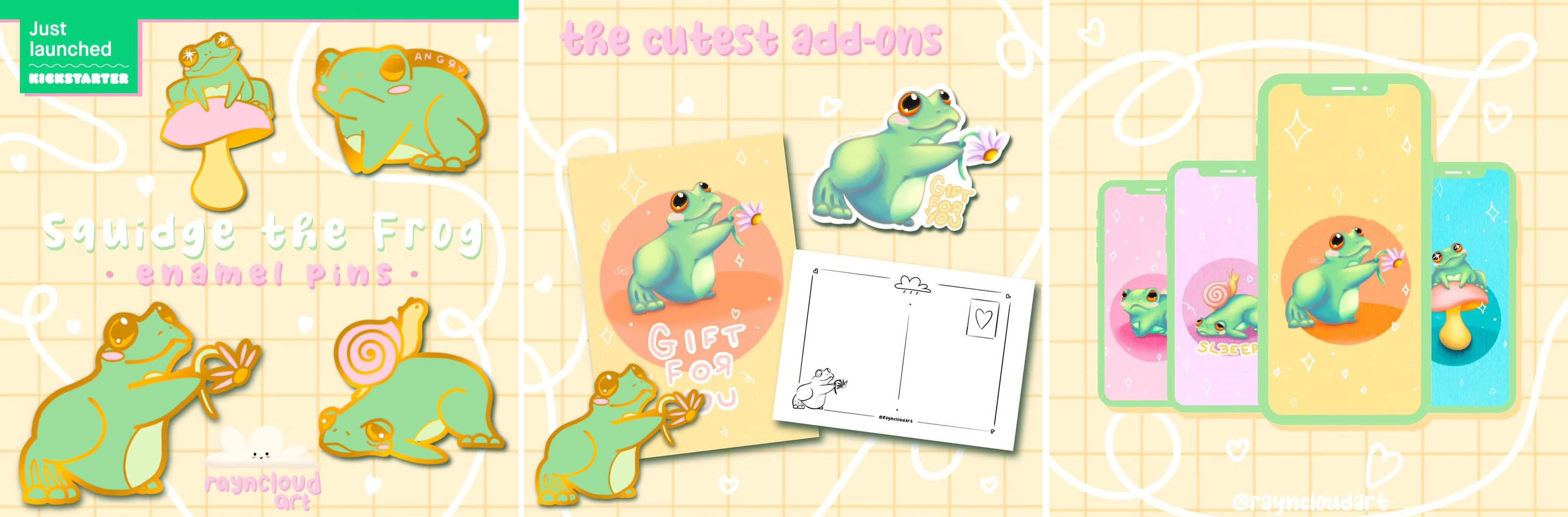
If you love cute frogs and enamel pins then Rayncloud Art’s Kickstarter is for you!

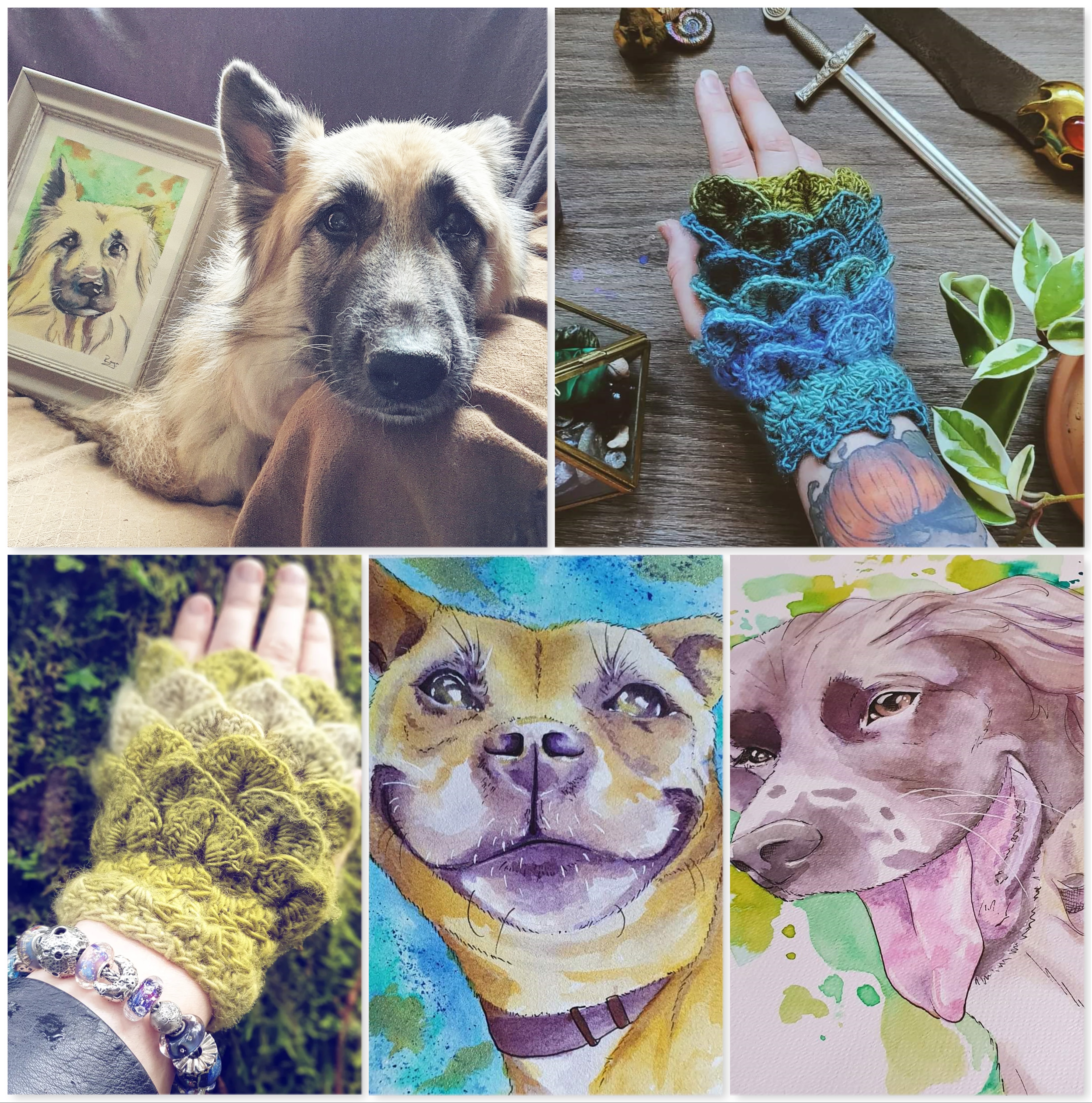
I recently backed Rayncloud Art’s new Kickstarter, and it’s so exciting I want to share it with you! Rayn is an independent artist with a track record of some great art and new ideas. Rayn is autistic and struggles with tics but doesn’t let it stop their art. One of the only things that helps calm their tics is working with their creativity. Rayn started out as a traditional artist, using watercolours, acrylics, and oils, and has recently moved into digital art. They mix crochet and much more into their brand too, creating an eclectic fusion of wonderful art.

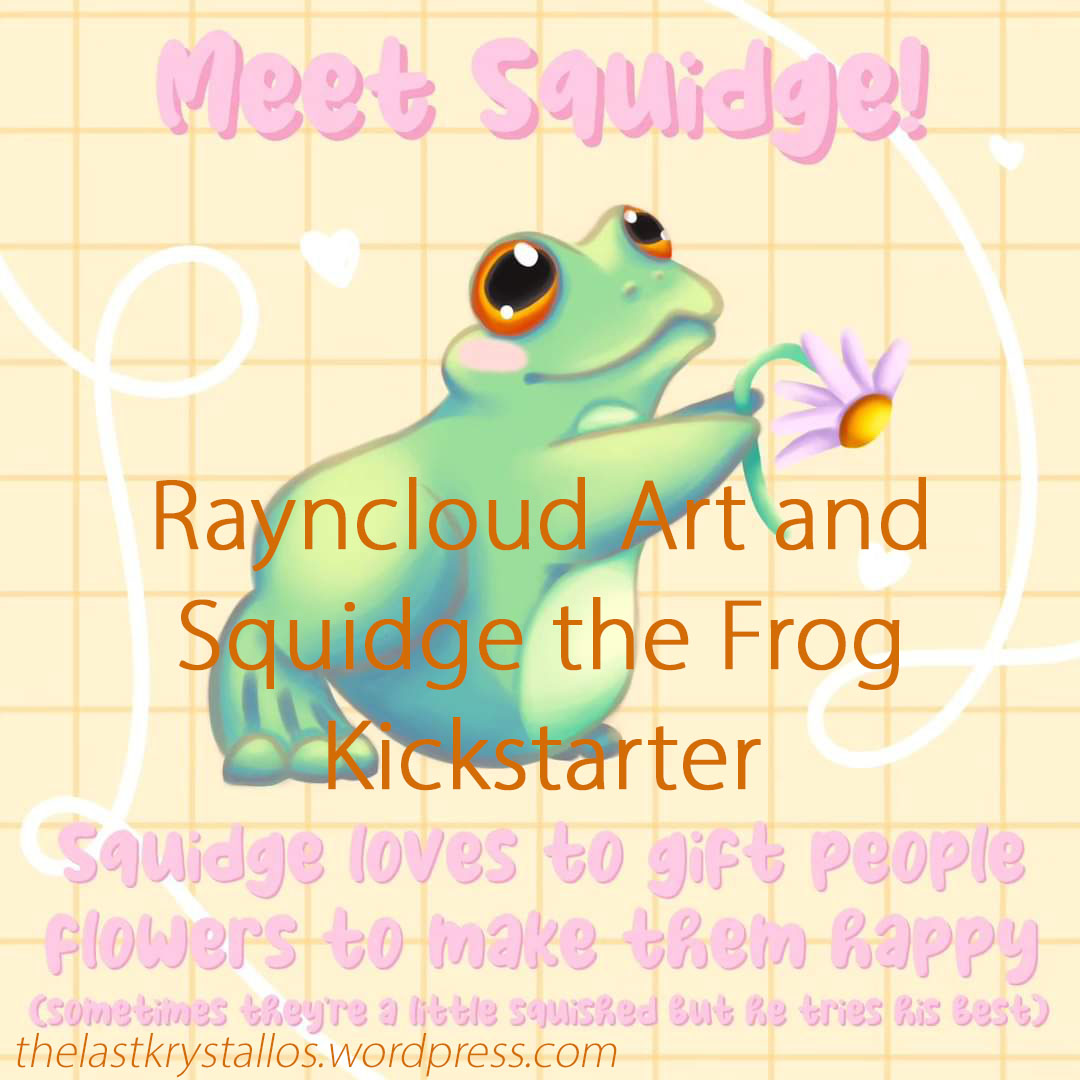
Rayn and Squidge the Frog © Rayn Shambrook

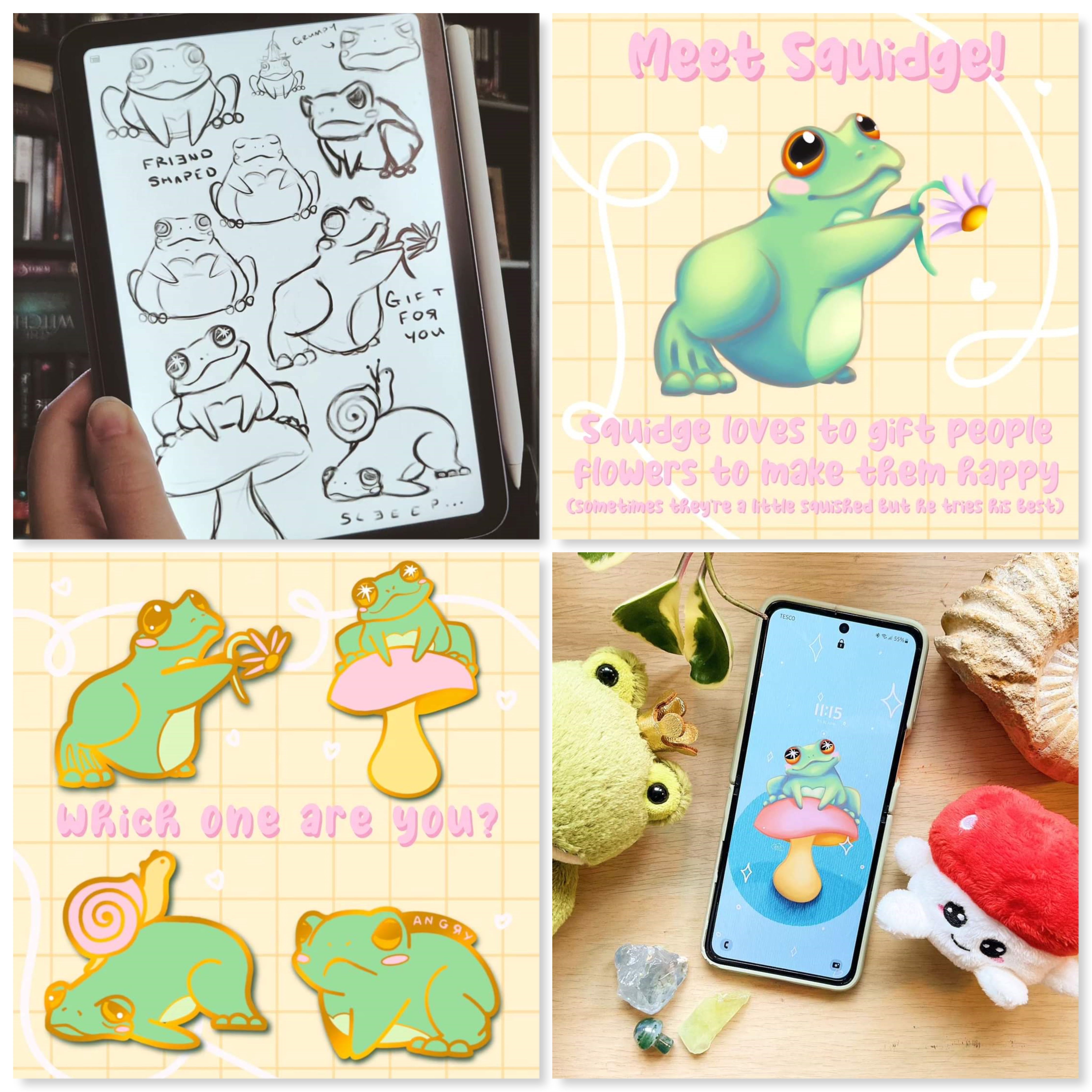
One of Rayn’s digital creations is Squidge the Frog, the cutest little frog, and they designed a set of enamel pins, stickers, postcards, and phone wallpapers based on him. With encouragement from fans Rayn decided to plan a Kickstarter to finance the pins.

Rayn’s Kickstarter kicked off a couple of weeks ago with a Squidge the Frog Flower pin, and, very quickly, successfully reached their target! If the Kickstarter grows and people continue backing it new enamel pin designs will be added. The next one is Squidge Mushroom pin, and there are two further designs if pledges rise!

Squidge the Frog © Rayn Shambrook

I backed this project, and can’t wait to get my pins!

Seriously, if you love frogs you should back this Kickstarter, and if you know anyone who collects cute pins, or adores frogs, then share the Kickstarter with them too!

Let’s see if we can unlock the next frog pin!

Squidge add-ons © Rayn Shambrook

I asked Rayn about their art and what led to this venture:

Tell me a little about your art and recent change of style from painting to digital art…

I’ve loved art since I can remember but I only recently took the plunge into trying out digital art. I’ve spent years playing with different traditional mediums finally settling on Watercolour as my favoured medium but I’d always wanted to try digital art. I tried it a tiny bit as a young teen but I didn’t have the right equipment and consumer technology for digital art just wasn’t as affordable and accessible as it is now. I tried out digital art for the first time at the end of 2022 and I fell in love with it. It took away one of the biggest barriers for me when it came to creating art which was the energy needed to set up before painting and to clean up after. All of a sudden I could paint on a whim even with very little energy. I would honestly consider it life changing!

What’s your favourite subject to paint/draw?

I think my favourite subject to draw will always be people and portraits. I love the depth and detail in them, the way that one tiny line can change a whole expression. But I also love working in a more illustrative style and with that I love drawing animals! Animals are one of my autistic special interests so I love taking the time to research and make sure I include important features in these more simplistic illustrations, like gills on a shark, or the horizontal pupils of a frog.

Digital Art Prints © Rayn Shambrook

Congratulations on your Kickstarter and reaching your first funding goal! Why frogs?

Thank you! I’m so happy about how well it’s going (I was so nervous that it would be a massive flop!)

It had to be frogs! I love frogs, I think theyre both strange looking and absolutely adorable! I also have a frog so I had to honour my boy Odo and make frogs my first pins.

Squidge the Frog has been in my art for perhaps longer than a lot of people realise, he’s been through a few changes.

Where would you like to take your art from here? More pins?

I definitely want to work on more pins, more of Squidge the Frog and also some other characters! (Members of my Ko-Fi will have seen the latest I’m working on.)

I want to work on more as well, I’m thinking keychains, washi tapes, maybe even tote bags or t-shirts!

Pet Portraits and Dragonscale Gloves © Rayn Shambrook

I’ve seen, and bought, some of your crochet, I adore my fingerless dragonscale gloves, do you enjoy expanding to other creative projects as well as painting and digital art?

I love letting my creativity run wild, crochet is a skill I’m so grateful to have learned and I’m working on some cute plushie keychains that are coming real soon to my shop.

I want to try polymer clay at some point too, just got to save for the equipment first!

I also love helping other people to learn new things too which is why I make YouTube videos.

You can find Rayn’s Kickstarter YouTube video here and follow their You Tube channel here.

Rayncloud Art and plushies © Rayn Shambrook

So, go and check out Squidge the Frog Kickstarter and see if you’re
interested in your own pin, and don’t forget all the lovely add-ons!

Go Squidge!

The Antidepressant Story – Panorama, and Me

Panorama shows the lack of available information on antidepressants
and it’s vital we become as informed as we can
 to tackle the rise of depression in our society.

The recent BBCOne Panorama episode The Antidepressant Story was an interesting watch (you can find it on iPlayer). It told of the progress and changes in the antidepressant industry, and the secretive nature of the pharmacological companies producing them. Most of the information wasn’t a surprise to me as my Dad had been addicted to little blue pills, probably diazepam, which were prescribed for his debilitating arthritis when I was small. He had given them up cold turkey and gone through a horrific time resulting in him avoiding drugs, even paracetamol, for the rest of his life.  I already understood that drugs forty or fifty years ago like Benzodiazepines, which had been prescribed for anxiety and other mental health issues, were highly addictive, but the pharmacological companies developing them tried to keep that fact hidden. They were times when antidepressants weren’t prescribed very often for fear of addiction. Then the new wave of SSRI’s (Selective serotonin reuptake inhibitors) came out, which currently include Fluoxetine, Paroxetine, Citalopram, Escitalopram, and Sertraline. These were not thought to be habit forming, as previous addictive medications were.

Antidepressants © Lisa Shambrook

Panorama talked about a lack of trials regarding withdrawal and long term usage. The longer you are on an antidepressant the more at risk you are of a higher level of withdrawal symptoms when you cease to use them. Drug companies were and are well aware of the problematic withdrawal symptoms, but certainly in the 1990’s avoided clarifying this information. Professor Rosenbaum, on Panorama, followed his patients who were coming off a new drug Venlafaxine, to see what their withdrawal symptoms were (I didn’t catch the date of his research). He found that 78% of those who’d taken the drug for 8 weeks suffered some sort of withdrawal. Venlafaxine is a much newer antidepressant, of the SNRI (Serotonin and norepinephrine reuptake inhibitors) class, including Duloxetine and Venlafaxine, that were designed to be more effective than SSRI’s, though studies are debatable. Neither pharmacological companies nor the medical profession in that time were keen on withdrawal being focused on.

Chained door © Lisa Shambrook

The programme concentrated deeply on the lack of information about withdrawal, despite all medical advice being that no antidepressant should be stopped quickly, and cessation should be in conjunction with your doctor. Panorama talked about people coming of antidepressants without understanding the withdrawal process or symptoms, and the lack of information from GP’s or prescribers.

Panorama noted that when patients used to come off antidepressants over a short period of time, just a few weeks, they almost always suffered symptoms that mirrored their previous depression, and they were put back on them, because they were often told they were relapsing.

Lisa © Lisa Shambrook

I understand this because in my experience of trying to tackle my own chronic depression, diagnosed at age 18, I was pretty much only ever offered antidepressants as a solution. Very often doctors had a short consultation time with me, much taken up with me explaining how I felt, before offering antidepressants. There just wasn’t enough time to talk about the side effects of starting or finishing them. I was often told it would take a few weeks to get used to the drug and to come back in a month to see how they were working. The second consultation was usually just to be sure they were okay and leaving the course open to however long I needed them, with a precursor to go back when I wanted to come off them and to do it slowly. The early years of taking antidepressants meant going back to my GP, reducing the dose by about half for a couple of weeks, then half again, then finish a month or two later, so about three months to finish. 

When Panorama noted that 2018 was the date when tapering became a public debate and the norm to come off antidepressants I was surprised because I’d always been advised to taper. I usually took 9 month courses, of which 3 months were tapering to stop them. It does, perhaps, demonstrate the issue of differing standards and knowledge amongst the medical profession. Though looking at the NHS Stopping or coming off antidepressants site, advising only 4 weeks or more, seems very ill advised and out dated. People interviewed on Panorama talked about taking years to withdraw safely.

The NHS site also is very vague about the symptoms of withdrawal, listing just a few, when I could list double that for several of my own withdrawals. It took until 2019 before some withdrawal side effects were accepted and included on the official side effects on medication leaflets.

Venlafaxine © Lisa Shambrook

 Pharmacological companies making the pills also make withdrawal more difficult by only producing a few different sized doses, for example Venlafaxine, which I take, is available in 25 mg; 50 mg; 75 mg; 100 mg; 37.5 mg; 150 mg; 225 mg; 112.5 mg doses. But recommended advice for withdrawal is to reduce the dose by 10mg each time, which is impossible with these tablet or capsule sizes. They also say they recommend tablets to be taken whole and not cut in half or crushed. I’ve always cut my tablets to reduce dosage, in half and in quarters. These companies need to think more about how patients will come off these medications, but that’s unlikely because in general their only interest is getting people on them rather than off them.

Often people who are depressed will grab at anything that promises to help and to lift them out of their condition. As with all medication patients need to know the details, the benefits and the risks. We’ve all looked at the long folded paper-thin leaflet inside a box of medicationPatient Package InsertMedication GuideInstructions for Use – but how many people read it all, or read beyond the dosage requirements? Patients need to know full side effects of using or starting a drug, and they need to know how to come off them and if there is likely to be a withdrawal period and symptoms.

Patient leaflet © Lisa Shambrook

The programme showed that a substantial number of people have been and are badly let down regarding antidepressants and their side effects or withdrawal symptoms.

Current statistics, according to Panorama, say that 23% of women in England are taking antidepressants and more than 8 million people in England use them. They are prescribed for many conditions including chronic pain and OCD, and more than 2 million people have been taking them for five years or longer. Over 100 million prescriptions were written for antidepressants in the UK in 2021. 1 in 7 people take them, so it’s vital we understand the risks and side effects.

Depression © Rayn Shambrook

Panorama continued with questions regarding the effectiveness of antidepressants. Control studies and clinical trials have shown similar results of the effectiveness between antidepressants and placebos, some studies showing only a 15% difference between the two in favour of the actual drug. To me this shows an interesting correlation between psychosomatic results and active chemical ones. But this is because every person responds differently to treatment, some don’t respond to antidepressants and some have major improvements, there is not a one-size-fits-all. It is said that for adults with more severe depression antidepressants remain an important treatment and can be lifesaving. These days, Panorama tells us, doctors are not supposed to prescribe antidepressants for mild depression unless a patient requests them. However, the lack of availability for any other ready treatment leaves that down to the individual GP or prescriber. I tried for years to get counselling on the NHS without luck. I took private counselling, until recently when I did see NHS counsellors, but waiting lists for other mental health treatment are huge and frustrating.

Antidepressants © Lisa Shambrook

During the last thirty-three years on and off antidepressants, I found I was prescribed antidepressants as a first choice. Even when I asked for counselling, or other options, antidepressants were the first port of call. I was prescribed Fluoxetine at 18 years-old, Escitalopram at 33, then Cipralex when I was 37 and Citalopram at 40. I was given Amytriptyline when I was 43 for anxiety and panic, and Sertraline when I was 45. I was prescribed Sertraline after a psychotic episode that I wasn’t sure I’d return home from. I tried to taper off after seven months without success. I continued taking this one for much longer than any other antidepressant I’d been on. I’d managed to take the others for six months then take three months to taper off them. I was offered Duloxetine some months after I came off Sertraline at 47, but it caused me excessive vomiting, so I decided to try without antidepressants while I waited for an Autism assessment.

At 50-years-old I was diagnosed as Autistic and finally understood much more of my own mental health history. It was mentioned by my assessor that many of my episodes of depression, diagnosed as Clinical Depression when I was 18, were more likely to be episodes of severe autistic overwhelm, burnout, and shutdown. These may well have been times when antidepressants may not have been appropriate. Each short term course I took made me feel like a zombie, sleeping a lot, closing me down, and numbing my mind and emotions. My children and family found it difficult to see me like that. I thought they were helping me, maybe they did, but maybe if I’d known I was autistic and allowed myself to unmask and be myself, I’d not have needed them. No medical professional ever looked further than depression, despite much of my symptoms being severe anxiety and panic, sensory sensitivities, and more rather than typical depression symptoms. Autistic people often find it difficult to put their feelings and thoughts into physical spoken words to describe their situation to a doctor.

Venlafaxine © Lisa Shambrook

I have recently, at 51, been prescribed Venlafaxine for anxiety and panic. I was drowning in catastrophising and intrusive thoughts. I can only describe myself as having been incredibly highly strung, going into overwhelm and panic very quickly, and spiralling into damaging catastrophising. I have been very aware of the risks of antidepressants, and each time I research the medication online and check out forums for peoples’ experiences with the specific drug. I took SSRI’s then the last two antidepressants I’ve been prescribed were SNRI’s. My research has also shown me that taking Venlafaxine is not an easy choice. It has a very short half-life, (the half-life is the period of time it takes for the drug to disappear from your system, which for Venlafaxine is about 20 hours) which means that withdrawal symptoms begin very quickly within 8 hours of missing a tablet, so I need to take it at the same time every day. I set an alarm. I am also aware that withdrawal from Venlafaxine will be a very serious undertaking. It will require tapering a very small amount regularly over a very long period of time, four weeks or so definitely won’t be sufficient.

I may be the oddity, I research a great deal into my medication, and much of this I know from online information, not from doctor’s advice. This does highlight very much the issues spoken of in the Panorama episode. There should be much more information put on the medication leaflet regarding side-effects as you start an antidepressant, the first few weeks can be hell starting a new one with lots of horrible side-effects – nausea, dizziness, tremors, weakness, sleep interruption, fixed eyes, flickering eyes, and disorientation. The same, if not worse, symptoms of withdrawal should also be listed and pointed out by a GP before you begin a course.

Sunlight © Lisa Shambrook

I am very lucky that Venlafaxine has been a blessing to me. My catastrophising and panic disappeared quickly, and I felt centred very fast after the initial 3 weeks of side-effects had passed. I feel much more normal, less anxious and jittery, and much more myself. I plan to remain on this antidepressant for the long term right now. However this is very much an educated decision with full knowledge of how to withdraw.

There should be no stigma with taking antidepressants, whether it’s for clinical depression, generalised anxiety disorder, for chronic pain, or for any other reason. There are many medical conditions where people will be on medications for a lifetime. We don’t know all the facts about long term antidepressants use, but until we have a much better idea, the pharmacological companies developing and making them should make sure they do trials, research, and keep us abreast of all the facts. GP’s and prescribers should be trained and well versed in all the appropriate facts to give us all the information we need to discern the right treatment for us.

Depression is ever growing in our society, for a number of reasons, it’s time to lift the stigma and understand treatment. There are many, many reasons for depression. Some is caused by societal and circumstantial events, some by chemical imbalance, and some by medication or illness. Life is harder than ever right now financially and emotionally for many people, and maybe our government should be looking at why and how they can help us become happier people, but until that happens we have to push through the best we can, and sometimes medication is the answer. Let’s be as informed as we can.

How have you coped with coming off a medication?
Did you get the right advice and information?
Could it be better?

The Web – Mid-week Flash Challenge

© Ron Levy

It wasn’t just mycelium that connected the forest. Threads of fungus, microscopic silken filaments spread through the soil listening, sensing, and feeling every emotion that filtered through the woods. Carpets of ferny mosses blanketed the ground covering the feet of the trees and tapering out to the path. And tree roots stretched deep, down into the earth, connecting to the mycorrhizal network.

Not a thing, not even a moth, could enter the forest without being known.

So when Corinthian Taylor slipped into the woods unseen, he was not unknown.

He peeked out from behind pine branches in the shadows, gazing at the cottage in the clearing, just a stone’s throw from the trees. A lusty smirk spread across his thin features, and he leaned, out of sight, against the tree.

The tree shuddered and needles fell, but Corinthian noticed nothing. He was too busy staring up at the open window. The rising sun was in just the right place to glint against the glass as the woman behind it moved across the room. Corinthian released a frustrated throaty growl and blinked as the sun momentarily blinded him.

As blue spots danced across his vision he couldn’t focus on the woman behind the window, and he looked away, shaking his head and rubbing his eyes. The window above slammed shut, and he froze for a moment, trying to blend with the Scots Pine. He relaxed sure he hadn’t been seen as he gazed at the house. His mind began playing scenarios, vibrant extracts of salacious desires. Blood pumped as he imagined entering the house and coming across the slight woman, and he pressed hard against the trunk.

The pine recoiled, resinous sap drained from its surface, and three pine cones dropped to the ground at Corinthian’s feet.

The back door opened and the woman stepped out into the morning. She smiled at the sun, took a sip from a glass of water, and smoothed her floaty petticoat as the gentle breeze teased the soft white muslin. She stretched her hand to smother a yawn and her slip lifted to reveal her thigh, and Corinthian could hardly contain himself as she moved forward into the glare of the sun. Against the light and beneath the thin gossamer material, her whole body revealed itself.

Almost out of his mind with longing the man grabbed at his crotch and tried not to groan. He already knew her next move. She would finish her water, place her glass on the windowsill, and dance into the forest to feel the moss beneath her bare feet.

It was her daily ritual, just as his routine was too.

Sometimes she danced alone in the forest, sometimes she met other men or women, sometimes she made love, and sometimes she fell asleep amongst the flora. He recalled watching her as she lay among wild garlic, the pungent scent tickling his nose so much he had to steal away before he woke her. Of all the people she met in the woods he had never been one of them.

This time as she danced, backlit by lemony morning rays, his resolve began to weaken, his sweat began to bead, and his trousers bulged.

It was with relief to him that she stepped into the shade and her shift covered her nakedness once more. She faded into the forest like a dragonfly. Corinthian girded himself and followed, leaving the Scots Pine and its disapproval behind him.

The woman slowed to gaze up at wildcats or red squirrels, pirouetting to drink in her surroundings. Corinthian sidestepped, with practiced ease, and leaned against an ancient tree. Not long before she’d pause, before she’d slip to the floor and spread herself across the moss. Corinthian knew that there would be no holding back and, as he adjusted his trousers, that today was the day.

Corinthian was right, there would be no holding back, and today was definitely the day.

Messages had been broadcasting through the soil, from roots to fungi strands, and mosses, brambles, and coiling ivy. The forest’s network had been communicating beneath Corinthian’s feet. Moss began to sink, to gurgle, and ivy fronds unfurled and curled around his ankles, and Corinthian had no time to think before he was deep beneath the compost, and the taste of foetid and festering mulch was the last thing to entertain his drowning senses.

The Scots Pine, by the house in the clearing, shook itself again and stood sentinel straight, its job done.

A good nine months since I last wrote a piece of Flash Fiction, but a photo of the forest taken by Ron Levy and chosen by Miranda, at Finding Clarity, for her Mid-Week Flash Challenge this week was perfect for me. The sheer magic of the forest…

Write up to 750 words inspired by the prompt photograph. I filled the brief with 747 words.

© Lisa Shambrook