
‘Mary Anning [is] probably the most important unsung (or inadequately sung)
collecting force in the history of paleontology’
Stephen Jay Gould (palaeontologist and evolutionary biologist)

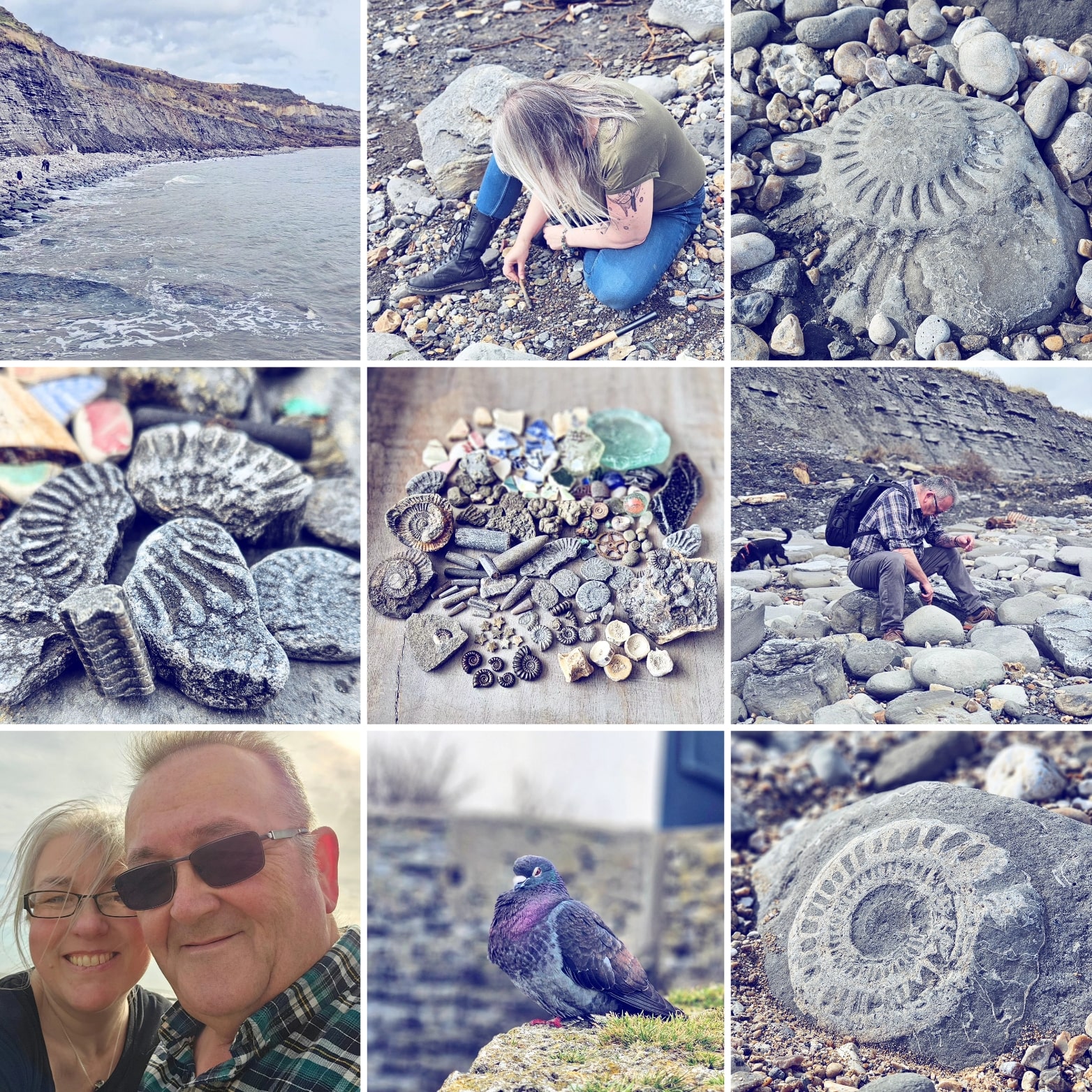
I’ve wanted to go to Lyme Regis for a while and back in April we did. The little town of Lyme Regis, part of the Jurassic Coast in Dorset, is famous for its fossils and for being the home of Mary Anning, one of the most significant fossil hunters in history.
Mary Anning, with her brother, discovered the first Ichthyosaurus skeleton when she was only 11. Then in 1823 she found the complete skeleton of a Plesiosaurus. She unearthed many fossils and sold them, generally without receiving credit for her finds in a male dominated geological community.

I’ve been following fossil hunter lymeregisfossils on Instagram and been really inspired, so I really wanted to go and hunt for my own treasures! After some wet and windy months, off we went and arrived to glorious hot sunshine for the whole weekend. We checked into The Royal Lion hotel and walked down to the beach.
One of the things you have to remember about beaches with fossils is that they are constantly eroded as the tides move in and out every day. Fossil hunters are welcomed, because as fossils are revealed on the beaches, if they’re not collected they will be lost forever to the sea.
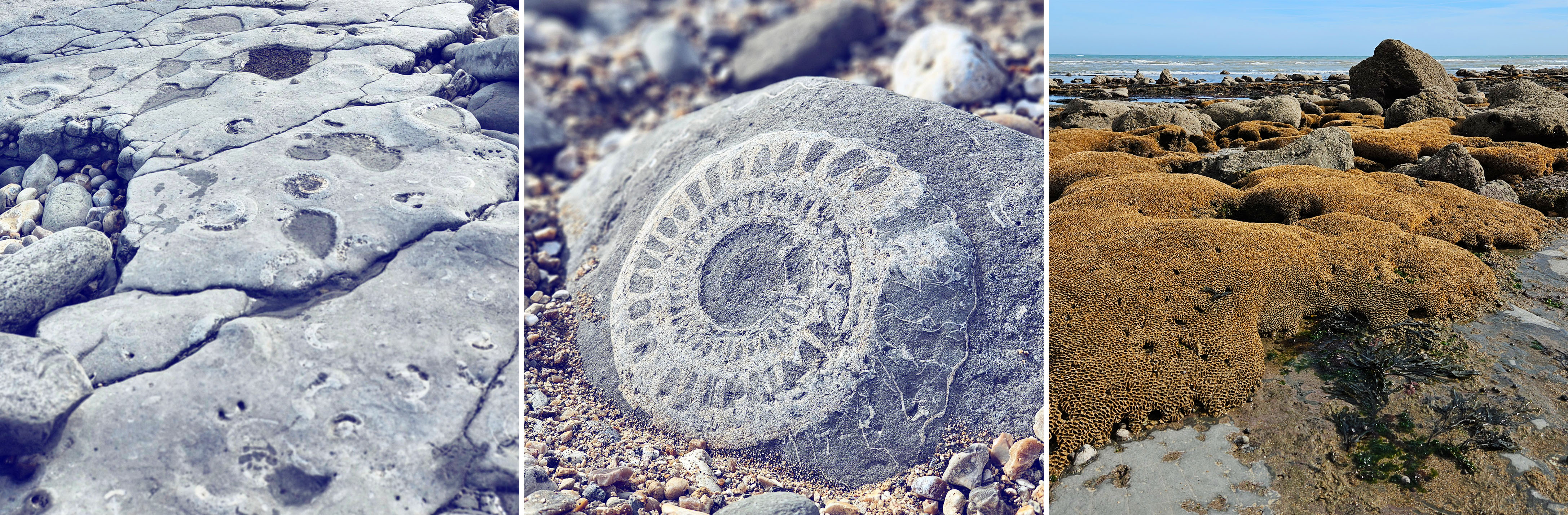
We walked west along the promenade towards the harbour and down to Monmouth beach. It’s a fair walk across pebbles, rocks, and boulders to find the Ammonite Pavement. It erodes more each year, but the pavement is there on a limestone ledge at low tide. Ammonite fossils embedded into the limestone slab from the Late Triassic period. Seeing them and all the large ammonite fossils preserved and imprinted into rocks and boulders was our first moment of Jurassic wonder. The fossils and the swathe of honeycomb tube worm reef were quite a sight to behold!
We booked a local fossil hunting walk with Lyme Regis Museum. We felt the talks beforehand, explaining the history and everything we needed to know about fossil hunting was rather long, but as an autistic person I’d done major research before we went, so I was just raring to go!

© Lisa Shambrook
Black Ven beach is to the east of the town and its huge dark cliffs stretch towards Charmouth. The cliffs are limestone and dark shale and reach 130m. Fossils are embedded deep within the cliffs and as they wear away the fossils are released onto the beach. There are regular mudslides and you should keep well away from the cliffs to avoid any sudden movement in them. In the Victorian era the cliffs were used as rubbish dumps and as they’ve eroded the rubbish ends up on the beach too.
We walked from the museum to Black Ven and down the steps to the beach. You aren’t likely to be alone on the beach, you’ll be sharing it with many fossil hunters and the overriding sound, besides waves, is the chink of hammers splitting open large pebbles in the hope of finding an ammonite inside!

Most people will find a few fossils, but there are plenty of tips for finding them. It’s good to know what you’re looking for.
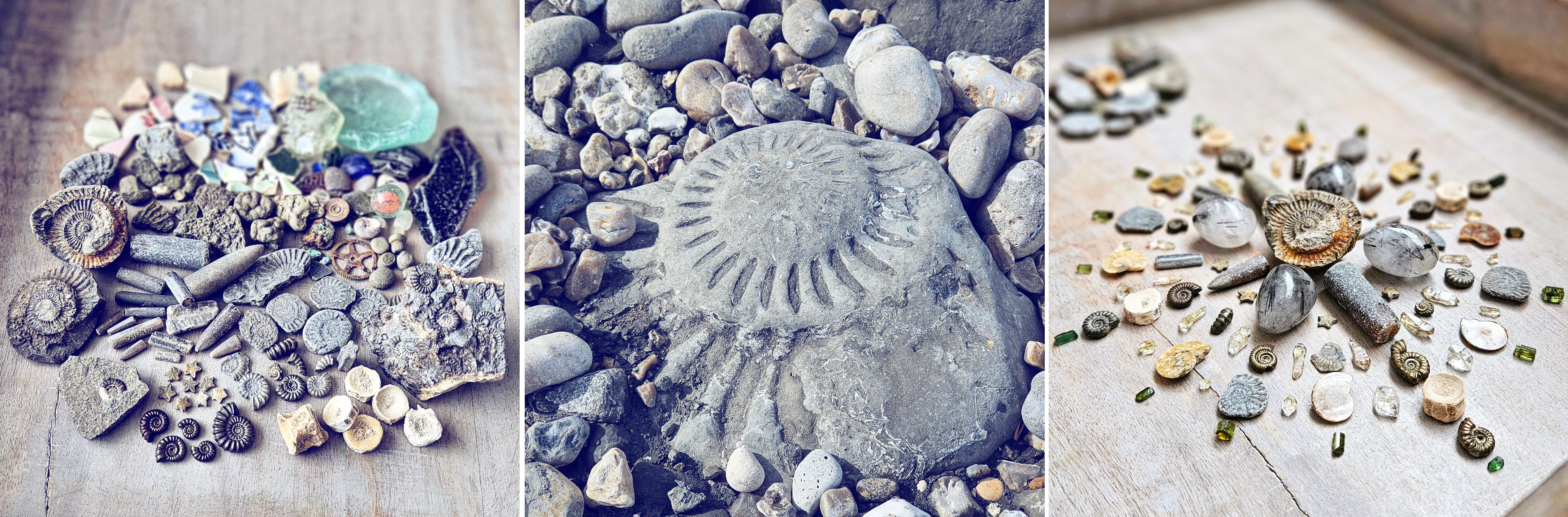
The easiest ammonite fossils to find are beef shale fossils. The stones are grey and thick. Beef shale is the base rock the cliffs are made from and with mudslides and rock falls they are the most obvious fossils. You can find ammonite impressions and fossils in small pieces of beef shale across the beach.
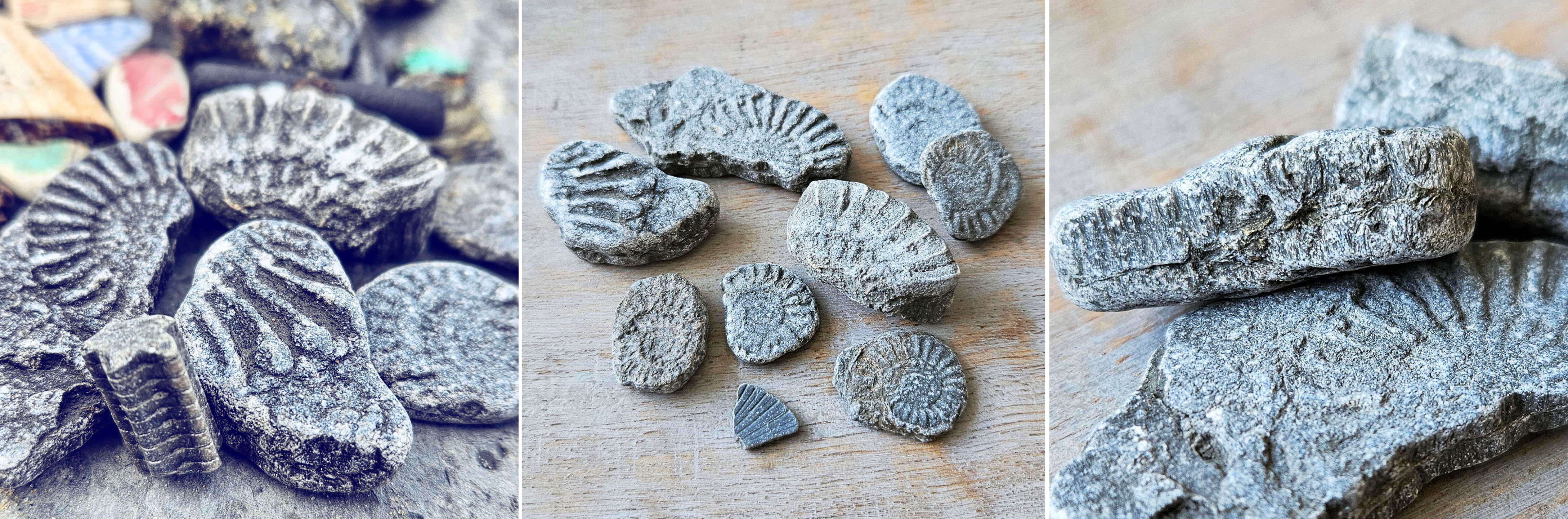
Belemnites are the internal part of an extinct squid-like creature. They are bullet-shaped black or grey stones that shouldn’t be too difficult to find. Some are the pointed domed end of the stone, and some look like narrow sticks.

Calcite ammonites and ammonite fossils can be found within oval rocks, but most will need to be hammered to chip them open to find them. A round or oval shaped pebble may have an edge that looks a little like a spine, which would tell you there’s likely to be an ammonite inside.

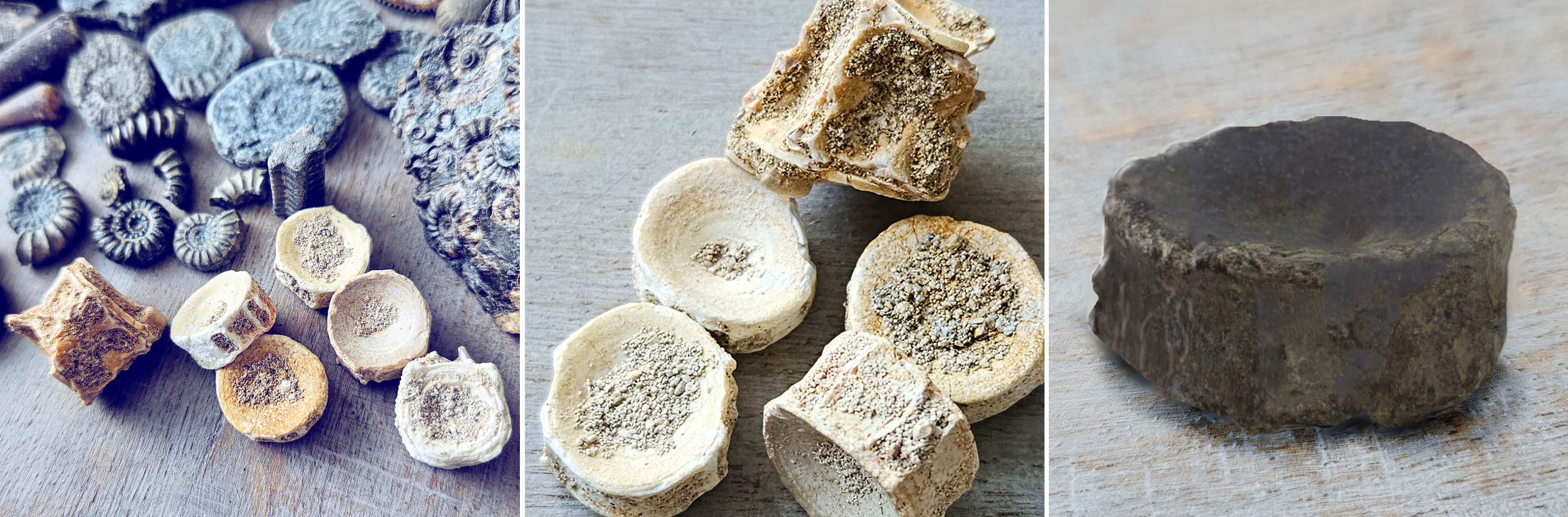
Dinosaur or Plesiosaurus vertebrae can be found as black pebble-like discs, but more difficult to identify if you’re not sure of them.
Pyritised Ammonites are a great find. These are ammonite fossils where their original organic material was slowly replaced by iron pyrite with fossilisation, rather than with calcite or quartz. Beautiful little bronze coloured pyrite ammonites. If you come across pyrite on the beach, small pieces of bronze coloured material, or glittered shale, you could be close to a pyritised ammonite. If you’re lucky you could find an intact ammonite, or you could find part of one. Pretty cool either way!

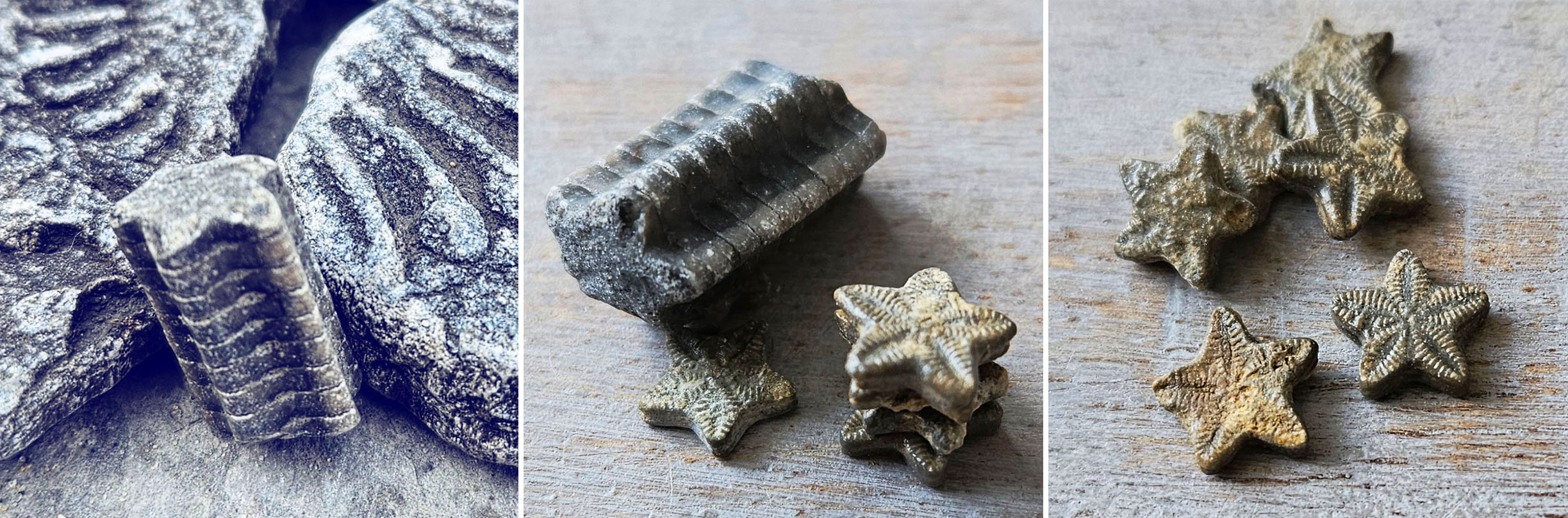
Crinoid stems or stars are the fossils of an extinct sea lily, a sort of biological anemone. It had long stems with fern-like fronds which waved around in the ocean. Some stones are imprinted with the stem and frond fossils, and you can find crinoid stems. The stems are made from segments of star shaped pieces, which can be found as a stack or as single tiny stars.
There are plenty more treasure to find, depending on what you call a treasure! You remember that I said the Victorians dumped their rubbish on the cliffs… the beach is strewn with their remnants. Beware that amid the pebbles, sand, and rocks, glass is all across the beach. Most of it is sea washed and has become sea glass, but some sharp pieces still remain. There are huge pieces of metal, piping, springs, broken cogs, equipment, broken china, tiles, bottle tops, Verdigris copper fragments, marbles, toys, and even bullets from the wars to be found or searched through.

I found a tiny white china doll, which I later discovered was a Frozen Charlotte, a cheap doll made in the Victorian times. The tiny ones like I found were often placed in puddings or cakes to be found when eaten, a bit like the silver sixpence in a Christmas pudding!
That first afternoon on the beach we spent a lot of time sifting through tiny stones and pebbles with our fingers, and with a piece of piping I’d found. We found beef shale fossils quite easily, and a few belemnites. I found lovely pieces of broken crockery, sea glass, a tiny cog, my frozen charlotte, and a marble. There were lots of pyrite, from the weird bubbly organic pieces which looked like bubbly grey-gold stones, to glittery pyrite. I searched frantically for pyritised ammonites, which was what I wanted to find the most, but I didn’t find any. I really wanted a pyritised ammonite and a crinoid, but as everyone began to leave, I’d not found those.

I was disappointed, but I also knew that finding anything was a gift, pot-luck really. It was getting late and the tide was coming in when I asked the ocean for one little fossil… I hugged Vince and then looked down and there I saw a crinoid stack. Nine tiny star-shaped segments just sitting against a rock beside us. I was ridiculously happy!
The next day we were due to drive home, but we stayed a little longer and went back to Black Ven. We had to wait while the tide went out. The best time to search for fossils is said to be an hour before and after low tide, when the beach has been churned up with the tide and released new fossils. We were a bit earlier, knowing we had to go home. So, we waited for the tide to move away from the steps to get onto the beach, and then searched. My second haul brought me more shale ammonite fossils, the butt end of a bullet, more china and sea glass, a few more belemnites, tiny fossilised gas bubbles, which look like teeny brown mushrooms, and I finally found my pyritised ammonites! Broken pieces and a couple of full ones.

I did buy a few prepared pyritised ammonites, a calcite ammonite, half ammonite pebbles, an ammonite fossilised piece of rock, cream-coloured dinosaur vertebrae, and a few crinoid stars from the local fossil shops. I wanted to make a crystal grid back home with my fossils!
To top it off, the hotel was lovely, and Vince and I had what was probably the most expensive and delicious dinner out we’d ever had! Tom’s in Lyme Regis, we felt very posh! Melt-in-the-mouth Dartmoor steak, potatoes Anna, cavolo nero kale, wild mushrooms, and peppercorn sauce, and then chocolate mousse, honeycomb, and salted caramel. It was stunning, and I really wanted to take a photo of it, but it felt too upmarket to do so, lol! Beautiful drinks too, Hendricks, lemonade, and sliced cucumber, which I loved, and Lyme Regis Gold Cap lager, which Vince enjoyed. We came away just a little drunk and very satisfied!
It was the best weekend in a long time, and we can’t wait to go back.
Lyme Regis caught both our imagination and our hearts.
 The Last Krystallos